


As Armenia holds nationwide elections today, experts say Russia has orchestrated an aggressive disinformation campaign aimed at discrediting the country’s prime minister, who has sought closer ties with the EU.
Armenia is formally allied with Moscow, but has built ties with Brussels amid frustration over Russia’s perceived failure to protect it during conflicts with neighboring Azerbaijan.
In just one week last month, a Russia-linked disinformation campaign spread 31 fake news reports about Armenian Prime Minister Nikol Pashinyan, accusing him of election fraud and of seeking to draw Armenia into a war with Russia, US-based disinformation watchdog NewsGuard said in an article last week.

Photo: Photolure via Reuters
Some of the fake reports were designed to look like international news outlets, such as France24 and Politico, while others mimicked popular Armenian-based sites Armenpress and CivilNet, NewsGuard reported.
“The fake reports were posted by anonymous X accounts that had few or no prior posts, all within minutes of each other, suggesting a coordinated campaign by inauthentic accounts aligned with Russia,” it said.
One video opened with a real clip from a Euronews report before transitioning into a fabricated segment that falsely claimed Pashinyan had an “aggressive cancer.” It used AI to mimic a real Euronews presenter’s voice.
NewsGuard said the operations aimed to “bolster the opposition candidate” — billionaire Armenian businessman Samvel Karapetyan, whom Pashinyan has accused of having Russia ties.
Karapetyan, who denies being aligned with Russia, is under house arrest on charges of plotting to overthrow Pashinyan, an allegation his supporters say is politically motivated.
Western governments have accused Russia of disinformation campaigns before, notably ahead of elections in Moldova and Romania last year, although experts say the scale of the operations this time appears unusually intense.
“Armenia is standing out, because of the volume and the number of operations involved. Watching this, it’s every operation, every tactic. It shows everything that Russia is capable of,” said Joseph Bodnar, a researcher at the Institute for Strategic Dialogue (ISD) who co-authored a report on Russian influence.
Efforts to sway the election began early last year, but have grown in scale and intensity in the past few months, said Ani Grigoryan, head of the fact-checking unit at Armenian outlet CivilNet.
Among those spreading the false reports is Storm-1516, a propaganda group that French authorities have linked to Russian intelligence, Grigoryan said.
Some fake news stories were “picked up by Armenian outlets, because they thought it was from real media,” she said.
Storm-1516 targeted Armenia “more than any other country between April 2025 and April 2026,” the ISD said.
Armenia’s foreign intelligence service said in January that influence operations were likely to become “comprehensive, complex and large-scale” ahead of the elections.
Russia has denied seeking to interfere in the vote, accusing Europe of doing the influencing.
“We have seen a sharp intensification of the dragging — a rather strong dragging — of Armenia toward the European Union and NATO structures,” a Russian Ministry of Foreign Affairs spokeswoman said on Thursday.
Opinion polls show Pashinyan’s Civil Contract party firmly ahead.
Several experts said that Russia was not the only source of disinformation ahead of the vote, with opposition parties also involved, but that Moscow had shown a particular interest.
Russian President Vladimir Putin has repeatedly warned Armenia against forging closer ties with Europe, and last week called for the country to hold a referendum on EU membership.
In addition to false claims about Pashinyan, influence operations have aimed to “damage the relationship between Armenia and EU countries, and France in particular,” said Simona N., coauthor of the ISD report on Russian influence.
Last month, a video posing as a US-based Armenian diaspora outlet falsely claimed Pashinyan had agreed to take in thousands of migrants expelled by EU countries.
The impact of the disinformation is difficult to assess.
“In the last two, three months we notice that opposition candidates are also starting to disseminate Russian narratives, that’s how Russia gets into Armenia’s info space,” Grigoryan said.
False narratives have crept into everyday conversations, Armenian investigative journalist and media literacy educator Tatev Hovhannisyan said.
She cited a fake post impersonating the BBC, which claimed that France would send troops to support Pashinyan if he lost.
“I am hearing: ‘It’s true, I saw it on Facebook.’ It’s hard to explain, especially to [the] older generation, that what they are seeing is not true,” she said.

Through the noise of rushing papers and whirring belts at a print factory in Kyoto, two creators watch their photo essay come to life in broadsheet form — part of an effort to win new audiences in the age of artificial intelligence (AI). Despite the decline of the publishing industry, self-publication and handmade “zine” magazines are growing in popularity in Japan, reflecting the nation’s enduring love of paper in the digital era. While speaking to Agence France-Presse at the plant, his hands black with ink, one of the creators, Kazuma Obara, said: “I think [paper] is a medium that engages all five
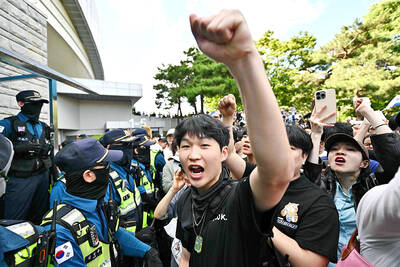
‘ABSURD MISTAKE’: The election commission said that there had been a failure to anticipate turnout after 14 polling stations ran short of ballot papers South Korean riot police yesterday cleared protesters from a Seoul polling station after a 35-hour blockade sparked by a shortage of ballot papers during local elections earlier this week. Wednesday’s election was the first nationwide vote since South Korean President Lee Jae-myung took office following the ouster of Yoon Suk-yeol over his short-lived martial law declaration. Lee’s ruling Democratic Party swept most races, but failed to flip the crucial Seoul mayoral seat. The South Korean National Election Commission apologized, blaming a failure to anticipate turnout after 14 polling stations in Seoul ran short of ballot papers. Some polling stations stayed open until 10pm to

Australian researchers have trained lab-grown brain cells on a silicon computer chip to play the 1990s shooter game Doom and said they are just scratching the surface of what the neurons could be capable of doing. It is the science-fiction work of biotech boffins at Cortical Labs, who researched and developed the technology that harnesses the workings of the brain’s networking system. Each so-called “biological computer” contains about 200,000 living human brain cells, grown from stem cells that were harvested from blood donations. Having mastered the simple computer game Pong, where a paddle is moved up and down to send a ball

France experienced its hottest spring on record, the French weather service said on Tuesday, after an exceptional early heat wave that also broke highs for the season in England and Wales. Meteo-France said the average nationwide temperature over March to May was 13.8°C — about 1.7°C above the norm, and surpassing records set in 2011 and 2020. “The warmest spring since records began in 1900,” it said in a bulletin. All three months were warmer than average, but the onset of an “unprecedented heatwave” late last month pushed the mercury to highs typically seen at the height of the summer. “Our country had never


 RSS
RSS