


A Nepalese mountaineer who survived nearly a week on Mount Everest said he “chewed ice” to stay alive as he recovered in a hospital after a miraculous rescue that stunned the climbing community.
Dawa Sherpa, 57, disappeared in brutal conditions on the upper slopes of the world’s tallest mountain on May 30 during one of the final climbs of the spring season.
With few climbers still on the peak and his oxygen exhausted, relatives had given up hope and begun ritual mourning prayers, believing he had died on the mountain.
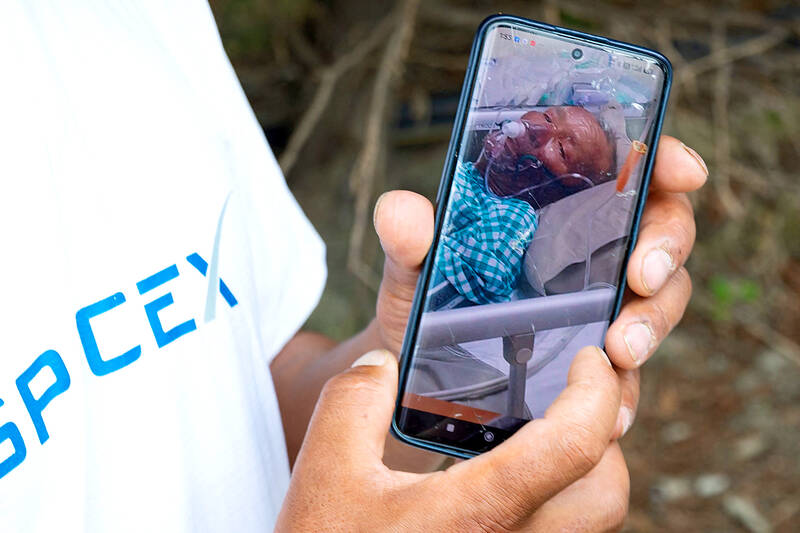
Photo: AFP
“I didn’t think I would be alive,” he told BBC Nepali on Friday from his hospital bed. “I thought I would perish this way. I didn’t get lost. As the oxygen ran out, I fell behind. After the oxygen finished, I couldn’t walk.”
Left stranded in freezing temperatures near Everest’s “death zone,” where oxygen levels are critically low, Dawa Sherpa said he survived for days with almost no food or water.
“I didn’t eat anything for the first two days. Then I began chewing ice. It hurt my teeth. I chewed the ice hard,” he said.
He said he survived on a few chocolates and snacks he found in his pockets.
“I soaked them in water and had them,” he said.
Dawa Sherpa, also known as “Hillary” after legendary climber Edmund Hillary, had told others after his rescue that at one point he fell into a crevasse before managing to climb out.
“Stepping on the snow, I stood up and looked above... It felt I could get out from there,” he said. “I then looked for ropes and found one. Then I held on to it and walked... Eventually I came down.”
He said he walked day and night toward base camp until finally encountering people almost a week later.
He was found crawling toward the base camp on Thursday morning by the Sagarmatha Pollution Control Committee (SPCC), a Nepalese team that helps set routes on Everest and clean up waste left behind.
“Boys from SPCC were going up to collect the waste. I met them. They carried me down,” he said.
He was flown to Kathmandu for treatment for frostbite, severe dehydration and a fractured thigh bone, doctors said.
“He is doing well. We had a chat,” his daughter Mendo Lhamu Sherpa said.
His survival has sparked celebration among fellow climbers, but also anger from family members who accused rescue teams of failing to locate him sooner.
Nepal Mountaineering Association president Fur Gelje Sherpa called the survival extraordinary, but said the incident highlighted serious concerns over climber safety.
“It is irresponsible and inhumane to leave a person behind,” he said. “I believe that an investigation committee must be formed to hold the responsible people accountable for this.”
Everest guide Rinji Sherpa, who comes from the same village as Dawa Sherpa, said the climber was highly experienced and familiar with the dangers of high-altitude mountaineering.
“He is very lucky, he has had several close calls before, but he has survived,” he said.
At least five climbers — two Indians and three Nepalese — died during this year’s Everest season.
More than 1,000 climbers reached Everest’s summit this season, according to preliminary Nepali government figures, making it the busiest season on record.

Through the noise of rushing papers and whirring belts at a print factory in Kyoto, two creators watch their photo essay come to life in broadsheet form — part of an effort to win new audiences in the age of artificial intelligence (AI). Despite the decline of the publishing industry, self-publication and handmade “zine” magazines are growing in popularity in Japan, reflecting the nation’s enduring love of paper in the digital era. While speaking to Agence France-Presse at the plant, his hands black with ink, one of the creators, Kazuma Obara, said: “I think [paper] is a medium that engages all five
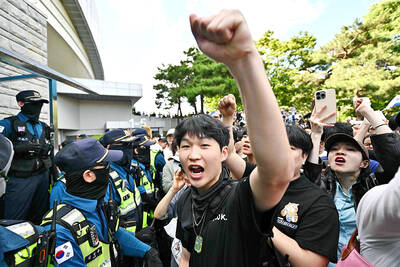
‘ABSURD MISTAKE’: The election commission said that there had been a failure to anticipate turnout after 14 polling stations ran short of ballot papers South Korean riot police yesterday cleared protesters from a Seoul polling station after a 35-hour blockade sparked by a shortage of ballot papers during local elections earlier this week. Wednesday’s election was the first nationwide vote since South Korean President Lee Jae-myung took office following the ouster of Yoon Suk-yeol over his short-lived martial law declaration. Lee’s ruling Democratic Party swept most races, but failed to flip the crucial Seoul mayoral seat. The South Korean National Election Commission apologized, blaming a failure to anticipate turnout after 14 polling stations in Seoul ran short of ballot papers. Some polling stations stayed open until 10pm to

Australian researchers have trained lab-grown brain cells on a silicon computer chip to play the 1990s shooter game Doom and said they are just scratching the surface of what the neurons could be capable of doing. It is the science-fiction work of biotech boffins at Cortical Labs, who researched and developed the technology that harnesses the workings of the brain’s networking system. Each so-called “biological computer” contains about 200,000 living human brain cells, grown from stem cells that were harvested from blood donations. Having mastered the simple computer game Pong, where a paddle is moved up and down to send a ball

France experienced its hottest spring on record, the French weather service said on Tuesday, after an exceptional early heat wave that also broke highs for the season in England and Wales. Meteo-France said the average nationwide temperature over March to May was 13.8°C — about 1.7°C above the norm, and surpassing records set in 2011 and 2020. “The warmest spring since records began in 1900,” it said in a bulletin. All three months were warmer than average, but the onset of an “unprecedented heatwave” late last month pushed the mercury to highs typically seen at the height of the summer. “Our country had never


 RSS
RSS