


En pointe, demi-pointe, entrechat — for Jotaro Kanazasi and Haruka Takemi, two Japanese dancers based in the historic Russian city of Nizhny Novgorod, life revolves entirely around their art, even as the war in Ukraine occasionally interrupts their daily routine.
Jotaro Kanazasi, 32, chose to settle in Russia 14 years ago, the country known for Moscow’s Bolshoi and St Petersburg’s Mariinsky theaters, to fulfil himself “fully as a dancer,” as he puts it in halting Russian.
Some foreign dancers chose to leave Russia after it sent troops to Ukraine in 2022, but Kanazasi decided to stay. The villainous sorcerer Rothbart in Tchaikovsky’s Swan Lake, Albrecht in Adolphe Adam’s Giselle, Kanazasi moves from role to role as a principal dancer at the Nizhny Novgorod Opera and Ballet Theatre, about 400km east of Moscow.

Photo: AFP
“I love Russian ballet and always wanted to become a dancer, but there is no national ballet school in Japan, so I chose Russia,” said his compatriot Haruka Takemi, 20, who has lived in Russia for six years.
Absorbed in their lives as professional dancers, Takemi and Kanazasi admit they follow the news only loosely, including the war Moscow has been waging in Ukraine since February 2022.
“My mother constantly sends me articles about Russia, about current events, about what is happening here, so that I stay informed,” Takemi said.
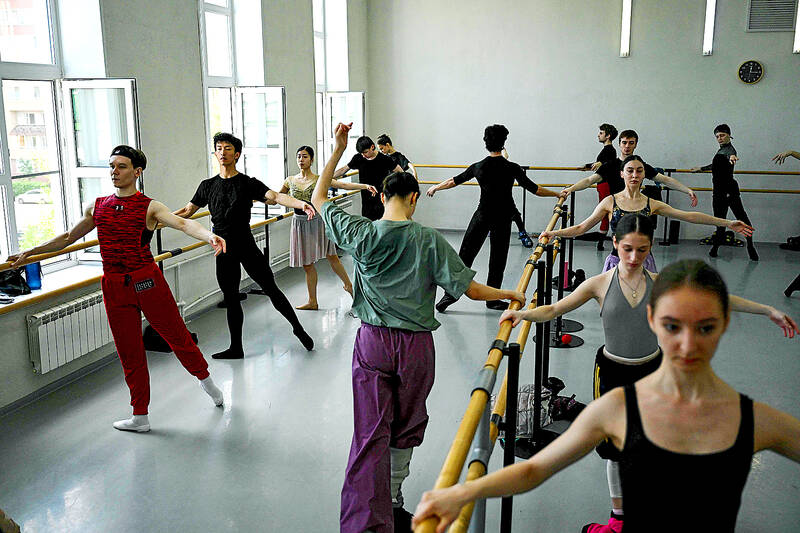
Photo: AFP
Russia has introduced huge censorship, unseen since Soviet times, during its military campaign. Her home country Japan has backed Ukraine since the start of the Russian offensive and joined Western sanctions against Moscow.
“I am either at the theater or at home, then back at the theater again. I work all the time and concentrate only on ballet,” she said, adding that it is her family who “worries” about her.
In response to near-daily Russian bombardments, Ukraine regularly strikes Russian territory, saying it hits military and energy sites to degrade Moscow’s capacity to fund its offensive.
Nizhny Novgorod — more than 800km from Ukraine — has not been spared. A nearby refinery of Russian energy giant Lukoil in Kstovo has been targeted by Ukrainian strikes in recent weeks.
“There are also difficulties with the Internet — you have to use a VPN as apps are sometimes blocked. But I need to stay in touch with my family so they know I am safe,” Takemi added.
Russia has imposed sweeping digital restrictions in the past few months, limiting access to mobile Internet in particular.
“There are quite a few Japanese dancers in Russia, who are graduates of the most prestigious Russian schools such as the Moscow State Academy of Choreography, the Vaganova Academy in St Petersburg and the Perm school,” said Valeri Konkov, director of the Nizhny Novgorod ballet company.
Making a career as a classical dancer in Japan is difficult, the dancers said — and, despite difficulties linked to the war, Kanazasi is determined to stay, saying: “As long as I can dance, I will stay here.”

‘CROSSING THE LINE’: China’s embassy in Seoul criticized US Forces Korea Commander General Xavier Brunson, asking if his ‘hostile’ remarks were authorized by Washington South Korea and the US are in talks over recent public remarks by the commander of US Forces Korea, Seoul’s presidential office said yesterday, after the comments drew sharp criticism from China. In a recent podcast interview, US Forces Korea Commander General Xavier Brunson described South Korea as “the dagger in the heart of Asia” from China’s east coast, prompting the Chinese embassy in Seoul to say that he had “truly crossed the line.” The interview came amid growing speculation that Washington might seek to expand the role of US Forces Korea in countering the growing regional influence of China, a key

SEEKING ORDER: Rodrigo Paz said that ‘anyone who wants to destroy the nation will have to deal with this president and the full force of the constitution’ Bolivian President Rodrigo Paz on Wednesday said that the nation was at a “breaking point” after nearly a month of protests that have caused shortages of food, fuel and medicine. Paz, who took office six months ago amid the worst economic crisis there in four decades, is battling a groundswell of fury over his policies. The political capital, La Paz, has been besieged by low-income workers and members of the indigenous majority calling for his resignation. “The country needs order and is reaching breaking point,” the 58-year-old said at a public event in La Paz, renewing his appeal for dialogue. On Tuesday, the Bolivian

Australian researchers have trained lab-grown brain cells on a silicon computer chip to play the 1990s shooter game Doom and said they are just scratching the surface of what the neurons could be capable of doing. It is the science-fiction work of biotech boffins at Cortical Labs, who researched and developed the technology that harnesses the workings of the brain’s networking system. Each so-called “biological computer” contains about 200,000 living human brain cells, grown from stem cells that were harvested from blood donations. Having mastered the simple computer game Pong, where a paddle is moved up and down to send a ball

Through the noise of rushing papers and whirring belts at a print factory in Kyoto, two creators watch their photo essay come to life in broadsheet form — part of an effort to win new audiences in the age of artificial intelligence (AI). Despite the decline of the publishing industry, self-publication and handmade “zine” magazines are growing in popularity in Japan, reflecting the nation’s enduring love of paper in the digital era. While speaking to Agence France-Presse at the plant, his hands black with ink, one of the creators, Kazuma Obara, said: “I think [paper] is a medium that engages all five


 RSS
RSS