


The Mozambique government said five of its nationals were killed in “xenophobic attacks” in South Africa at the weekend, with local police yesterday confirming two deaths.
The killings in the southern coastal town of Mossel Bay are the first to be officially linked to the latest wave of protests against illegal migrants sweeping South Africa.
The Mozambique government’s media office said in a statement late on Monday that violence broke out on Friday, focused on Mossel Bay, about 380km east of Cape Town.
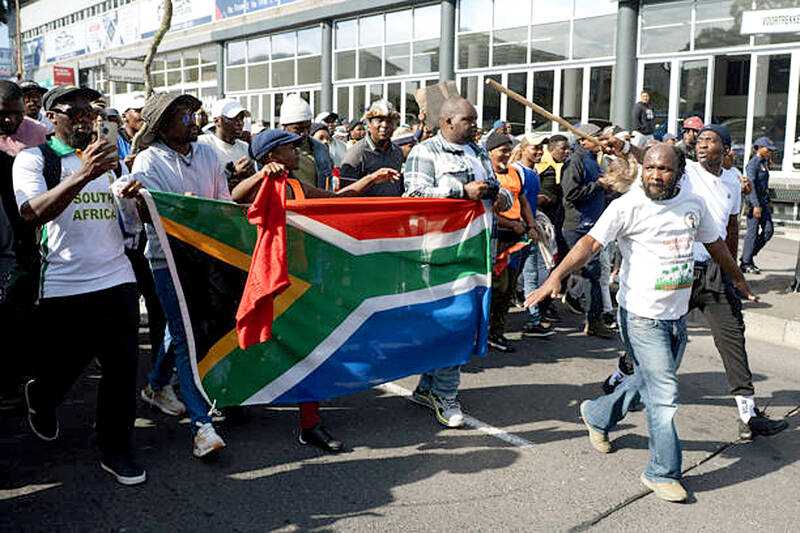
Photo: AFP
“Regrettably, seven Mozambican citizens have died, five of them as a direct consequence of the xenophobic attacks and the other two as a result of a road accident, when they were traveling in a private vehicle on their way back to Mozambique,” it said.
However, the South African police told Agence France-Presses only two Mozambique nationals were killed in Mossel Bay late on Friday, declining to say whether they died in anti-migrant violence.
“It is not true that five people were killed,” Western Cape police spokesperson Brigadier Novela Potelwa said.
“Two Mozambicans lost their lives in the Asla Park informal settlement outside the town on Friday evening, one 27-year-old and a 43-year-old,” she said.
The region has seen protests against illegal migrants similar to demonstrations that have swept South Africa in the past few weeks, notably in Johannesburg and east coast city of Durban.
Local media said a protest that started in Asla Park on Friday had escalated, resulting in several houses being torched and hundreds of people displaced.
The Mozambique government said the violence prompted 300 Mozambicans to return to their country by their own means on Saturday.
“The remaining just over 500 have since been sheltered in a safe location in the Western Cape Province, and as of today, 1 June, the process of their repatriation to Mozambique is already under way,” it said.
Mossel Bay Mayor Dirk Kotze at the weekend voiced “deep concern and dismay at the current xenophobic attacks where people have been murdered, houses burned and families displaced.”
South Africa, the continent’s most industrialized economy, has long been a destination for both legal and undocumented African workers.
It has experienced repeated waves of xenophobic violence over the past decades, with illegal migrants accused of crime and taking jobs from locals.
In 2008, 62 people — including 21 South Africans — were killed in anti-immigrant riots that also displaced thousands. Further outbreaks followed in 2015 and 2016.
The latest spike in anti-immigrant tensions has been building for months and comes as political parties seek support ahead of local government elections in November.
One citizen-led group has issued an ultimatum for illegal migrants to be expelled by June 30 and there have been reports of groups checking the documentation of foreign nationals and forcing small businesses run by non-South Africans to close.
The action has no official backing and has been criticised by the authorities.
With tensions building, Ghana flew out 300 of its citizens last week and is planning to take home hundreds more.

‘CROSSING THE LINE’: China’s embassy in Seoul criticized US Forces Korea Commander General Xavier Brunson, asking if his ‘hostile’ remarks were authorized by Washington South Korea and the US are in talks over recent public remarks by the commander of US Forces Korea, Seoul’s presidential office said yesterday, after the comments drew sharp criticism from China. In a recent podcast interview, US Forces Korea Commander General Xavier Brunson described South Korea as “the dagger in the heart of Asia” from China’s east coast, prompting the Chinese embassy in Seoul to say that he had “truly crossed the line.” The interview came amid growing speculation that Washington might seek to expand the role of US Forces Korea in countering the growing regional influence of China, a key

SEEKING ORDER: Rodrigo Paz said that ‘anyone who wants to destroy the nation will have to deal with this president and the full force of the constitution’ Bolivian President Rodrigo Paz on Wednesday said that the nation was at a “breaking point” after nearly a month of protests that have caused shortages of food, fuel and medicine. Paz, who took office six months ago amid the worst economic crisis there in four decades, is battling a groundswell of fury over his policies. The political capital, La Paz, has been besieged by low-income workers and members of the indigenous majority calling for his resignation. “The country needs order and is reaching breaking point,” the 58-year-old said at a public event in La Paz, renewing his appeal for dialogue. On Tuesday, the Bolivian

Australian researchers have trained lab-grown brain cells on a silicon computer chip to play the 1990s shooter game Doom and said they are just scratching the surface of what the neurons could be capable of doing. It is the science-fiction work of biotech boffins at Cortical Labs, who researched and developed the technology that harnesses the workings of the brain’s networking system. Each so-called “biological computer” contains about 200,000 living human brain cells, grown from stem cells that were harvested from blood donations. Having mastered the simple computer game Pong, where a paddle is moved up and down to send a ball

Through the noise of rushing papers and whirring belts at a print factory in Kyoto, two creators watch their photo essay come to life in broadsheet form — part of an effort to win new audiences in the age of artificial intelligence (AI). Despite the decline of the publishing industry, self-publication and handmade “zine” magazines are growing in popularity in Japan, reflecting the nation’s enduring love of paper in the digital era. While speaking to Agence France-Presse at the plant, his hands black with ink, one of the creators, Kazuma Obara, said: “I think [paper] is a medium that engages all five


 RSS
RSS