


A French woman infected in a hantavirus outbreak on a cruise ship is critically ill and being treated with an artificial lung, a doctor at the Paris hospital caring for the sickened passenger said on Tuesday.
The outbreak has reached 11 total reported cases, nine of which have been confirmed.
Three people on the cruise died, including a Dutch couple who health officials believe were the first exposed to the virus while visiting South America.
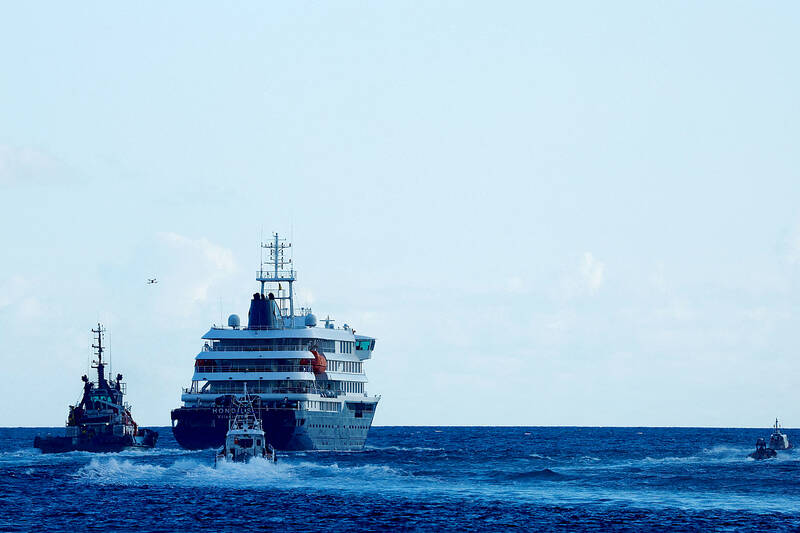
Photo: Reuters
The French passenger hospitalized in Paris has a severe form of the disease that has caused life-threatening lung and heart problems, said Xavier Lescure, an infectious-disease specialist at Bichat Hospital.
Lescure said that the woman is on a life-support device that pumps blood through an artificial lung, providing it with oxygen and returning it to the body.
The hope is that the device relieves enough pressure on the lungs and heart to give them some time to recover, he said, calling it “the final stage of supportive care.”
With the evacuation of all passengers and many crew members completed, the MV Hondius is sailing back to the Netherlands, where it is to be cleaned and disinfected.
WHO director-general Tedros Adhanom Ghebreyesus said confirmed and suspected cases have only been reported among the cruise ship’s passengers or crew.
“At the moment, there is no sign that we are seeing the start of a larger outbreak,” Tedros said.
However, “the situation could change, and given the long incubation period of the virus, it’s possible we might see more cases in the coming weeks,” he added.
The latest person confirmed to be infected is a Spanish passenger who tested positive for hantavirus after being evacuated from the ship, the Spanish Ministry of Health said on Tuesday.
The passenger was in quarantine at a military hospital in Madrid.
Health authorities say it is the first hantavirus outbreak on a cruise ship.
While there is no cure or vaccine for hantavirus, the WHO says early detection and treatment improves survival rates.
The Argentine Ministry of Health on Tuesday said that a team of scientific experts would be dispatched to investigate the origin of outbreak.
The Dutch couple who died, identified by the WHO as the first cruise passengers infected with hantavirus, spent several months in Argentina and other South American countries before boarding the cruise ship.
Argentine officials have said the couple took a bird-watching tour that included a stop at a dump where they might have been exposed to rodents carrying the infection.
The ministry said that its team would investigate the landfill and other locations the couple visited where rats known to carry the virus are found, although local officials in the province where the cruise departed have challenged the theory that it began there.
Eighty-seven passengers and 35 crew were escorted from the Hondius to shore in Tenerife, Spain, by personnel in full-body protective gear and breathing masks in a carefully choreographed effort that ended on Monday.
Two aircraft arrived in the southern Dutch city of Eindhoven overnight carrying Dutch nationals, as well as passengers from Australia and New Zealand and crew members from the Philippines.
All were placed into quarantine, the Dutch government said.
Some crew stayed aboard the ship and set course for the Dutch port city of Rotterdam, said the ship’s operator, Oceanwide Expeditions.
Hantavirus usually spreads from rodent droppings and is not easily transmitted between people.
However, the Andes virus detected in the cruise ship outbreak might be able to spread between people in rare cases.
Symptoms — which can include fever, chills and muscle aches — usually start between one and eight weeks after exposure.
Tedros has advised that returning passengers should stay in quarantine, either in their homes or in other facilities, for 42 days.

‘CROSSING THE LINE’: China’s embassy in Seoul criticized US Forces Korea Commander General Xavier Brunson, asking if his ‘hostile’ remarks were authorized by Washington South Korea and the US are in talks over recent public remarks by the commander of US Forces Korea, Seoul’s presidential office said yesterday, after the comments drew sharp criticism from China. In a recent podcast interview, US Forces Korea Commander General Xavier Brunson described South Korea as “the dagger in the heart of Asia” from China’s east coast, prompting the Chinese embassy in Seoul to say that he had “truly crossed the line.” The interview came amid growing speculation that Washington might seek to expand the role of US Forces Korea in countering the growing regional influence of China, a key

SEEKING ORDER: Rodrigo Paz said that ‘anyone who wants to destroy the nation will have to deal with this president and the full force of the constitution’ Bolivian President Rodrigo Paz on Wednesday said that the nation was at a “breaking point” after nearly a month of protests that have caused shortages of food, fuel and medicine. Paz, who took office six months ago amid the worst economic crisis there in four decades, is battling a groundswell of fury over his policies. The political capital, La Paz, has been besieged by low-income workers and members of the indigenous majority calling for his resignation. “The country needs order and is reaching breaking point,” the 58-year-old said at a public event in La Paz, renewing his appeal for dialogue. On Tuesday, the Bolivian

Through the noise of rushing papers and whirring belts at a print factory in Kyoto, two creators watch their photo essay come to life in broadsheet form — part of an effort to win new audiences in the age of artificial intelligence (AI). Despite the decline of the publishing industry, self-publication and handmade “zine” magazines are growing in popularity in Japan, reflecting the nation’s enduring love of paper in the digital era. While speaking to Agence France-Presse at the plant, his hands black with ink, one of the creators, Kazuma Obara, said: “I think [paper] is a medium that engages all five

Australian researchers have trained lab-grown brain cells on a silicon computer chip to play the 1990s shooter game Doom and said they are just scratching the surface of what the neurons could be capable of doing. It is the science-fiction work of biotech boffins at Cortical Labs, who researched and developed the technology that harnesses the workings of the brain’s networking system. Each so-called “biological computer” contains about 200,000 living human brain cells, grown from stem cells that were harvested from blood donations. Having mastered the simple computer game Pong, where a paddle is moved up and down to send a ball


 RSS
RSS