


An American national and a French woman evacuated from the cruise ship hit by a deadly hantavirus outbreak have tested positive, officials said yesterday, as the complex operation to repatriate those on board continued.
The French woman, one of five passengers from France flown back from the MV Hondius and placed in isolation in Paris, started to feel unwell on Sunday night and “tests came back positive,” French Minister of Health Stephanie Rist said.
Late on Sunday, the US Department of Health and Human Services said that one American national evacuated from the ship had “mild symptoms” and that another had tested positive for the Andes virus, the only hantavirus strain that is transmissible between humans.
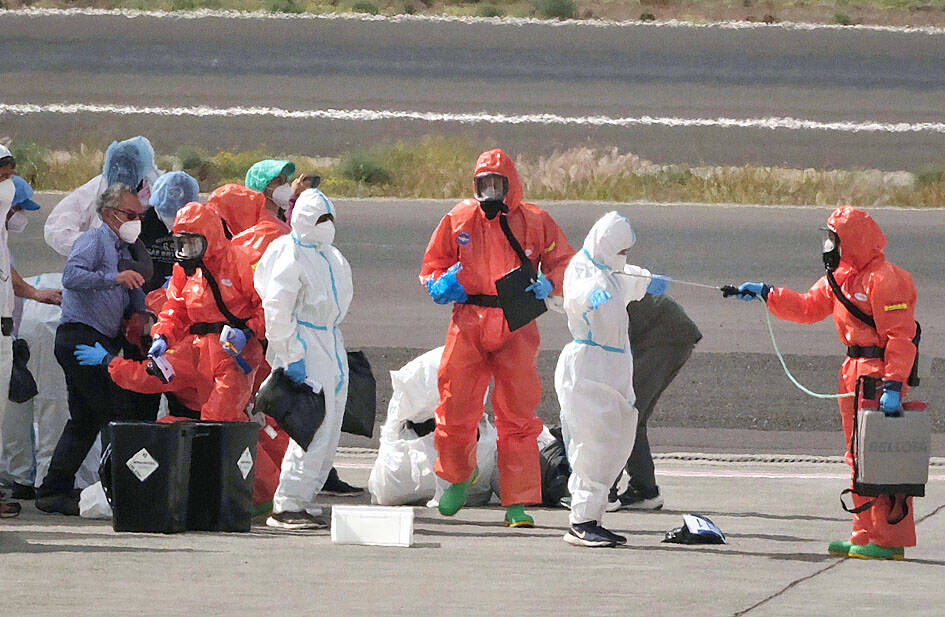
Photo: AP
Three passengers from the ship, a Dutch couple and a German woman, have died, while others have fallen sick with the rare disease, which usually spreads among rodents.
No vaccines or specific treatments exist for hantavirus, which is endemic in Argentina, where the ship set sail last month, but health officials have said that the risk for global public health is low and downplayed comparisons to the COVID-19 pandemic.
Rist said that 22 more contact cases had been identified among French nationals, including eight people who had traveled on an April 25 flight between Saint Helena and Johannesburg, and 14 more on a flight between Johannesburg and Amsterdam.
The Dutch woman who died was on the flight to Johannesburg and later briefly boarded a flight to Amsterdam, but was removed prior to takeoff.
The repatriation operation evacuated 94 people of 19 different nationalities on Sunday, Spanish Minister of Health Monica Garcia announced on Tenerife, in Spain’s Canary Islands.
Spanish officials said the evacuation of most of the ship’s nearly 150 passengers and crew, which includes 23 nationalities, would continue until the final repatriation flights to Australia and the Netherlands yesterday afternoon.
The Dutch-flagged ship would refuel yesterday morning and was expected to depart for the Netherlands with about 30 crew members at 7pm.
Passengers in blue medical suits began disembarking the vessel on Sunday to reach the small industrial port of Granadilla on Tenerife.
Canary Islands authorities had warned that the operation must be completed by yesterday, when adverse weather conditions would force the ship to leave.
The Atlantic archipelago’s regional government had consistently resisted taking in the ship, which was only authorized to anchor offshore.
The WHO recommends a 42-day quarantine and “active follow-up,” including daily checks for symptoms such as fever, the WHO Epidemic and Pandemic Preparedness and Prevention director Maria van Kerkhove said in Geneva, Switzerland.
The Greek Ministry of Health said that a Greek male evacuee would spend 45 days in mandatory hospital quarantine in Athens, while 14 Spanish citizens would also isolate at a military hospital in Madrid.
Australia said it would place its six evacuees in a purpose-built quarantine facility north of Perth for at least three weeks.
British officials said 20 UK citizens who were aboard the ship would be taken to a hospital near Liverpool for tests and about 72 hours of quarantine.
A top US health official said that the 17 American passengers would not necessarily be quarantined.
Depending on the estimated risk, passengers can choose to go home “without exposing other people on the way,” US Centers for Disease Control and Prevention acting director Jay Bhattacharya said.
WHO director-general Tedros Adhanom Ghebreyesus said that policy “may have risks.”

‘CROSSING THE LINE’: China’s embassy in Seoul criticized US Forces Korea Commander General Xavier Brunson, asking if his ‘hostile’ remarks were authorized by Washington South Korea and the US are in talks over recent public remarks by the commander of US Forces Korea, Seoul’s presidential office said yesterday, after the comments drew sharp criticism from China. In a recent podcast interview, US Forces Korea Commander General Xavier Brunson described South Korea as “the dagger in the heart of Asia” from China’s east coast, prompting the Chinese embassy in Seoul to say that he had “truly crossed the line.” The interview came amid growing speculation that Washington might seek to expand the role of US Forces Korea in countering the growing regional influence of China, a key

SEEKING ORDER: Rodrigo Paz said that ‘anyone who wants to destroy the nation will have to deal with this president and the full force of the constitution’ Bolivian President Rodrigo Paz on Wednesday said that the nation was at a “breaking point” after nearly a month of protests that have caused shortages of food, fuel and medicine. Paz, who took office six months ago amid the worst economic crisis there in four decades, is battling a groundswell of fury over his policies. The political capital, La Paz, has been besieged by low-income workers and members of the indigenous majority calling for his resignation. “The country needs order and is reaching breaking point,” the 58-year-old said at a public event in La Paz, renewing his appeal for dialogue. On Tuesday, the Bolivian

Forecasters in Europe yesterday warned of exceptional heat as record temperatures driven by a “heat dome” push temperatures well above seasonal norms across the continent. The surge follows a record-breaking Monday, with France logging its hottest day in the month of May on record, its weather agency said, and the UK also posting unprecedented highs. A so-called “heat dome” of warm air from northern Africa trapped under a high-pressure system over western Europe is behind the high temperatures not usually seen until high summer. Restrictions on outdoor work were imposed in parts of Italy, beaches in southwest France filled earlier than usual and

Australian researchers have trained lab-grown brain cells on a silicon computer chip to play the 1990s shooter game Doom and said they are just scratching the surface of what the neurons could be capable of doing. It is the science-fiction work of biotech boffins at Cortical Labs, who researched and developed the technology that harnesses the workings of the brain’s networking system. Each so-called “biological computer” contains about 200,000 living human brain cells, grown from stem cells that were harvested from blood donations. Having mastered the simple computer game Pong, where a paddle is moved up and down to send a ball


 RSS
RSS