


European leaders yesterday said that US President Donald Trump’s snap decision to pull thousands of US troops out of Germany came as a surprise, but is a fresh sign that Europe must take care of its own security.
The Pentagon last week announced that it would pull about 5,000 troops out of Germany, but Trump told reporters on Saturday that “we’re going to cut way down. And we’re cutting a lot further than 5,000.”
He offered no reason for the move, which blindsided NATO, but his decision came amid an escalating dispute with German Chancellor Friedrich Merz over the US-Israeli war on Iran, and Trump’s anger that European allies have been reluctant to get involved in the conflict in the Middle East.
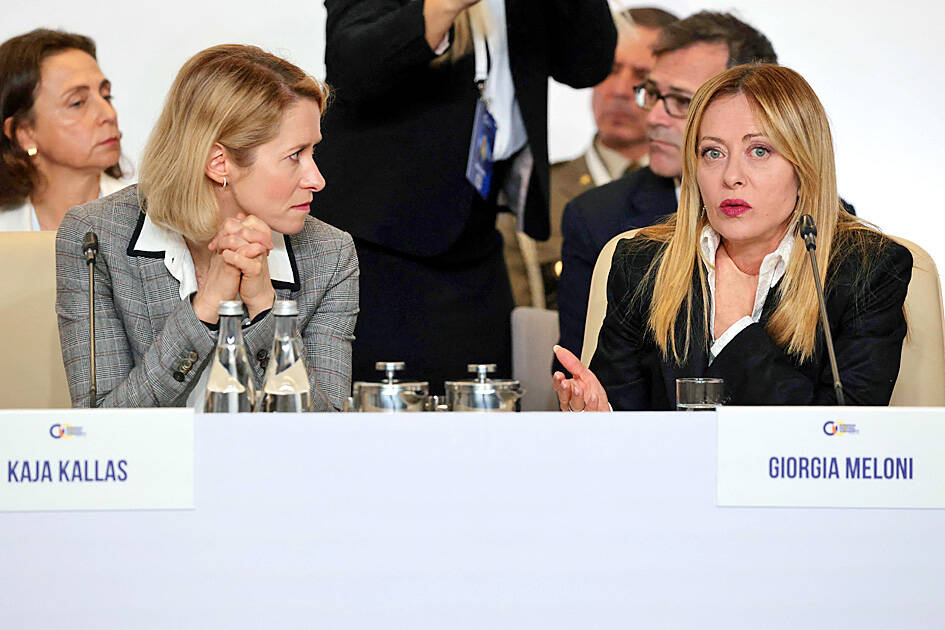
Photo: AFP
Asked about the decision to pull out 5,000 troops from Germany, Norwegian Prime Minister Jonas Gahr Store said: “I wouldn’t exaggerate that because I think we are expecting that Europe is taking more charge of its own security.
“I do not see those figures as dramatic, but I think they should be handled in a harmonious way inside the framework of NATO,” he told reporters in Yerevan, where European leaders are holding a summit.
EU High Representative for Foreign Affairs and Security Policy Kaja Kallas said: “There has been a talk about withdrawal of US troops for a long time from Europe. But of course, the timing of this announcement comes as a surprise.”
“I think it shows that we have to really strengthen the European pillar in NATO,” she said.
Asked whether she believes that Trump is trying to punish Merz, who said that the US has been humiliated by Iran in talks to end the war, Kallas said: “I don’t see into the head of President Trump, so he has to explain it himself.”
Over the weekend, NATO spokesperson Allison Hart said that officials at the 32-nation military alliance “are working with the US to understand the details of their decision on force posture in Germany.”
European allies and Canada have known since just after he came to office again last year that Trump would pull troops out of Europe — indeed some left Romania in October — but US officials had pledged to coordinate any moves with their NATO allies to avoid creating a security vacuum.
NATO Secretary-General Mark Rutte played down the move, saying that “there has been at this point disappointment on the US side” about European support for the war on Iran.
Notably France, Spain and the UK have declined to give US forces free rein to use bases on their territory to attack Iran. Spain has denied them the use of its airspace and bases there for the war.
However, Rutte, who has championed Trump’s leadership at NATO, despite the US president’s criticism of the majority of the allies, said: “I would say the Europeans have heard a message. They are now making sure that all the bilateral basing agreements are being implemented.”
Rutte added that European nations “have decided to pre-position assets, key assets, close to the theater for the next phase.”
He provided no details, but the Europeans have insisted they would not help police the Strait of Hormuz, a key energy trade route, until the war is over.
French President Emmanuel Macron said “if the United States is ready to reopen Hormuz, that’s great. That’s what we’ve been asking for since the beginning.”
However, he underlined that Europeans are not ready to get involved in any operation “that does not seem clear to us.”

‘CROSSING THE LINE’: China’s embassy in Seoul criticized US Forces Korea Commander General Xavier Brunson, asking if his ‘hostile’ remarks were authorized by Washington South Korea and the US are in talks over recent public remarks by the commander of US Forces Korea, Seoul’s presidential office said yesterday, after the comments drew sharp criticism from China. In a recent podcast interview, US Forces Korea Commander General Xavier Brunson described South Korea as “the dagger in the heart of Asia” from China’s east coast, prompting the Chinese embassy in Seoul to say that he had “truly crossed the line.” The interview came amid growing speculation that Washington might seek to expand the role of US Forces Korea in countering the growing regional influence of China, a key

Through the noise of rushing papers and whirring belts at a print factory in Kyoto, two creators watch their photo essay come to life in broadsheet form — part of an effort to win new audiences in the age of artificial intelligence (AI). Despite the decline of the publishing industry, self-publication and handmade “zine” magazines are growing in popularity in Japan, reflecting the nation’s enduring love of paper in the digital era. While speaking to Agence France-Presse at the plant, his hands black with ink, one of the creators, Kazuma Obara, said: “I think [paper] is a medium that engages all five

Australian researchers have trained lab-grown brain cells on a silicon computer chip to play the 1990s shooter game Doom and said they are just scratching the surface of what the neurons could be capable of doing. It is the science-fiction work of biotech boffins at Cortical Labs, who researched and developed the technology that harnesses the workings of the brain’s networking system. Each so-called “biological computer” contains about 200,000 living human brain cells, grown from stem cells that were harvested from blood donations. Having mastered the simple computer game Pong, where a paddle is moved up and down to send a ball

France experienced its hottest spring on record, the French weather service said on Tuesday, after an exceptional early heat wave that also broke highs for the season in England and Wales. Meteo-France said the average nationwide temperature over March to May was 13.8°C — about 1.7°C above the norm, and surpassing records set in 2011 and 2020. “The warmest spring since records began in 1900,” it said in a bulletin. All three months were warmer than average, but the onset of an “unprecedented heatwave” late last month pushed the mercury to highs typically seen at the height of the summer. “Our country had never


 RSS
RSS