


North Korea dramatically increased executions during the COVID-19 pandemic, particularly for consuming South Korean dramas, K-pop, and other foreign culture and political offenses, a report published yesterday showed.
Pyongyang closed its borders in January 2020 to stop the spread of the coronavirus, with research and media reports indicating that the diplomatically isolated nation spent subsequent years bolstering security along its frontiers.
Campaigners have said the shutdown worsened longstanding human rights abuses in North Korea, whose government is widely seen as one of the world’s most repressive.
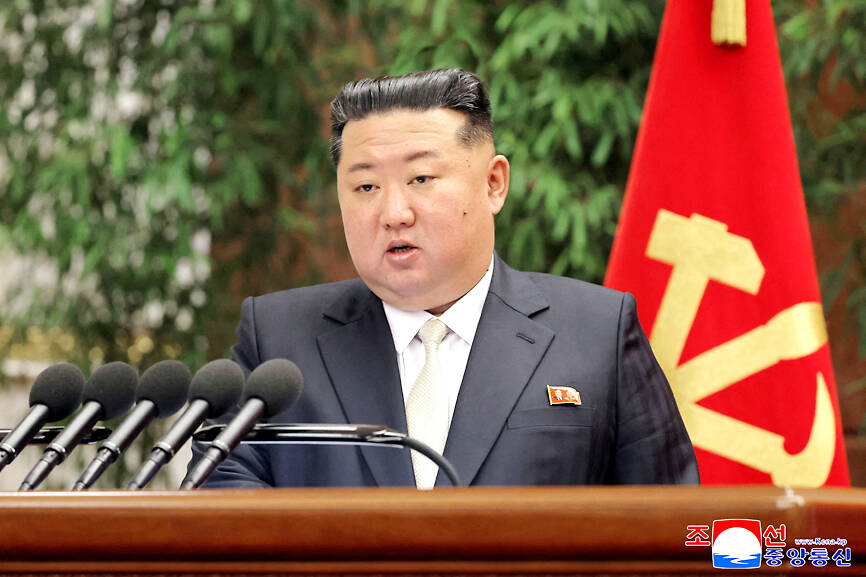
Photo: KCNA via Reuters
The report by the Transitional Justice Working Group, an advocacy non-governmental organization, found that the number of executions and death sentencings more than doubled in the nearly five years after the border closure, compared with the same period before.
The number of condemned people also more than tripled over the same timeframe, according to the findings.
The group drew data from hundreds of North Korean escapees and several media outlets that maintain networks of sources inside the secretive nation, where there is no independent media and little international presence.
It analyzed 144 known cases of executions and death sentencings, involving hundreds of people.
Since the pandemic, authorities have ramped up the use of capital punishment for offenses such as consuming South Korean movies, dramas and music, it said.
Death penalty cases related to foreign culture, religion and “superstition” jumped by 250 percent after the border closure.
Another major spike in executions for political crimes, such as criticizing North Korean leader Kim Jong-un, could suggest that the government is “responding to growing internal dissatisfaction or intensifying state violence to suppress political discontent,” the report said.
Nearly three-quarters of the executions were carried out in public, with most people shot to death, it said.
It said that killings had taken place in dozens of cities and counties since Kim rose to power in the early 2010s.
They included several sites in the capital, Pyongyang, as well as public grounds such as defunct airfields, riverbanks, farmland and open-storage yards for mine waste.
The North Korean government is accused of rights abuses including torture, forced labor, and severe restrictions on freedom of expression and movement.
It is said to operate four political prison camps where up to 65,000 people are subjected to hard labor, according to a report by the Korea Institute for National Unification.
The UN High Commissioner for Human Rights last year said that the overall human rights situation in North Korea over the past decade had shown no improvement and in many cases had worsened.
North Korea has consistently rejected allegations of abuses, accusing the UN of politicizing human rights to undermine the regime.

Young Chinese, many who fear age discrimination in their workplace after turning 35, are increasingly starting “one-person companies” that have artificial intelligence (AI) do most of the work. Smaller start-ups are already in vogue in Silicon Valley and elsewhere, with rapidly advancing AI tools seen as a welcome teammate even as they threaten layoffs at existing firms. More young people in China are subscribing to the model, as cities pledge millions of dollars in funding and rent subsidies for such ventures, in alignment with Beijing’s political goal of “technological self-reliance.” “The one-person company is a product of the AI era,” said Karen Dai

South Korea’s air force yesterday apologized for a 2021 midair collision involving two fighter jets, a day after auditors said the pilots were taking selfies and filming during the flight and held them responsible for the accident. “We sincerely apologize to the public for the concern caused by the accident that occurred in 2021,” an air force spokesman told a news conference, adding that one of the pilots involved had been suspended from flying duties, received severe disciplinary action and has since left the military. The apology followed a report released on Wednesday by the South Korean Board of Audit and Inspection,

About 240 Indians claiming descent from a Biblical tribe landed at Tel Aviv airport on Thursday as part of a government operation to relocate them to Israel. The newcomers passed under a balloon arch in blue and white, the colors of the Israeli flag, as dozens of well-wishers welcomed them with a traditional Jewish song. They were the first “bnei Menashe” (“sons of Manasseh”) to arrive in Israel since the government in November last year announced funding for the immigration of about 6,000 members of the community from the states of Manipur and Mizoram in northeast India. The community claims to descend from

‘TROUBLING’: The firing of Phelan, who was an adviser to a nonprofit that supported the defense of Taiwan, was another example of ‘dysfunction’ under Trump, a US senator said US Secretary of the Navy John Phelan has been fired, a US official and a person familiar with the matter said on Wednesday, in another wartime shakeup at the Pentagon coming just weeks after US Secretary of Defense Pete Hegseth ousted the Army’s top general. The Pentagon announced his departure in a brief statement, saying he was leaving the administration “effective immediately,” but it did not provide a reason or say whether it was his decision to go. The sources, who spoke on condition of anonymity, said Phelan was dismissed in part because he was moving too slowly to implement reforms to


 RSS
RSS