


When NATO’s call came, the French fighter pilots scrambled with practiced urgency, already suited up to shorten their response times.
They dashed in vans to hangars where their prepped and armed Rafale jets awaited, clambered into the cockpits and fired up the engines, which puffed and screamed.
Within minutes of takeoff from the Siauliai Air Base in Lithuania, they were over the Baltic Sea, first intercepting a Russian Il-20 reconnaissance aircraft and then tailing supersonic Russian bombers and their fighter escorts that neared the airspace of multiple NATO countries.
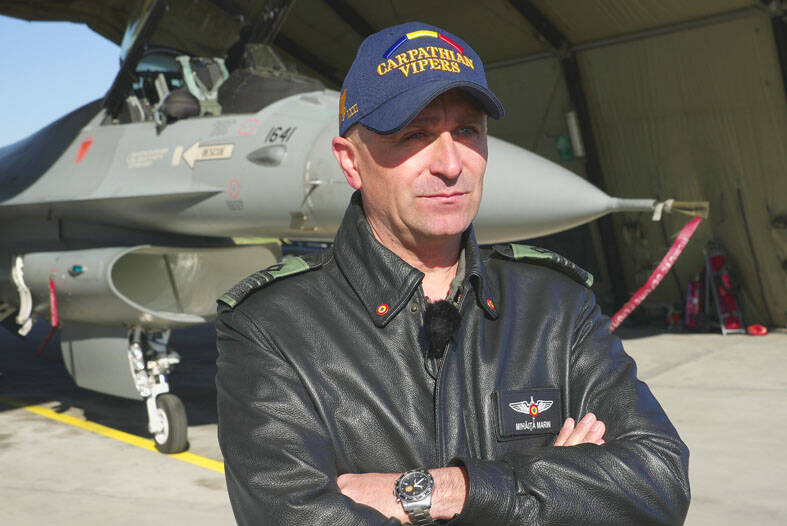
Photo: AP
In a conflict situation, things could quickly get heated.
However, for the moment, with Russia and the military alliance at odds over Ukraine, but not at war, pilots on both sides just watched and filmed each other — keeping their distance like wary tomcats with claws unsheathed, their missiles visible, but not used.
One of the points of the posturing — in aerial ballets that take place away from public gaze hundreds of times a year — is to try to ensure that the frostiness between NATO and the Kremlin over Russia’s full-scale invasion of Ukraine does not tilt into open hostility.
Commanders and pilots flying NATO air-policing missions on the eastern flank of the 32-nation military alliance say that their goal is to deter, not provoke.
They believe their presence is reassuring for Baltic states — Estonia, Latvia and Lithuania — that border Russia and its ally Belarus, but do not themselves have airpower to fight off any Russian attack, if it ever came to that.
“It’s a game of cat and mouse, or rather cat and cat,” said Lieutenant Colonel Alexandre, commander of a French Air Force wing of four Rafales that is sharing the Lithuanian base with another fighter detachment from Romania.
Citing security concerns, the French military withheld the commander’s surname.
“We watch each other, scrutinize each other and try to make sure that it doesn’t go any further,” he said.
Alliance members take turns policing Baltic skies around the clock, seven days a week. The French inherited the building that now serves as their temporary headquarters from a Spanish detachment. They are to hand it over to Italian replacements in August.
Successive teams leave plaques and badges on a wall that records their passage.
NATO scrambles jets to identify and possibly take other action when Russian planes fly in Baltic airspace without switched-on transponders, and without filing flight plans or communicating by radio with air traffic controllers.
“There are plenty of times in which, on purpose or not, they’re not really respecting the ICAO — the International Civil Aviation Organization — rules, regarding flight plans and behavior,” said Colonel Mihaita Marin, commanding the Romanian detachment of six F-16s.
“So obviously we are forced to take off and just make sure that they are who they say they are and their intention is peaceful,” he said.
The arrival of spring, bringing better flying conditions, means French and Romanian flyers have been busy since they deployed at the start of this month on four-month NATO rotations.
Marin said interceptions “are getting close to daily” and “that will definitely increase as the weather is getting better.”
French aircrews had their busiest day so far on Monday.
Scrambled under NATO command, French Rafales met and observed a pair of Russian Tu-22M3 bombers carrying supersonic, anti-ship missiles from their bellies that Russia has also used in Ukraine, repurposing them to attack ground targets, and which can be equipped to carry a nuclear warhead.
The strategic bombers’ more than four-hour flight from an airbase near St Petersburg, Russia, escorted by Su-30 and Su-35 fighters, remained in international airspace, but took them past the coasts of NATO countries Finland, Estonia, Latvia, Lithuania and Poland, doubling back when they approached Denmark.
The French detachment said the Russian planes did not have switched-on transponders, file flight plans or enter into radio contact. Fighter jets from Sweden, Finland, Poland, Denmark and Romania also went airborne to keep watch, according to the French.
NATO did not respond to requests for comment.
Alexandre said it is not clear why Russian pilots behave in ways that could endanger other users of Baltic airspace.
“We don’t know if it’s lack of professionalism or just a means for them to test us, but what is sure is that we need to go every time,” he said. “We cannot say: ‘OK, that’s usual, this time we will just let them pass.’”
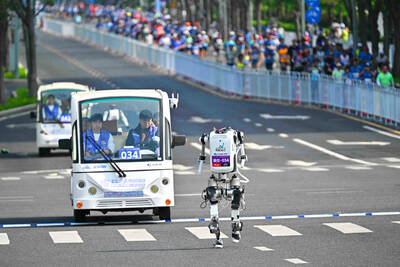
A humanoid robot that won a half-marathon race for robots in Beijing on Sunday ran faster than the human world record in a show of China’s technological leaps. The winner from Honor, a Chinese smartphone maker, completed the 21km race in 50 minutes and 26 seconds, said a WeChat post by the Beijing Economic-Technological Development Area, also known as Beijing E-Town, where the race began. That was faster than the human world record holder, Ugandan Jacob Kiplimo, who finished the same distance in about 57 minutes in March at the Lisbon road race. The performance by the robot marked a significant step forward
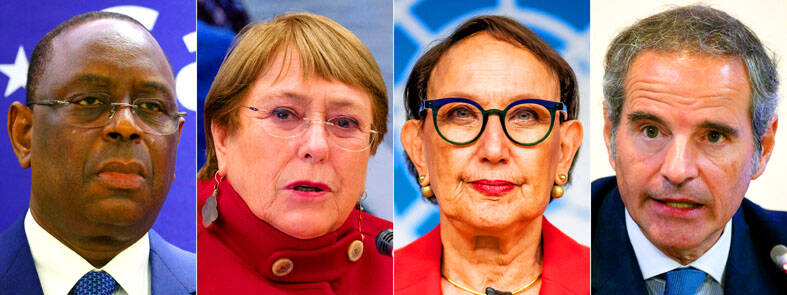
Four contenders are squaring up to succeed Antonio Guterres as secretary-general of the UN, which faces unprecedented global instability, wars and its own crushing budget crisis. Chile’s Michelle Bachelet, Argentina’s Rafael Grossi, Costa Rica’s Rebeca Grynspan and Senegal’s Macky Sall are each to face grillings by 193 member states and non-governmental organizations for three hours today and tomorrow. It is only the second time the UN has held a public question-and-answer, a format created in 2016 to boost transparency. Ultimately the five permanent members of the UN’s top body, the Security Council, hold the power, wielding vetoes over who leads the

An earthquake registering a preliminary magnitude of 7.7 off northern Japan on Monday prompted a short-lived tsunami alert and the advisory of a higher risk of a possible mega-quake for coastal areas there. The Cabinet Office and the Japan Meteorological Agency said there was a 1% chance for a mega-quake, compared to a 0.1% chance during normal times, in the next week or so following the powerful quake near the Chishima and Japan trenches. Officials said the advisory was not a quake prediction but urged residents in 182 towns along the northeastern coasts to raise their preparedness while continuing their daily lives. Prime
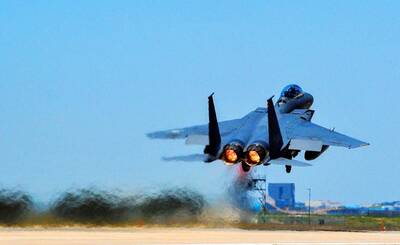
South Korea’s air force yesterday apologized for a 2021 midair collision involving two fighter jets, a day after auditors said the pilots were taking selfies and filming during the flight and held them responsible for the accident. “We sincerely apologize to the public for the concern caused by the accident that occurred in 2021,” an air force spokesman told a news conference, adding that one of the pilots involved had been suspended from flying duties, received severe disciplinary action and has since left the military. The apology followed a report released on Wednesday by the South Korean Board of Audit and Inspection,


 RSS
RSS