


Voting in one of India’s most closely watched state elections began yesterday after a national voter roll revision removed millions of names and raised concerns over disenfranchisement in West Bengal, one of the few large states not governed by Indian Prime Minister Narendra Modi’s ruling party.
The election has national implications. Modi’s Bharatiya Janata Party (BJP) is seeking gains in a state long dominated by a regional opposition party, while a victory for West Bengal Chief Minister Mamata Banerjee would bolster her position as a leading opposition figure.
A second phase of polling is scheduled for next week. Voting was also taking place in the southern state of Tamil Nadu.
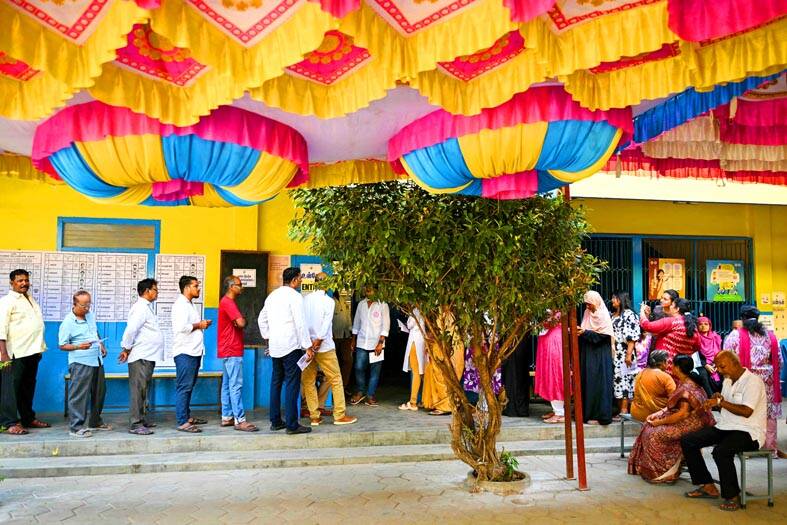
Photo: AFP
The voting was part of a wider round of state elections testing the BJP’s reach in opposition strongholds. The results of the latest elections and the earlier polls in Kerala and Assam states and the federally administered territory of Puducherry were expected on May 4.
The election is taking place after a sweeping revision of electoral rolls by the Election Commission of India aimed at removing duplicate, deceased and ineligible voters.
About 9 million names — roughly 12 percent of the electorate — were deleted, including 6.3 million listed as deceased or absent and 2.7 million marked “doubtful” and pending verification, officials said.
Some affected voters said they had voted in previous elections and hold valid identification, but were removed without clear explanation.
Sheikh Najrul Islam, a 53-year-old paramilitary officer on election duty in West Bengal, said he last voted in 2021 and holds valid identification documents, yet his name no longer appears on the voter list.
“The Election Commission has deputed me to ensure free and fair polls. Yet, it does not consider me a citizen of this country,” he said.
In another case, Taibunessa Begum, a 62-year-old retired school administrator, said she was shocked to find her name deleted despite having a passport, pension records and earlier voter registration.
“It felt like being told I don’t exist,” she said.
Opposition leaders allege the deletions disproportionately affect Muslims and other marginalized communities.
Modi’s party said the revision was a routine administrative exercise carried out across multiple states, adding that any disproportionate impact in West Bengal reflects the presence of undocumented migrants.
They said that many Hindu voters were also removed.
However, critics link the deletions to broader political messaging by Modi and some BJP leaders, who have repeatedly suggested the revisions of the voter lists targeted people who immigrated illegally from neighboring Bangladesh.
Opposition leaders said such rhetoric has deepened fears among minority communities, particularly Muslims, that the voter roll revision is being used to exclude them.
Derek O’Brien, of the opposition Trinamool Congress, called the exercise “invisible rigging.”
“The motive is to disenfranchise voters,” he said.
Analysts said the deletions could fuel fears of longer-term consequences.
“Losing one’s place in the electoral roll can be deeply unsettling. It is not only about voting rights; it is about dignity, recognition and the assurance that one counts as a citizen,” political analyst Iman Kalyan Lahiri said.
For many affected voters, the issue is more immediate.
“This is not just about politics,” Begum said. “It is about identity, about whether we belong to this country.”

Four contenders are squaring up to succeed Antonio Guterres as secretary-general of the UN, which faces unprecedented global instability, wars and its own crushing budget crisis. Chile’s Michelle Bachelet, Argentina’s Rafael Grossi, Costa Rica’s Rebeca Grynspan and Senegal’s Macky Sall are each to face grillings by 193 member states and non-governmental organizations for three hours today and tomorrow. It is only the second time the UN has held a public question-and-answer, a format created in 2016 to boost transparency. Ultimately the five permanent members of the UN’s top body, the Security Council, hold the power, wielding vetoes over who leads the

A humanoid robot that won a half-marathon race for robots in Beijing on Sunday ran faster than the human world record in a show of China’s technological leaps. The winner from Honor, a Chinese smartphone maker, completed the 21km race in 50 minutes and 26 seconds, said a WeChat post by the Beijing Economic-Technological Development Area, also known as Beijing E-Town, where the race began. That was faster than the human world record holder, Ugandan Jacob Kiplimo, who finished the same distance in about 57 minutes in March at the Lisbon road race. The performance by the robot marked a significant step forward
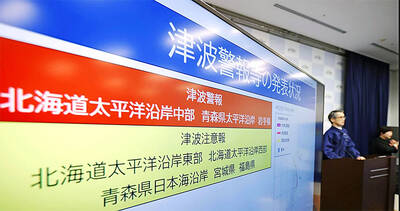
An earthquake registering a preliminary magnitude of 7.7 off northern Japan on Monday prompted a short-lived tsunami alert and the advisory of a higher risk of a possible mega-quake for coastal areas there. The Cabinet Office and the Japan Meteorological Agency said there was a 1% chance for a mega-quake, compared to a 0.1% chance during normal times, in the next week or so following the powerful quake near the Chishima and Japan trenches. Officials said the advisory was not a quake prediction but urged residents in 182 towns along the northeastern coasts to raise their preparedness while continuing their daily lives. Prime
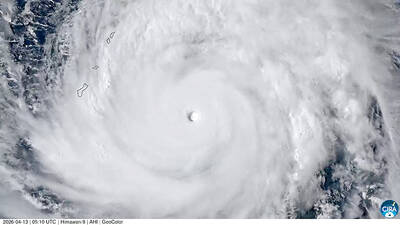
HAZARDOUS CONDITION: The typhoon’s sheer size, with winds extending 443km from its center, slowed down the ability of responders to help communities, an official said The US Coast Guard was searching for six people after losing contact with their disabled boat off the coast of Guam following Typhoon Sinlaku. The crew of the 44m dry cargo vessel, the US-registered Mariana, on Wednesday notified the coast guard that the boat had lost its starboard engine and needed assistance, Petty Officer 3rd Class Avery Tibbets said yesterday. The coast guard set up a one-hour communication schedule with the vessel, but lost contact on Thursday. A Coast Guard HC-130 Hercules aircraft was launched to search for the six people on board, but it had to return to Guam because of


 RSS
RSS