


Pro-Russian former Bulgarian president Rumen Radev has won the parliamentary elections by landslide, official results showed yesterday, sidelining long-dominant political forces and potentially pushing the EU and NATO member state closer to Moscow.
The performance, exceeding opinion poll forecasts, is one of the strongest results for a single party in a generation and might end, for now, the chronic instability that led to eight elections in five years.
Radev’s Progressive Bulgaria party had 44.7 percent of the vote after 91.7 percent of ballots were counted, suggesting it could rule alone, but he has not ruled out a coalition with a pro-European group or a smaller party.
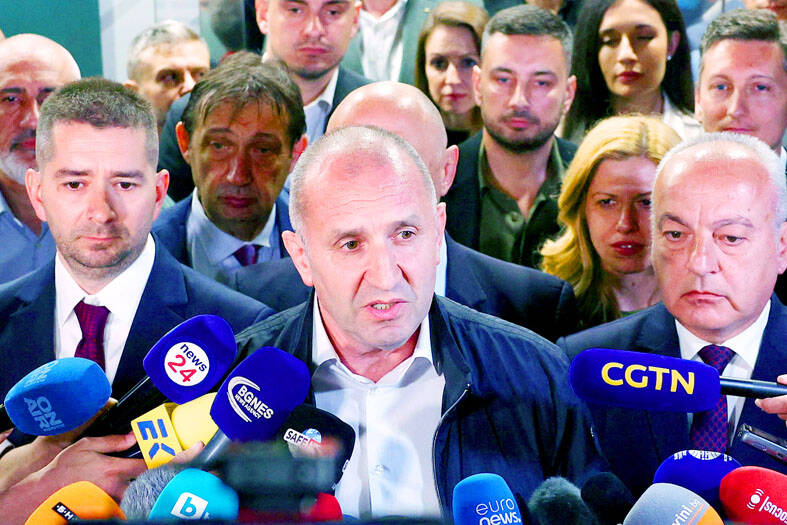
Photo: Reuters
Progressive Bulgaria’s tally put it far ahead of the pro-European We Continue the Change-Democratic Bulgaria (PP-DB) coalition with 13.2 percent, and the long-dominant GERB party, led by former prime minister Boyko Borissov, at 13.4 percent.
“This is a victory of hope over distrust, a victory of freedom over fear, and finally, if you will, a victory of morality,” Radev told a press conference late on Sunday.
A euroskeptic and former fighter pilot opposed to military support for Ukraine’s war effort against Moscow, Radev stepped down from Bulgaria’s largely ceremonial presidency in January to run in the parliamentary election after mass protests forced out the previous government in December.
He rode a wave of frustration with political instability in the Balkan nation of 6.5 million, where voters are sick of corruption and veteran parties that have dominated politics for decades.
“There is now an opportunity for the things people have been hoping to see change to actually become visible,” said Evelina Koleva, a manager at digital marketing company in Sofia.
Radev’s campaign drew comparisons with Hungary’s pro-Kremlin former prime minister Viktor Orban when he talked about improving ties with Moscow and resuming the free flow of Russian oil and gas into Europe.
He also criticized the EU for relying too heavily on renewable energy.
However, Radev has been vague on policy and it is not yet clear how much he would change foreign policy in Bulgaria, a Black Sea nation on the EU’s southeastern flank which joined the eurozone in January — a move Radev has criticized.
Analysts do not expect him to try to reverse Bulgaria’s adoption of the euro or to block wider EU aid packages to Ukraine. On Sunday Radev said he would be willing to work on judicial reform with PP-DB and that Bulgaria would “make efforts to continue on its European path.”
Some voters were wary.
“I don’t know whether to believe there will be a change in the political class,” said Venelin Spasov, a 31-year-old real-estate broker from Sofia. “But I hope it’s for the best because, after all, it is high time we had some kind of change.”
Bulgaria has developed rapidly since the fall of communism in 1989 and joined the EU in 2007. Life expectancy has risen sharply, unemployment is the lowest in the EU and the economy has greater safeguards since adopting the euro.
However, it lags EU countries in other metrics.
The cost of living has become a particular issue since Bulgaria joined the euro. The previous government fell amid protests against a new budget proposing tax increases and higher social security contributions.
“The country’s main challenge is the economic crisis and the demographic crisis,” said Tihomir Bezlov, a senior fellow at the Centre for the Study of Democracy in Sofia.
“There do not seem to be many ideas in the winning camp on either of these issues,” he said.

‘CROSSING THE LINE’: China’s embassy in Seoul criticized US Forces Korea Commander General Xavier Brunson, asking if his ‘hostile’ remarks were authorized by Washington South Korea and the US are in talks over recent public remarks by the commander of US Forces Korea, Seoul’s presidential office said yesterday, after the comments drew sharp criticism from China. In a recent podcast interview, US Forces Korea Commander General Xavier Brunson described South Korea as “the dagger in the heart of Asia” from China’s east coast, prompting the Chinese embassy in Seoul to say that he had “truly crossed the line.” The interview came amid growing speculation that Washington might seek to expand the role of US Forces Korea in countering the growing regional influence of China, a key

SEEKING ORDER: Rodrigo Paz said that ‘anyone who wants to destroy the nation will have to deal with this president and the full force of the constitution’ Bolivian President Rodrigo Paz on Wednesday said that the nation was at a “breaking point” after nearly a month of protests that have caused shortages of food, fuel and medicine. Paz, who took office six months ago amid the worst economic crisis there in four decades, is battling a groundswell of fury over his policies. The political capital, La Paz, has been besieged by low-income workers and members of the indigenous majority calling for his resignation. “The country needs order and is reaching breaking point,” the 58-year-old said at a public event in La Paz, renewing his appeal for dialogue. On Tuesday, the Bolivian

Forecasters in Europe yesterday warned of exceptional heat as record temperatures driven by a “heat dome” push temperatures well above seasonal norms across the continent. The surge follows a record-breaking Monday, with France logging its hottest day in the month of May on record, its weather agency said, and the UK also posting unprecedented highs. A so-called “heat dome” of warm air from northern Africa trapped under a high-pressure system over western Europe is behind the high temperatures not usually seen until high summer. Restrictions on outdoor work were imposed in parts of Italy, beaches in southwest France filled earlier than usual and

Australian researchers have trained lab-grown brain cells on a silicon computer chip to play the 1990s shooter game Doom and said they are just scratching the surface of what the neurons could be capable of doing. It is the science-fiction work of biotech boffins at Cortical Labs, who researched and developed the technology that harnesses the workings of the brain’s networking system. Each so-called “biological computer” contains about 200,000 living human brain cells, grown from stem cells that were harvested from blood donations. Having mastered the simple computer game Pong, where a paddle is moved up and down to send a ball


 RSS
RSS