


Thousands of people yesterday turned out see Pope Leo XIV, who was celebrating a big Mass in Cameroon’s port city and then was to visit the country’s Catholic university on a day focused on encouraging young people.
Leo traveled to Douala, the commercial and economic capital of Cameroon, to celebrate Mass. The Vatican predicted about 600,000 people would turn out for the liturgy, the biggest crowd Leo is expected to draw on his 11-day, four-nation trip, the first to Africa by history’s first American pope.
With an hour to go before the liturgy got underway, the big field in front of the Japoma sports stadium was bursting with people singing and dancing as an announcer shouted “Habemus Papam” (We have a pope). The Latin phrase is used to announce the election of a new pope, but in this case joyfully announced Leo’s arrival.
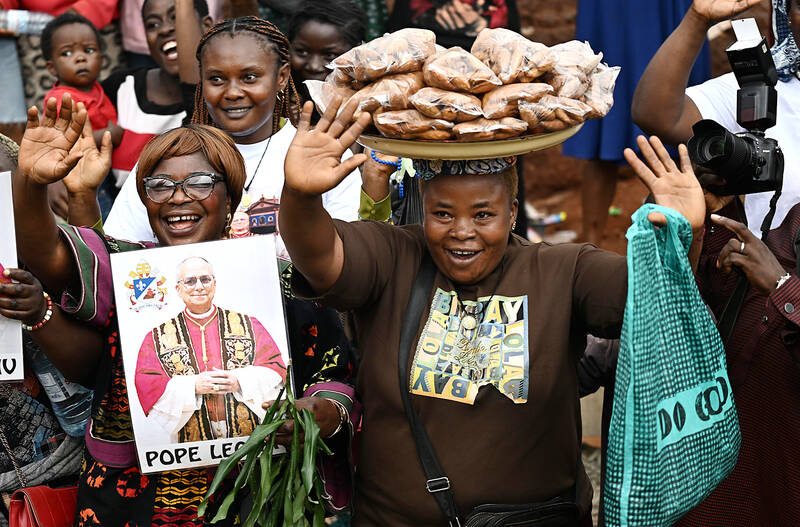
Photo: EPA
The crowd cheered when Leo emerged in his open-sided popemobile, with waves of young people running alongside him trying to keep up, as he looped through the crowd. Some had spent the night on the ground, battling mosquitoes, to be in place for the late morning Mass, but said they were willing to make the sacrifice for the pope.
“I wanted to offer this effort to the pope, to show him that what he is doing and what he wants to accomplish should truly come to life,” Alex Nzumo said.
Later yesterday, Leo had an appointment back in the capital, Yaounde, with students, professors and administrators at the Catholic University of Central Africa. Popes have often used such encounters, especially in the developing world, to rally young people to persevere in the face of poverty, corruption and other challenges.
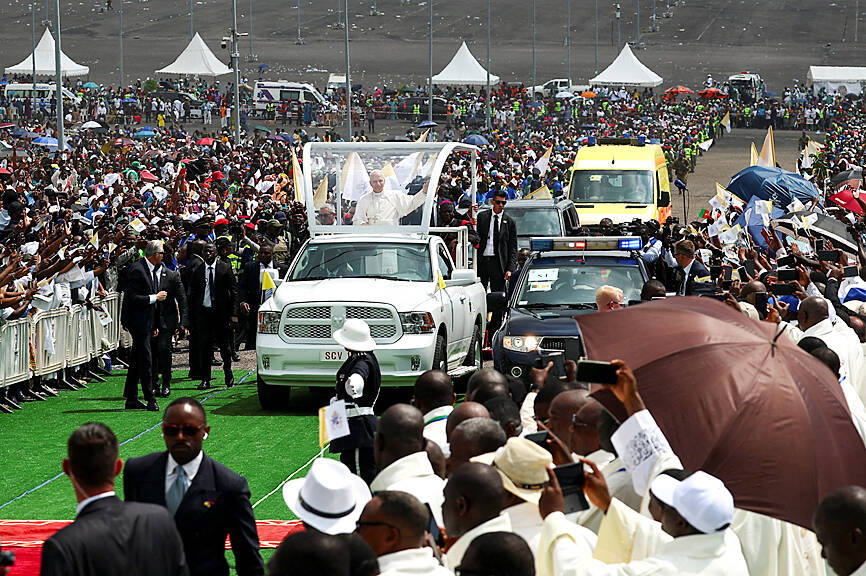
Photo: Reuters
With a population of 29 million, Cameroon is an overwhelmingly young country, where the median age is 18. Catholics represent about 29 percent of the population, and the country is a major source of growth and priestly vocations for the church.
Leo has already offered words of encouragement to Cameroon’s youth, including in his opening speech to Cameroonian President Paul Biya — at 93 the world’s oldest leader.
In the speech, Leo demanded the “chains of corruption” in Cameroon be broken and said Cameroon’s youth represent the future and hope of the country.
But with Biya in power since 1982, Cameroon perhaps represents the most dramatic example of the tension between Africa’s youth and the continent’s many aging leaders.
Despite being an oil-producing country experiencing modest economic growth, young people say the benefits have not trickled down beyond the elites.
“Of course, when unemployment and social exclusion persist, frustration can lead to violence,” Leo said in his opening address to Biya and government authorities earlier this week. “Investing in the education, training and entrepreneurship of young people is, therefore, a strategic choice for peace. It is the only way to curb the outflow of wonderful talent to other parts of the world.”
According to World Bank data, the unemployment rate in Cameroon stands at 3.5 percent, but 57 percent of the labor force aged 18 to 35 works in informal employment.
The dire economic outlook in Cameroon has led to significant brain drain and has strained an already understaffed health sector, as many doctors and nurses are leaving the country for more lucrative jobs in Europe and North America.
In 2023, about one-third of doctors who graduated from medical school in Cameroon left the country, the Cameroonian Ministry of Higher Education said.
Growing frustration over Biya’s record and long-term rule intensified during October’s tense presidential election, in which Biya secured an eighth consecutive term.
When Cameroon’s main opposition candidate, Issa Tchiroma Bakary, contested the result of the poll, deadly protests erupted throughout the country.

‘CROSSING THE LINE’: China’s embassy in Seoul criticized US Forces Korea Commander General Xavier Brunson, asking if his ‘hostile’ remarks were authorized by Washington South Korea and the US are in talks over recent public remarks by the commander of US Forces Korea, Seoul’s presidential office said yesterday, after the comments drew sharp criticism from China. In a recent podcast interview, US Forces Korea Commander General Xavier Brunson described South Korea as “the dagger in the heart of Asia” from China’s east coast, prompting the Chinese embassy in Seoul to say that he had “truly crossed the line.” The interview came amid growing speculation that Washington might seek to expand the role of US Forces Korea in countering the growing regional influence of China, a key

SEEKING ORDER: Rodrigo Paz said that ‘anyone who wants to destroy the nation will have to deal with this president and the full force of the constitution’ Bolivian President Rodrigo Paz on Wednesday said that the nation was at a “breaking point” after nearly a month of protests that have caused shortages of food, fuel and medicine. Paz, who took office six months ago amid the worst economic crisis there in four decades, is battling a groundswell of fury over his policies. The political capital, La Paz, has been besieged by low-income workers and members of the indigenous majority calling for his resignation. “The country needs order and is reaching breaking point,” the 58-year-old said at a public event in La Paz, renewing his appeal for dialogue. On Tuesday, the Bolivian

Forecasters in Europe yesterday warned of exceptional heat as record temperatures driven by a “heat dome” push temperatures well above seasonal norms across the continent. The surge follows a record-breaking Monday, with France logging its hottest day in the month of May on record, its weather agency said, and the UK also posting unprecedented highs. A so-called “heat dome” of warm air from northern Africa trapped under a high-pressure system over western Europe is behind the high temperatures not usually seen until high summer. Restrictions on outdoor work were imposed in parts of Italy, beaches in southwest France filled earlier than usual and

Australian researchers have trained lab-grown brain cells on a silicon computer chip to play the 1990s shooter game Doom and said they are just scratching the surface of what the neurons could be capable of doing. It is the science-fiction work of biotech boffins at Cortical Labs, who researched and developed the technology that harnesses the workings of the brain’s networking system. Each so-called “biological computer” contains about 200,000 living human brain cells, grown from stem cells that were harvested from blood donations. Having mastered the simple computer game Pong, where a paddle is moved up and down to send a ball


 RSS
RSS