


In these polarizing times, Minnesotans have found something they can agree on — the thrill of a meat raffle.
Meat raffles have been popular in pockets of the US for decades, offering a fun way to raise money for charities while handing out prizes ranging from ground beef and hot dogs to chicken breasts and steaks.
However, while inflation has surged and meat prices have soared, Minnesota’s US$70 per-event prize limit has not changed in nearly 40 years.
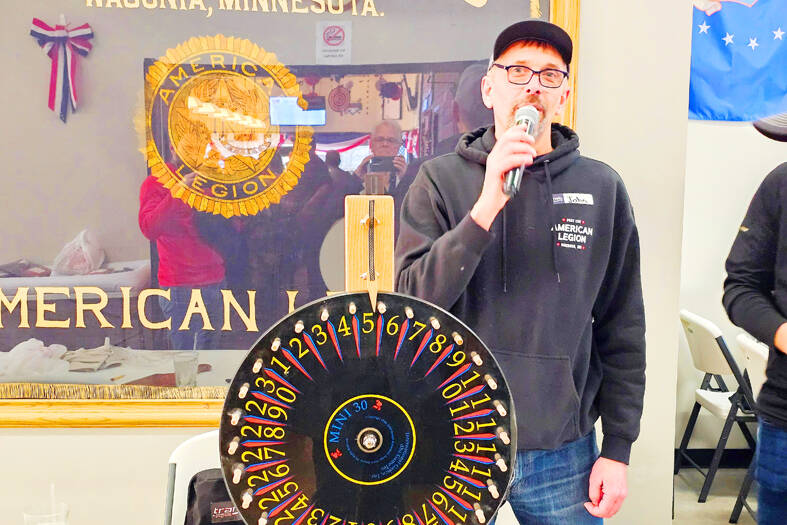
Photo: AP
The deeply divided Minnesota Legislature has not been able to agree on much this year, but it is almost a sure bet to respond by upping the cap to US$200. That would allow charities to offer more and bigger grill packs, and thicker, fancier steaks, while funding youth sports teams and other causes.
It would also ensure that the state’s beloved if quirky tradition of gambling for meat products remains viable.
“This is probably the best feel-good bill that we have going on in the legislature right now,” said Minnesota State Representative Jim Nash, lead House author of the meat raffle legislation.
Even with the lower prize limit, Andrea “Mama” Avaloz scored with a US$2 bet. Game organizers spun a wheel and landed on her No. 5, making her a winner of the American Legion Post 150 in the lakeside town of Waconia, about 48km west of Minneapolis.
“So I have a little fajita meat. We are set to go,” Avaloz said as she picked up her plastic-wrapped prize. “Beef sticks. Love them.”
Moments later she realized there was a surprise hidden beneath her beef and sausages.
“Oh my God, I have pork chops,” she said. “I picked a good one. I’m so excited.”
Meat raffles originated during World War II as a response to wartime rationing in the UK. They spread to Canada, Australia and New Zealand, and eventually migrated to Minnesota, Wisconsin, western New York and a few other US states.
Nash, who represents Waconia, said he expects a vote in the House next week to expand the prize cap and approval soon after in the Minnesota Senate.
“It’s an opportunity for bipartisanship,” he said. “It’s an opportunity to do good things.”

‘CROSSING THE LINE’: China’s embassy in Seoul criticized US Forces Korea Commander General Xavier Brunson, asking if his ‘hostile’ remarks were authorized by Washington South Korea and the US are in talks over recent public remarks by the commander of US Forces Korea, Seoul’s presidential office said yesterday, after the comments drew sharp criticism from China. In a recent podcast interview, US Forces Korea Commander General Xavier Brunson described South Korea as “the dagger in the heart of Asia” from China’s east coast, prompting the Chinese embassy in Seoul to say that he had “truly crossed the line.” The interview came amid growing speculation that Washington might seek to expand the role of US Forces Korea in countering the growing regional influence of China, a key

SEEKING ORDER: Rodrigo Paz said that ‘anyone who wants to destroy the nation will have to deal with this president and the full force of the constitution’ Bolivian President Rodrigo Paz on Wednesday said that the nation was at a “breaking point” after nearly a month of protests that have caused shortages of food, fuel and medicine. Paz, who took office six months ago amid the worst economic crisis there in four decades, is battling a groundswell of fury over his policies. The political capital, La Paz, has been besieged by low-income workers and members of the indigenous majority calling for his resignation. “The country needs order and is reaching breaking point,” the 58-year-old said at a public event in La Paz, renewing his appeal for dialogue. On Tuesday, the Bolivian

Through the noise of rushing papers and whirring belts at a print factory in Kyoto, two creators watch their photo essay come to life in broadsheet form — part of an effort to win new audiences in the age of artificial intelligence (AI). Despite the decline of the publishing industry, self-publication and handmade “zine” magazines are growing in popularity in Japan, reflecting the nation’s enduring love of paper in the digital era. While speaking to Agence France-Presse at the plant, his hands black with ink, one of the creators, Kazuma Obara, said: “I think [paper] is a medium that engages all five

Australian researchers have trained lab-grown brain cells on a silicon computer chip to play the 1990s shooter game Doom and said they are just scratching the surface of what the neurons could be capable of doing. It is the science-fiction work of biotech boffins at Cortical Labs, who researched and developed the technology that harnesses the workings of the brain’s networking system. Each so-called “biological computer” contains about 200,000 living human brain cells, grown from stem cells that were harvested from blood donations. Having mastered the simple computer game Pong, where a paddle is moved up and down to send a ball


 RSS
RSS