


Australia would raise defense spending to 3 percent of GDP by 2033 as armed conflicts flare worldwide, Australian Minister for Defence Richard Marles said yesterday.
“International norms that once constrained the use of force and military coercion continue to erode,” Marles said in a speech in Canberra, outlining a boost to spending on missile defense, drones and guided weapon stockpiles.
“More countries are engaged in conflict today than at any time since the end of World War II and this is occurring across every region of the world,” he said.
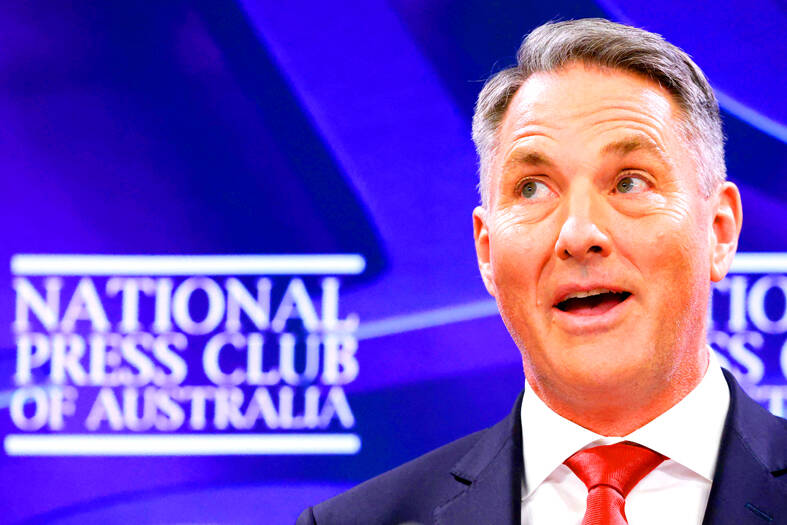
Photo: AFP
Australia’s defense spending had previously been forecast to rise to 2.3 percent of GDP by 2033.
However, the country plans to spend an additional A$53 billion (US$38 billion) over the next decade compared with its 2024 defense strategy, Marles said.
In the shorter term, spending would climb by an extra A$14 billion over four years, he added.
To reach the 3 percent figure, Australia changed how it calculates the defense budget to match a NATO definition that includes factors such as military pensions and defense intelligence.
Marles said that allows better comparisons with other countries, and put Australia ahead of comparable European and Asian nations with a defense spend this year of 2.8 percent.
The new spending still falls short of the 3.5 percent of GDP that US Secretary of Defense Pete Hegseth urged Australia to reach last year.
Wary of China’s navy buildup, Australia has reshaped its defense force to focus on its missile strike capability and deterring an adversary from its northern approaches.
It has also embarked on its largest-ever military spending project to build nuclear-powered submarines under the AUKUS agreement with the US and the UK.
Marles said that Australia this year would focus on building greater military self-reliance, but was not jettisoning its US security alliance, which he said remained “fundamental.”
“There is no effective balance of power in the Indo-Pacific absent the continued presence of the United States,” he said.
Spending to build a missile defense system would accelerate — up to A$30 billion over the next decade, Marles added.
Another A$36 billion would be spent to build guided missiles locally, he added.
Australia’s vast coastline and small population have also spurred a focus on developing large autonomous submarines and fighter jets, dubbed the Ghost Shark and Ghost Bat.
This week, Canberra said it would boost spending on drones by up to A$5 billion in response to shifts in warfare tactics in the Middle East and Ukraine.
Under the AUKUS agreement, the US is to sell Australia two nuclear-powered submarines from 2032.
Australia and Britain are to build a new class of submarine in the 2040s.

‘CROSSING THE LINE’: China’s embassy in Seoul criticized US Forces Korea Commander General Xavier Brunson, asking if his ‘hostile’ remarks were authorized by Washington South Korea and the US are in talks over recent public remarks by the commander of US Forces Korea, Seoul’s presidential office said yesterday, after the comments drew sharp criticism from China. In a recent podcast interview, US Forces Korea Commander General Xavier Brunson described South Korea as “the dagger in the heart of Asia” from China’s east coast, prompting the Chinese embassy in Seoul to say that he had “truly crossed the line.” The interview came amid growing speculation that Washington might seek to expand the role of US Forces Korea in countering the growing regional influence of China, a key

SEEKING ORDER: Rodrigo Paz said that ‘anyone who wants to destroy the nation will have to deal with this president and the full force of the constitution’ Bolivian President Rodrigo Paz on Wednesday said that the nation was at a “breaking point” after nearly a month of protests that have caused shortages of food, fuel and medicine. Paz, who took office six months ago amid the worst economic crisis there in four decades, is battling a groundswell of fury over his policies. The political capital, La Paz, has been besieged by low-income workers and members of the indigenous majority calling for his resignation. “The country needs order and is reaching breaking point,” the 58-year-old said at a public event in La Paz, renewing his appeal for dialogue. On Tuesday, the Bolivian

Forecasters in Europe yesterday warned of exceptional heat as record temperatures driven by a “heat dome” push temperatures well above seasonal norms across the continent. The surge follows a record-breaking Monday, with France logging its hottest day in the month of May on record, its weather agency said, and the UK also posting unprecedented highs. A so-called “heat dome” of warm air from northern Africa trapped under a high-pressure system over western Europe is behind the high temperatures not usually seen until high summer. Restrictions on outdoor work were imposed in parts of Italy, beaches in southwest France filled earlier than usual and

Australian researchers have trained lab-grown brain cells on a silicon computer chip to play the 1990s shooter game Doom and said they are just scratching the surface of what the neurons could be capable of doing. It is the science-fiction work of biotech boffins at Cortical Labs, who researched and developed the technology that harnesses the workings of the brain’s networking system. Each so-called “biological computer” contains about 200,000 living human brain cells, grown from stem cells that were harvested from blood donations. Having mastered the simple computer game Pong, where a paddle is moved up and down to send a ball


 RSS
RSS