


Chinese authorities have banned entombing cremated remains in cheap apartments, a practice that had gained popularity as mourners take advantage of the subdued housing market to dodge rising funeral costs.
“Bone-ash apartments” are units in remote, barely occupied residential complexes that can be cheaper than a public cemetery plot, local media reported. but regulations that came into force on Monday explicitly ban “the use of residential dwellings specifically for the interment of ashes.”
Human remains are only permitted to be buried in designated areas such as public cemeteries, the Chinese State Council said.
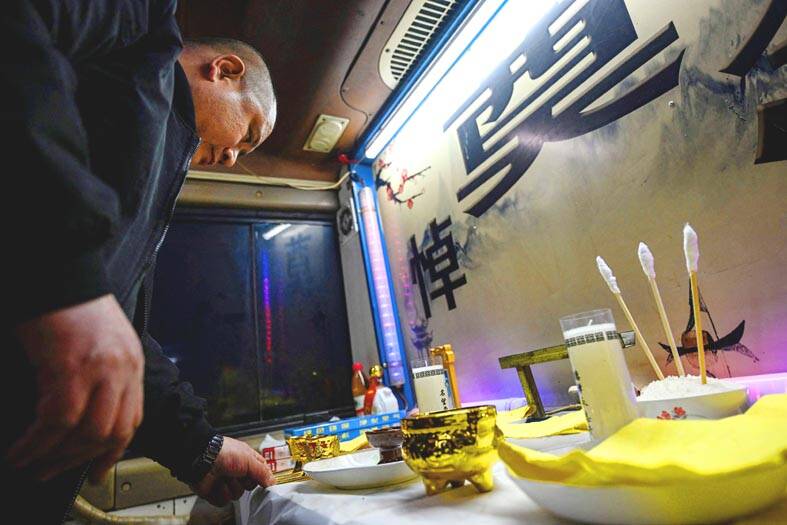
Photo: AFP
Bone-ash apartments are often identifiable by sealed-off windows or closed curtains, local media reports said.
A resident quoted by the Legal Daily newspaper described peeking inside an apartment in his estate to see two candlesticks around a black box and a black-and-white portrait, a typical arrangement in China for commemorating the dead.
Demand for cemetery plots is increasing as China’s population ages and deaths outpace births.
Funerals in 2020 cost nearly half of the nation’s average annual salary, a survey by British insurance firm SunLife showed.
China’s market watchdog yesterday announced new rules to tackle fraud and a lack of transparency in funeral pricing to “reduce the burden of funerals on the masses.”
In contrast, the price of apartments has continued to fall as consumer confidence remains low and a long-running property sector crisis lingers.
Debt and stalled construction have plagued leading firms since 2020, when curbs on excessive borrowing and speculation dramatically narrowed access to credit.

‘CROSSING THE LINE’: China’s embassy in Seoul criticized US Forces Korea Commander General Xavier Brunson, asking if his ‘hostile’ remarks were authorized by Washington South Korea and the US are in talks over recent public remarks by the commander of US Forces Korea, Seoul’s presidential office said yesterday, after the comments drew sharp criticism from China. In a recent podcast interview, US Forces Korea Commander General Xavier Brunson described South Korea as “the dagger in the heart of Asia” from China’s east coast, prompting the Chinese embassy in Seoul to say that he had “truly crossed the line.” The interview came amid growing speculation that Washington might seek to expand the role of US Forces Korea in countering the growing regional influence of China, a key

SEEKING ORDER: Rodrigo Paz said that ‘anyone who wants to destroy the nation will have to deal with this president and the full force of the constitution’ Bolivian President Rodrigo Paz on Wednesday said that the nation was at a “breaking point” after nearly a month of protests that have caused shortages of food, fuel and medicine. Paz, who took office six months ago amid the worst economic crisis there in four decades, is battling a groundswell of fury over his policies. The political capital, La Paz, has been besieged by low-income workers and members of the indigenous majority calling for his resignation. “The country needs order and is reaching breaking point,” the 58-year-old said at a public event in La Paz, renewing his appeal for dialogue. On Tuesday, the Bolivian

Forecasters in Europe yesterday warned of exceptional heat as record temperatures driven by a “heat dome” push temperatures well above seasonal norms across the continent. The surge follows a record-breaking Monday, with France logging its hottest day in the month of May on record, its weather agency said, and the UK also posting unprecedented highs. A so-called “heat dome” of warm air from northern Africa trapped under a high-pressure system over western Europe is behind the high temperatures not usually seen until high summer. Restrictions on outdoor work were imposed in parts of Italy, beaches in southwest France filled earlier than usual and

Australian researchers have trained lab-grown brain cells on a silicon computer chip to play the 1990s shooter game Doom and said they are just scratching the surface of what the neurons could be capable of doing. It is the science-fiction work of biotech boffins at Cortical Labs, who researched and developed the technology that harnesses the workings of the brain’s networking system. Each so-called “biological computer” contains about 200,000 living human brain cells, grown from stem cells that were harvested from blood donations. Having mastered the simple computer game Pong, where a paddle is moved up and down to send a ball


 RSS
RSS