


Gray and white smoke around the clock, dust-covered trees and nonstop noise — residents living next to Vietnam’s biggest chemical production complex coexist with toxic fumes from the factories.
“It smells stinky, pungent, rotten,” said 64-year-old Nguyen, who lives in a one-story concrete house 3km from Tang Loong industrial park in remote Lao Cai Province and asked to be identified by one name due to security concerns.
“Even if we close the doors, the smell is still in the air,” she said.
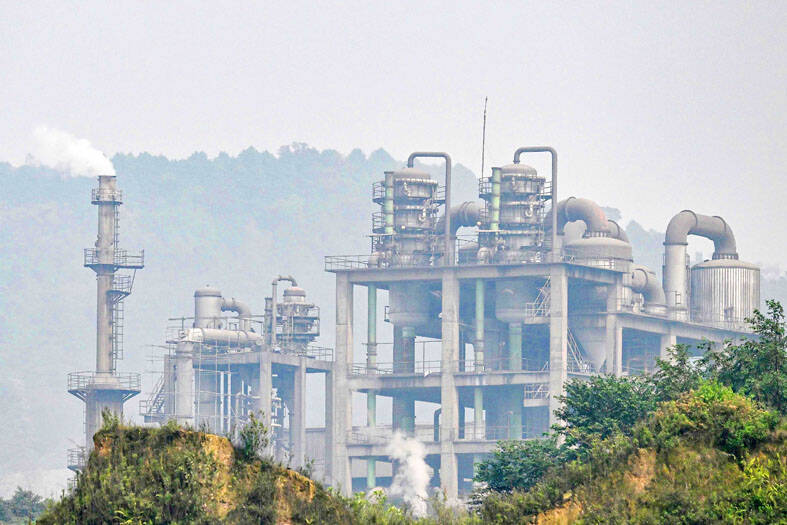
Photo: AFP
Among the largest of several firms at the industrial park is Duc Giang Chemicals Group (DGC), whose giant facilities produce yellow phosphorus and phosphoric acid.
It describes itself as one of the world’s largest exporters of yellow phosphorus — used to produce fertilizers, flame retardants and phosphoric acid — with an annual capacity of nearly 70,000 tonnes, but police this month announced the arrest of DGC chairman Dao Huu Huyen — one of the nation’s richest men — alongside his son, who was once the firm’s chief executive officer, and five other company officials.
They have been accused of “illegal dumping of millions of tonnes of waste across an area spanning tens of hectares” and illegally extracting hundreds of thousands of tonnes of phosphate ore, as well as tax offenses.
The alleged crimes took place over an extended period and sparked “public outrage,” police said.
It is an unusually high corporate fall: DGC is a member of the VN-30 stock index and had a market capitalization of about US$1 billion before the arrests came to light.
Originally a state-owned company, it was partly privatized more than 20 years ago.
“There normally is a political reason why certain big domestic companies or company executives are targeted in Vietnam’s political economy,” said Miguel Chanco, an economist focused on Asia at Pantheon Macroeconomics.
However, the DGC arrests “may eventually be framed as just another case of high-level corruption,” he added.
The one-party state has pursued a sprawling, high-profile anti-corruption campaign which has netted dozens of business leaders and senior government figures.
The sweeping drive — accelerated by top leader To Lam, who became communist party chief in 2024 — has removed many of his opponents, according to analysts, leaving Lam as Vietnam’s most dominant leader in decades.
Andrew Wells-Dang, a Southeast Asia expert at the Washington-based Stimson Center, said that authorities would have investigated the case extensively before acting.
The accusations against DGC were “probably not different from what many mining companies do, just on a larger and more blatant scale,” he said. “If anything, what the arrests show is a negative: the Duc Giang leaders apparently do not have the level of political connections to be able to avoid this outcome.”
Vietnam is a manufacturing hub — phosphoric acid is used in making semiconductors and electric vehicle batteries — and one of Asia’s fastest-growing economies. Tang Loong illustrates the trade-off in many developing nations between growth and the environment.
Government schemes drove agricultural and then industrial development in the poor, mountainous province in the 1970s, and over the years concrete roads have replaced grass-covered paths, while neighborhoods feature newly-built villas and private cars.
“My parents were among the first ones to settle down here,” one woman living nearby said. “They were poor and had to work so hard on the hills to make ends meet.”
Now young people can earn at least 10 million dong (US$380) a month at the factories — considered a reasonable wage outside Vietnam’s major cities.
“My kids all work in the industrial zone,” the woman said outside her modern two-story house. “None of my children and grandchildren have any health problems.”
Nguyen said that she had become used to the smoke and noise.
“We want a better life, less polluted of course, but we have to accept the way it is,” she said. “We have nowhere else to go.”

‘CROSSING THE LINE’: China’s embassy in Seoul criticized US Forces Korea Commander General Xavier Brunson, asking if his ‘hostile’ remarks were authorized by Washington South Korea and the US are in talks over recent public remarks by the commander of US Forces Korea, Seoul’s presidential office said yesterday, after the comments drew sharp criticism from China. In a recent podcast interview, US Forces Korea Commander General Xavier Brunson described South Korea as “the dagger in the heart of Asia” from China’s east coast, prompting the Chinese embassy in Seoul to say that he had “truly crossed the line.” The interview came amid growing speculation that Washington might seek to expand the role of US Forces Korea in countering the growing regional influence of China, a key

SEEKING ORDER: Rodrigo Paz said that ‘anyone who wants to destroy the nation will have to deal with this president and the full force of the constitution’ Bolivian President Rodrigo Paz on Wednesday said that the nation was at a “breaking point” after nearly a month of protests that have caused shortages of food, fuel and medicine. Paz, who took office six months ago amid the worst economic crisis there in four decades, is battling a groundswell of fury over his policies. The political capital, La Paz, has been besieged by low-income workers and members of the indigenous majority calling for his resignation. “The country needs order and is reaching breaking point,” the 58-year-old said at a public event in La Paz, renewing his appeal for dialogue. On Tuesday, the Bolivian

Australian researchers have trained lab-grown brain cells on a silicon computer chip to play the 1990s shooter game Doom and said they are just scratching the surface of what the neurons could be capable of doing. It is the science-fiction work of biotech boffins at Cortical Labs, who researched and developed the technology that harnesses the workings of the brain’s networking system. Each so-called “biological computer” contains about 200,000 living human brain cells, grown from stem cells that were harvested from blood donations. Having mastered the simple computer game Pong, where a paddle is moved up and down to send a ball

Through the noise of rushing papers and whirring belts at a print factory in Kyoto, two creators watch their photo essay come to life in broadsheet form — part of an effort to win new audiences in the age of artificial intelligence (AI). Despite the decline of the publishing industry, self-publication and handmade “zine” magazines are growing in popularity in Japan, reflecting the nation’s enduring love of paper in the digital era. While speaking to Agence France-Presse at the plant, his hands black with ink, one of the creators, Kazuma Obara, said: “I think [paper] is a medium that engages all five


 RSS
RSS