


US President Donald Trump on Sunday said that Moscow could send oil to Cuba despite Washington’s de facto fuel blockade, as a Russian tanker was expected to deliver some much-needed crude oil to the crisis-hit island.
While the shipment would give the nation some relief, Trump renewed his threats against the communist government, predicting that it would fail “within a short period of time.”
The Anatoly Kolodkin, which is carrying 730,000 barrels of crude, was off northeast Cuba on Sunday evening and is expected to dock in the western port of Matanzas by today, shipping tracker MarineTraffic said.
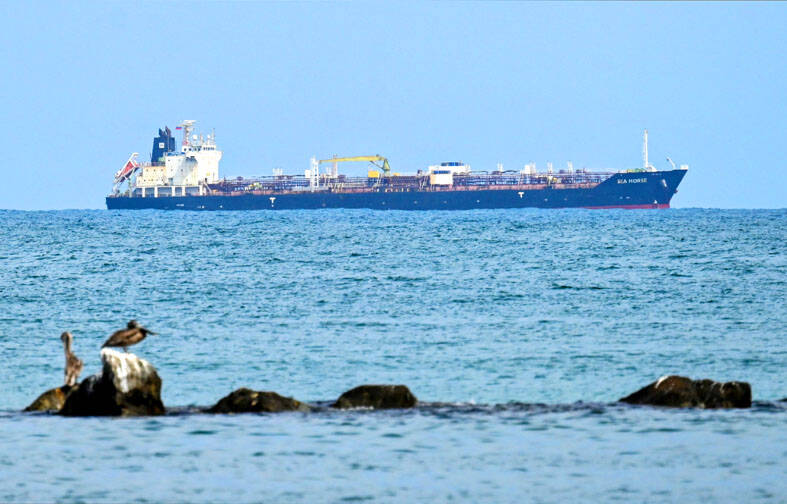
Photo: AFP
It would be the first shipment of oil to the island since January, bringing some temporary relief to the nation of 9.6 million people that has endured a deepening energy and economic crisis.
‘BAD REGIME’
“If a country wants to send some oil into Cuba right now, I have no problem with that, whether it’s Russia or not,” Trump told reporters as he flew back to Washington from his Mar-a-Lago estate in Florida.
“Cuba’s finished, they have a bad regime, they have very bad and corrupt leadership, and whether or not they get a boat of oil it’s not going to matter,” Trump said. “I’d prefer letting it in, whether it’s Russia or anybody else, because the people need heat and cooling, and all of the other things that you need.”
Cuba lost its main regional ally and oil supplier in January when US forces captured then-Venezuelan president Nicolas Maduro.
Trump subsequently threatened to impose tariffs on any country sending oil to Cuba and has mused about “taking” the island.
“Within a short period of time, it’s going to fail, and we will be there to help it out,” he said.
After Washington launched the oil blockade, Cuban President Miguel Diaz-Canel imposed emergency measures to conserve fuel, including strict rationing of gasoline.
He earlier this month said that “any external aggressor will encounter an unbreakable resistance.”
Fuel prices have soared, public transport has dwindled and some airlines have suspended flights to Cuba, hitting the nation’s fragile economy.
Cubans have endured regular outages as its aging power plants struggle to meet demand, with seven nationwide blackouts since 2024, including two this month, sparking rare protests.
A humanitarian aid convoy brought more than 50 tonnes of medicine, food, solar panels and other goods to Cuba by air and sea last week.
The Anatoly Kolodkin, which is under US sanctions, left the Russian port of Primorsk on March 8.
It was escorted by a Russian navy ship across the English Channel, but the two vessels parted ways when the tanker entered the Atlantic Ocean, the British Royal Navy said.
The New York Times, citing an unnamed US official briefed on the matter, said the US Coast Guard was allowing the tanker to reach Cuba.
Another ship that was reportedly carrying Russian diesel to Cuba, the Hong Kong-flagged Sea Horse, was rerouted to Venezuela.
Once the Anatoly Kolodkin’s crude arrives in Cuba, it would take about 15 to 20 days to process the oil and another 5 to 10 days to deliver its refined products, said Jorge Pinon, an expert on Cuba’s energy sector at the University of Texas at Austin.
“The urgent need today in Cuba is diesel,” the former oil executive said.
The Russian shipment could be converted into 250,000 barrels of diesel, enough to cover the nation’s demand for about 12-and-a-half days, Pinon said.
BIG DECISION
Pinon said the government would have to decide whether to use the fuel for backup power generators or for buses, tractors and trains needed to keep the economy going for two weeks.
“If you are Diaz-Canel or somebody making the decision, you go: ‘OK, where where do I go with that diesel?’” he said. “Do I want to generate more electricity so there are less apagones [blackouts]? Or do I want to put it in the transportation sector?”

‘GROSS NEGLIGENCE?’ Despite a spleen typically being significantly smaller than a liver, the surgeon said he believed Bryan’s spleen was ‘double the size of what is normal’ A Florida surgeon who is facing criminal charges after allegedly removing a patient’s liver instead of his spleen has said he is “forever traumatized” by that person’s death. In a deposition from November last year that was recently obtained by NBC, 44-year-old Thomas Shaknovsky described the death of 70-year-old William Bryan as an “incredibly unfortunate event that I regret deeply.” Bryan died after the botched surgery; and last month, a grand jury in Tallahassee indicted Shaknovsky on a charge of manslaughter. “I’m forever traumatized by it and hurt by it,” Shaknovsky added, also saying that wrong-site surgeries can happen “during

Kouri Richins, a Utah mother who published a children’s book about grief after the death of her husband is to serve a life sentence for his murder without the possibility of parole, a judge ruled on Wednesday. Richins was convicted in March of aggravated murder for lacing a cocktail given to her husband, Eric Richins, with five times the lethal dose of fentanyl at their home near Park City in 2022. A jury also found her guilty of four other felonies, including insurance fraud, forgery and attempted murder for trying to poison her husband weeks earlier on Feb. 14, 2022, with a

Former Chinese ministers of national defense Wei Fenghe(魏鳳和) and Li Shangfu (李尚福) were both sentenced to death with a two-year reprieve over graft charges, state news agency Xinhua reported on Thursday, underscoring the severity of the purge in the military. The armed forces have been one of the main targets of a broad corruption crackdown ordered by Chinese President Xi Jinping (習近平) after coming to power in 2012. The purges reached the elite Rocket Force, which oversees nuclear weapons as well as conventional missiles, in 2023. Earlier this year they escalated further, resulting in the removal of the top general in

‘PERSONAL MISTAKES’: Eileen Wang has agreed to plead guilty to the felony, which comes with a maximum sentence of 10 years in federal prison A southern California mayor has agreed to plead guilty to acting as an illegal agent for the Chinese government and has resigned from her city position, officials said on Monday. Eileen Wang (王愛琳), mayor of Arcadia, was charged last month with one count of acting in the US as an illegal agent of a foreign government. She was accused of doing the bidding of Chinese officials, such as sharing articles favorable to Beijing, without prior notification to the US government as required by law. The 58-year-old was elected in November 2022 to a five-person city council, from which the mayor is selected


 RSS
RSS