


Scientists in Geneva on Tuesday took some antiprotons out for a spin — a very delicate one — in a truck, in a never-tried-before test drive that has been deemed a success.
If the so-called antimatter had come into contact with actual matter, even for a fraction of an instant, it would have been annihilated in a quick flash of energy. So experts at the European Organization for Nuclear Research (CERN) had to be extra careful when they took 92 antiprotons on the road for a short ride.
The antiprotons were suspended in a vacuum inside a specially designed box and held in place by supercooled magnets.
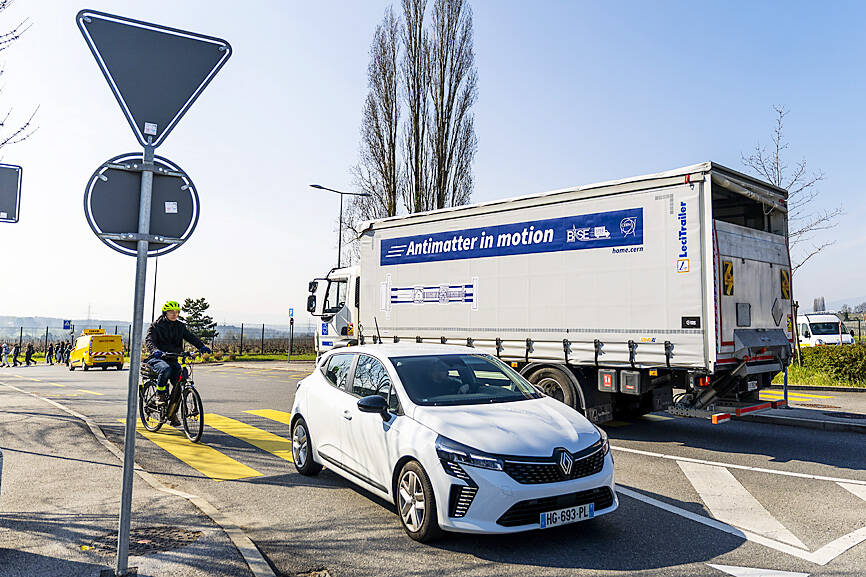
Photo: EPA
In methodical exercise over about three hours, the nearly 1,000kg cryogenic box was craned up slowly and moved through a cavernous lab the onto the truck.
The drive on CERN’s campus itself lasted only about 30 minutes to test how, if at all, the infinitesimal particles could be transported by road without seeping out.
The antiprotons were then placed back in their usual lab area, and the operation was concluded with applause, claims of success and a bottle of Champagne.
“Transporting antimatter is a pioneering and ambitious project,” CERN director for research and computing Gautier Hamel de Monchenault said. “We are at the beginning of an exciting scientific journey that will allow us to further deepen our understanding of antimatter.”
Manipulating antimatter, like antiprotons, can be tricky business. As scientists understand the universe today, for every type of particle that exists, there is a corresponding antiparticle, exactly matching the particle but with an opposite charge.
If the opposites come into contact, they “annihilate” each other, setting off lots of energy, depending on the masses involved. Any bumps in the road on the test journey that aren’t compensated for by the specially-designed box could spoil the whole exercise.
“The motivation behind these experiments is to compare matter and antimatter with extremely high accuracy and watch for differences which we might have not seen yet,” CERN physicist Stefan Ulmer said.
The exercise was a first step toward making good on hopes, one day, to deliver CERN antiprotons to researchers abroad — such as at Heinrich Heine University in Dusseldorf, Germany, which is about eight hours away in normal driving conditions.
“We are scientists. We want to understand something about the fundamental symmetries of nature, and we know that if we do these experiments outside of this accelerator facility, we can measure 100 to 1,000 times better,” Ulmer said.
The antiprotons were encased in a “transportable antiproton trap” box that is compact enough to fit through ordinary laboratory doors and fit on a truck. It used superconducting magnets cooled to minus-269°C that allowed the antiprotons to be remain suspended in a vacuum — not touching the inner walls, which are made of matter.


Through the noise of rushing papers and whirring belts at a print factory in Kyoto, two creators watch their photo essay come to life in broadsheet form — part of an effort to win new audiences in the age of artificial intelligence (AI). Despite the decline of the publishing industry, self-publication and handmade “zine” magazines are growing in popularity in Japan, reflecting the nation’s enduring love of paper in the digital era. While speaking to Agence France-Presse at the plant, his hands black with ink, one of the creators, Kazuma Obara, said: “I think [paper] is a medium that engages all five
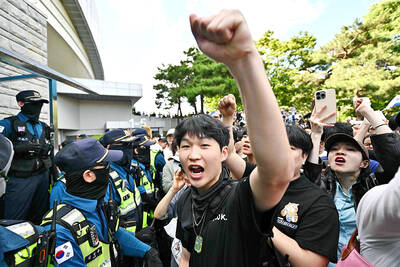
‘ABSURD MISTAKE’: The election commission said that there had been a failure to anticipate turnout after 14 polling stations ran short of ballot papers South Korean riot police yesterday cleared protesters from a Seoul polling station after a 35-hour blockade sparked by a shortage of ballot papers during local elections earlier this week. Wednesday’s election was the first nationwide vote since South Korean President Lee Jae-myung took office following the ouster of Yoon Suk-yeol over his short-lived martial law declaration. Lee’s ruling Democratic Party swept most races, but failed to flip the crucial Seoul mayoral seat. The South Korean National Election Commission apologized, blaming a failure to anticipate turnout after 14 polling stations in Seoul ran short of ballot papers. Some polling stations stayed open until 10pm to

France experienced its hottest spring on record, the French weather service said on Tuesday, after an exceptional early heat wave that also broke highs for the season in England and Wales. Meteo-France said the average nationwide temperature over March to May was 13.8°C — about 1.7°C above the norm, and surpassing records set in 2011 and 2020. “The warmest spring since records began in 1900,” it said in a bulletin. All three months were warmer than average, but the onset of an “unprecedented heatwave” late last month pushed the mercury to highs typically seen at the height of the summer. “Our country had never
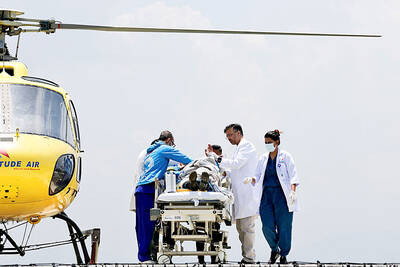
A Sherpa guide was found crawling to base camp on Mount Everest a week after he went missing and was reunited with his family, who had given up hope he would return. Dawa Sherpa was last seen on Friday last week descending the mountain, but he did not reach base camp even though his client did. The pair were among the last climbers on the mountain as the climbing season came to an end and the route was dismantled. Dawa was located by a cleaning crew on Thursday morning as he was crawling down the snowy slopes around the Khumbu Icefall, just above


 RSS
RSS