


A military transport plane with 128 people on board, mostly soldiers, crashed shortly after taking off on Monday in Puerto Leguizamo, Colombia, killing at least 66 people and leaving dozens injured, the head of Colombia’s armed forces said.
General Hugo Alejandro Lopez Barreto said that four military personnel were still missing.
“Sadly, as a consequence of this tragic accident, 66 of our military elements died,” he said.
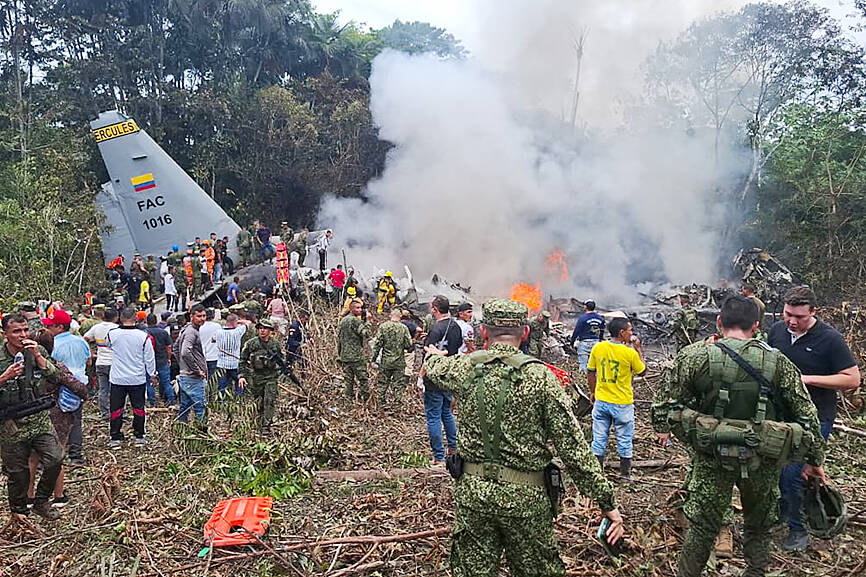
Photo: EPA
“At the moment, we have no information, or indications, that it was an attack by an illegal armed group,” Barreto added.
In a video posted on social media, Deputy Mayor Carlos Claros said that the bodies of the victims were taken to the small town’s morgue, and that the only two clinics in town treated the injured before they were flown to larger cities. Puerto Leguizamo is in Putumayo, an Amazonian province that borders Ecuador and Peru.
“I want to thank the people of Puerto Leguizamo who came out to help the victims of this accident,” Claros told Colombian television station RCN.
Colombian Minister of Defense Pedro Sanchez wrote on X that the plane that crashed on Monday was transporting troops to another city in Putumayo.
Images shared online by Colombian media outlets showed a black cloud of smoke rising from a field where the plane crashed and a truck with soldiers rushing to the site.
The airplane had 128 people on board, including 115 from the army, 11 crew members and 2 from the National Police. Baretto said 57 people were evacuated.
Media outlets shared videos of soldiers being rushed from the site on motorcycles driven by local residents, while another group of residents tried to put out the fire that the plane crash had created in a field surrounded by dense foliage.
Colombian Aerospace Force Chief of Staff Major General Carlos Fernando Silva said details of the crash were not yet known, “except that the plane had a problem and went down about 2 kilometers from the airport.”
He added that two planes, with 74 beds, were sent to the area to fly the injured back to hospitals in the capital, Bogota, and elsewhere.
Petro seized on the accident to promote what he called his longtime campaign to modernize planes and other equipment used by his country’s military, saying those efforts have been blocked by “bureaucratic difficulties” and suggesting that some officials should be held accountable.
“If civilian or military administrative officials are not up to the challenge, they must be removed,” Petro said.
Critics of the president said that military aircraft have been given less flight hours under the Petro administration due to budget cuts, leading to less experienced crews.
Erich Saumeth, a Colombian aviation expert and military analyst, said that the Hercules C-130 that crashed on Monday had been donated by the US in 2020.
Three years later, it went through a detailed revision known as an overhaul, in which its engines were inspected and key components were replaced.
“I don’t think this plane crashed because of a lack of good parts,” Saumeth said.
Investigations will have to determine why the engines of the Hercules, which has four propellers, failed so quickly after take off, he added.
In a message on X on Monday, the defense minister said that so far there were no signs indicating that the plane was attacked by rebel groups that operate near Puerto Leguizamo.
Sanchez wrote that the accident was “profoundly painful for the country,” adding: “We hope that our prayers can help to relieve some of the pain.”

‘CROSSING THE LINE’: China’s embassy in Seoul criticized US Forces Korea Commander General Xavier Brunson, asking if his ‘hostile’ remarks were authorized by Washington South Korea and the US are in talks over recent public remarks by the commander of US Forces Korea, Seoul’s presidential office said yesterday, after the comments drew sharp criticism from China. In a recent podcast interview, US Forces Korea Commander General Xavier Brunson described South Korea as “the dagger in the heart of Asia” from China’s east coast, prompting the Chinese embassy in Seoul to say that he had “truly crossed the line.” The interview came amid growing speculation that Washington might seek to expand the role of US Forces Korea in countering the growing regional influence of China, a key

SEEKING ORDER: Rodrigo Paz said that ‘anyone who wants to destroy the nation will have to deal with this president and the full force of the constitution’ Bolivian President Rodrigo Paz on Wednesday said that the nation was at a “breaking point” after nearly a month of protests that have caused shortages of food, fuel and medicine. Paz, who took office six months ago amid the worst economic crisis there in four decades, is battling a groundswell of fury over his policies. The political capital, La Paz, has been besieged by low-income workers and members of the indigenous majority calling for his resignation. “The country needs order and is reaching breaking point,” the 58-year-old said at a public event in La Paz, renewing his appeal for dialogue. On Tuesday, the Bolivian

Forecasters in Europe yesterday warned of exceptional heat as record temperatures driven by a “heat dome” push temperatures well above seasonal norms across the continent. The surge follows a record-breaking Monday, with France logging its hottest day in the month of May on record, its weather agency said, and the UK also posting unprecedented highs. A so-called “heat dome” of warm air from northern Africa trapped under a high-pressure system over western Europe is behind the high temperatures not usually seen until high summer. Restrictions on outdoor work were imposed in parts of Italy, beaches in southwest France filled earlier than usual and

Australian researchers have trained lab-grown brain cells on a silicon computer chip to play the 1990s shooter game Doom and said they are just scratching the surface of what the neurons could be capable of doing. It is the science-fiction work of biotech boffins at Cortical Labs, who researched and developed the technology that harnesses the workings of the brain’s networking system. Each so-called “biological computer” contains about 200,000 living human brain cells, grown from stem cells that were harvested from blood donations. Having mastered the simple computer game Pong, where a paddle is moved up and down to send a ball


 RSS
RSS