


Cuba’s power grid on Saturday collapsed, leaving the country without electricity for a third time in the month, as the communist government battles with a decaying infrastructure and a US-imposed oil blockade.
The Cuban Electric Union, which reports to the Cuban Ministry of Energy and Mines, announced a total blackout across the island without initially giving a cause for the outage.
The union later said the blackout was caused by an unexpected failure of a generating unit at the Nuevitas thermoelectric plant in Camaguey Province.
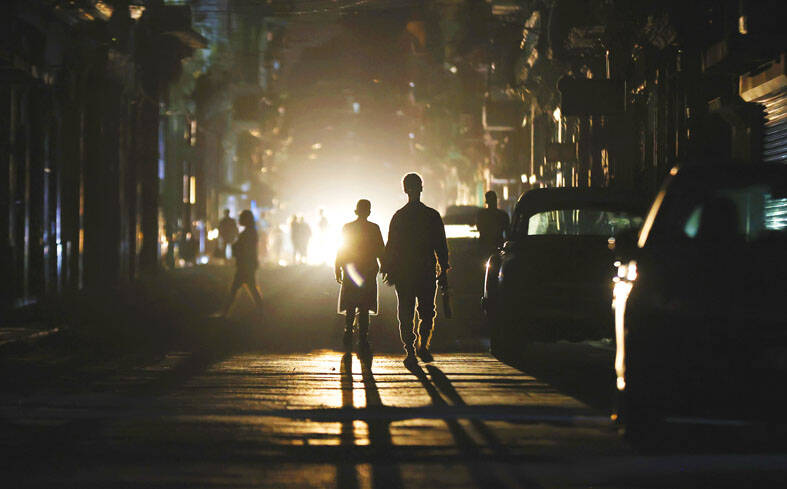
Photo: EPA
“From that moment, a cascading effect occurred in the machines that were online,” the ministry said, adding that it activated “micro-islands” of generating units to provide power to vital centers, hospitals and water systems.
Authorities said they were working to restore power.
Power outages have become relatively common in the last pwo years due to breakdowns in the aging infrastructure. The breakdowns are compounded by daily blackouts of up to 12 hours caused by fuel shortages, which also destabilize the system.
The last nationwide blackout occurred on Monday. Saturday’s outage was the second in the past week and the third in March.
The blackouts have a significant impact on the population, whose lives are disrupted by reduced work hours, lack of electricity for cooking and food spoilage when refrigerators stop working, among many other consequences. In some cases, hospitals have canceled surgeries.
Cuban President Miguel Diaz-Canel said the island has not received oil from foreign suppliers for three months. Cuba produces barely 40 percent of the fuel it needs to power its economy.
The country’s aging grid has drastically eroded in recent years, but the government has also blamed the outages on a US energy blockade after US President Donald Trump in January warned of tariffs on any country that sells or provides oil to Cuba.
The Trump administration is demanding that Cuba release political prisoners, and move toward political and economic liberalization in return for a lifting of sanctions. Trump also has raised the possibility of a “friendly takeover of Cuba.”
Another reason Cuba has been struggling with dwindling oil is the removal of Venezuela’s leader, which halted critical petroleum shipments from the nation that had been a steadfast ally to Havana.

‘CROSSING THE LINE’: China’s embassy in Seoul criticized US Forces Korea Commander General Xavier Brunson, asking if his ‘hostile’ remarks were authorized by Washington South Korea and the US are in talks over recent public remarks by the commander of US Forces Korea, Seoul’s presidential office said yesterday, after the comments drew sharp criticism from China. In a recent podcast interview, US Forces Korea Commander General Xavier Brunson described South Korea as “the dagger in the heart of Asia” from China’s east coast, prompting the Chinese embassy in Seoul to say that he had “truly crossed the line.” The interview came amid growing speculation that Washington might seek to expand the role of US Forces Korea in countering the growing regional influence of China, a key

SEEKING ORDER: Rodrigo Paz said that ‘anyone who wants to destroy the nation will have to deal with this president and the full force of the constitution’ Bolivian President Rodrigo Paz on Wednesday said that the nation was at a “breaking point” after nearly a month of protests that have caused shortages of food, fuel and medicine. Paz, who took office six months ago amid the worst economic crisis there in four decades, is battling a groundswell of fury over his policies. The political capital, La Paz, has been besieged by low-income workers and members of the indigenous majority calling for his resignation. “The country needs order and is reaching breaking point,” the 58-year-old said at a public event in La Paz, renewing his appeal for dialogue. On Tuesday, the Bolivian

Through the noise of rushing papers and whirring belts at a print factory in Kyoto, two creators watch their photo essay come to life in broadsheet form — part of an effort to win new audiences in the age of artificial intelligence (AI). Despite the decline of the publishing industry, self-publication and handmade “zine” magazines are growing in popularity in Japan, reflecting the nation’s enduring love of paper in the digital era. While speaking to Agence France-Presse at the plant, his hands black with ink, one of the creators, Kazuma Obara, said: “I think [paper] is a medium that engages all five

Australian researchers have trained lab-grown brain cells on a silicon computer chip to play the 1990s shooter game Doom and said they are just scratching the surface of what the neurons could be capable of doing. It is the science-fiction work of biotech boffins at Cortical Labs, who researched and developed the technology that harnesses the workings of the brain’s networking system. Each so-called “biological computer” contains about 200,000 living human brain cells, grown from stem cells that were harvested from blood donations. Having mastered the simple computer game Pong, where a paddle is moved up and down to send a ball


 RSS
RSS