


Outraged EU leaders rounded on Hungarian Prime Minister Viktor Orban after he refused to lift his veto on funds for Ukraine’s war effort at a Thursday summit, accusing him of a “gross act of disloyalty” tantamount to “blackmail.”
Moscow’s closest partner in the bloc, Orban has long resisted helping Kyiv to repel Russia’s invasion by stalling EU aid and repeated rounds of sanctions.
This time, Orban is holding up a 90 billion euro (US$104 billion) loan — which he previously greenlit — as leverage in a feud over damage to a pipeline through Ukraine, which has choked the flow of Russian oil to Hungary and Slovakia.
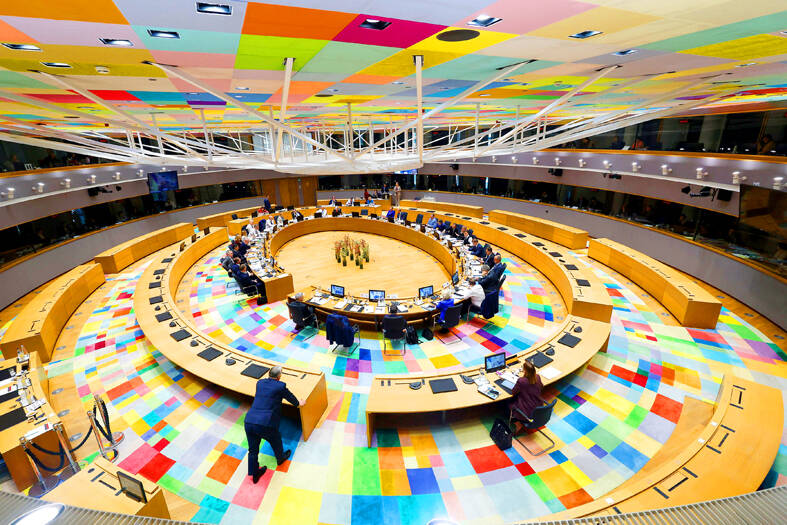
Photo: Reuters
“No oil = no money,” the Hungarian leader posted on X after the talks, refusing to budge, despite concerted pressure from fellow leaders and a video address from Ukrainian President Volodymyr Zelenskiy pleading for the funds’ release.
Leaders lined up after the summit to condemn Hungary’s U-turn, with French President Emmanuel Macron calling it “unprecedented” and German Chancellor Friedrich Merz slamming “a gross act of disloyalty.”
“I am firmly convinced that it will leave deep marks,” Merz told a press conference in the early hours yesterday.
Orban had made it clear he planned to play hardball, as he leans into anti-EU and anti-Ukrainian narratives ahead of close-fought national elections on April 12.
“I held my ground and we are exactly where we were this morning: If there is oil, there will be money,” Orban said afterward.
At odds with his EU peers on many fronts, Orban has held up countless decisions on Ukraine though solutions have ultimately been found — in one famous case by having him leave the room while the bloc approved the start of membership talks with Kyiv.
This time, though, EU leaders made clear he had crossed a line.
“Nobody can blackmail the European institutions,” European Council President Antonio Costa said, calling Hungary’s stance “completely unacceptable.”
Budapest, joined by Bratislava, refused to endorse summit conclusions reaffirming the intent to release the funds — which requires unanimity — with leaders agreeing to revisit the matter at their next planned meeting.
However, Macron told reporters after the summit there would be “no Plan B.”
“When heads of state and government reach a decision, it must be honored,” he said. “The credibility of the Council is at stake.”
At the root of the standoff is a weeks-long dispute in which landlocked Hungary and Slovakia accuse Ukraine of stalling on pipeline repairs — while Zelenskiy has branded linking the issue to support for Kyiv’s war effort “blackmail.”
The European Commission moved this week to unblock the situation by sending a team to help restore oil transit, but Orban dismissed the scheme as a “fairy tale.”
Briefing on Thursday’s closed-door talks, an EU diplomat said that “all the other leaders said Orban’s stance was unacceptable” with the exception of Italian Prime Minister Giorgia Meloni, who voiced sympathy with his situation in the election run-up.
Although Orban denies it, many of his counterparts see his blocking as squarely motivated by national politics.
“He’s using Ukraine as a weapon in his election campaign, and it’s not good. We had a deal,” Finnish Prime Minister Petteri Orpo told reporters in Brussels.
“We all know it’s linked to the elections — we are going to have to be creative,” summed up a second EU diplomat.
However, this time it remains unclear when he might blink.
Complicating matters, leaders have been wary of offering Orban — who is trailing main rival Peter Magyar in the polls — a chance to bolster his image as an EU maverick by escalating the standoff with him.
Facing a budget shortfall four years into the war, Kyiv is estimated to need an influx of funds in early May — implying a decision to unlock the EU loan by the middle next month.
The failure to break the deadlock might push the issue back until after the Hungarian vote, whatever its outcome.
Can Ukraine hold out until then? Unclear, EU diplomats said.

‘CROSSING THE LINE’: China’s embassy in Seoul criticized US Forces Korea Commander General Xavier Brunson, asking if his ‘hostile’ remarks were authorized by Washington South Korea and the US are in talks over recent public remarks by the commander of US Forces Korea, Seoul’s presidential office said yesterday, after the comments drew sharp criticism from China. In a recent podcast interview, US Forces Korea Commander General Xavier Brunson described South Korea as “the dagger in the heart of Asia” from China’s east coast, prompting the Chinese embassy in Seoul to say that he had “truly crossed the line.” The interview came amid growing speculation that Washington might seek to expand the role of US Forces Korea in countering the growing regional influence of China, a key

SEEKING ORDER: Rodrigo Paz said that ‘anyone who wants to destroy the nation will have to deal with this president and the full force of the constitution’ Bolivian President Rodrigo Paz on Wednesday said that the nation was at a “breaking point” after nearly a month of protests that have caused shortages of food, fuel and medicine. Paz, who took office six months ago amid the worst economic crisis there in four decades, is battling a groundswell of fury over his policies. The political capital, La Paz, has been besieged by low-income workers and members of the indigenous majority calling for his resignation. “The country needs order and is reaching breaking point,” the 58-year-old said at a public event in La Paz, renewing his appeal for dialogue. On Tuesday, the Bolivian

Forecasters in Europe yesterday warned of exceptional heat as record temperatures driven by a “heat dome” push temperatures well above seasonal norms across the continent. The surge follows a record-breaking Monday, with France logging its hottest day in the month of May on record, its weather agency said, and the UK also posting unprecedented highs. A so-called “heat dome” of warm air from northern Africa trapped under a high-pressure system over western Europe is behind the high temperatures not usually seen until high summer. Restrictions on outdoor work were imposed in parts of Italy, beaches in southwest France filled earlier than usual and

Australian researchers have trained lab-grown brain cells on a silicon computer chip to play the 1990s shooter game Doom and said they are just scratching the surface of what the neurons could be capable of doing. It is the science-fiction work of biotech boffins at Cortical Labs, who researched and developed the technology that harnesses the workings of the brain’s networking system. Each so-called “biological computer” contains about 200,000 living human brain cells, grown from stem cells that were harvested from blood donations. Having mastered the simple computer game Pong, where a paddle is moved up and down to send a ball


 RSS
RSS