


A Socialist candidate was leading in Paris, while the far right looked strong in several southern cities as projections arrived from first-round local elections on Sunday, seen as a political barometer ahead of France’s presidential poll.
A centrist touted as a strong contender for next year’s presidential race, Edouard Philippe, is well-placed to remain mayor in the northern city of Le Havre in a second-round local election in a week’s time.
The former prime minister, seen as one of the best candidates to take on the far-right National Rally (RN) party in next year’s presidential contest, had made his re-election in the port city a prerequisite of his campaign.
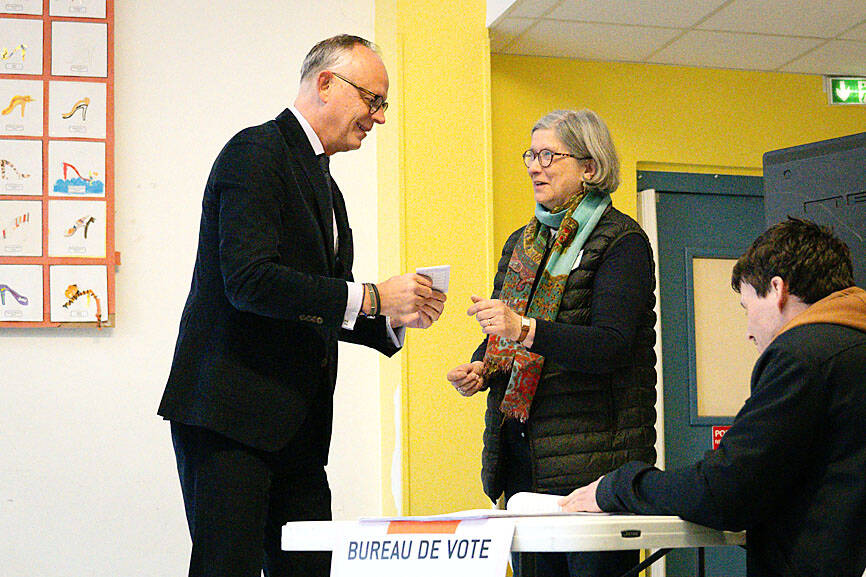
Photo: AFP
Analysts see the local races as an early indicator of key trends and patterns of tactical voting ahead of the presidential showdown.
The RN views next year’s contest as its strongest chance yet to take power, with French President Emmanuel Macron stepping down after the maximum two terms in office.
The elections in about 35,000 villages, towns and city boroughs are held over two rounds on consecutive Sundays.
In more than 90 percent of communes, the mayor was expected to be elected in the first round, but races in many bigger cities would go into second rounds, with politicians on Sunday evening already moving to make cross-party alliances against their key opponents.
In Paris, Socialist candidate Emmanuel Gregoire was in the lead ahead of former French minister of culture Rachida Dati, projections from two pollsters indicated.
Right-wing Dati is hoping to wrest control of the city from the left, which has run the French capital for the last quarter of a century.
The RN sees the local elections as an opportunity to show it can govern at the local level.
The far-right mayor of Perpignan was re-elected with 50.61 percent of the vote, official results showed.
The city of about 100,000 inhabitants is the largest city so far under control of the anti-immigration party.
In France’s second-largest city of more than 800,000, Marseille, an incumbent left-wing mayor was neck and neck with a far-right candidate.
In Nice, France’s fifth-biggest city of about 350,000, an ally of the far-right enjoyed a lead of about 10 percentage points, estimates showed.
The far-right party’s candidate was also in the lead in the southern city of Toulon — an urban center of more than 150,000 people — ahead of the incumbent mayor, projections showed.
“Change won’t wait for 2027. It starts next Sunday. It starts in seven days,” RN leader Jordan Bardella told supporters.
He also claimed “several outgoing mayors” from the party were re-elected in the first round.
Historically, France’s major cities have been governed either by center-left parties or the Republicans.
By contrast, the RN, far-left firebrand Jean Luc Melenchon’s party and Macron’s centrists have struggled to establish a strong local footprint.
In the northern town of Roubaix, a hard-left candidate had a strong lead with 45 percent of the vote. If he were to win in the second round, the town of about 98,000 people would become the largest city run by Melenchon’s party.
Pollsters said turnout on Sunday was the country’s lowest, other than the last local polls in 2020 held during the COVID-19 pandemic.
According to estimates from several polling organizations, overall turnout stood at between 56 percent and 58.5 percent, compared with 63.55 percent at the equivalent elections in 2014.
The year 2020 aside, “we have reached a record low,” Francois Kraus of the IFOP polling institute said.

‘CROSSING THE LINE’: China’s embassy in Seoul criticized US Forces Korea Commander General Xavier Brunson, asking if his ‘hostile’ remarks were authorized by Washington South Korea and the US are in talks over recent public remarks by the commander of US Forces Korea, Seoul’s presidential office said yesterday, after the comments drew sharp criticism from China. In a recent podcast interview, US Forces Korea Commander General Xavier Brunson described South Korea as “the dagger in the heart of Asia” from China’s east coast, prompting the Chinese embassy in Seoul to say that he had “truly crossed the line.” The interview came amid growing speculation that Washington might seek to expand the role of US Forces Korea in countering the growing regional influence of China, a key

SEEKING ORDER: Rodrigo Paz said that ‘anyone who wants to destroy the nation will have to deal with this president and the full force of the constitution’ Bolivian President Rodrigo Paz on Wednesday said that the nation was at a “breaking point” after nearly a month of protests that have caused shortages of food, fuel and medicine. Paz, who took office six months ago amid the worst economic crisis there in four decades, is battling a groundswell of fury over his policies. The political capital, La Paz, has been besieged by low-income workers and members of the indigenous majority calling for his resignation. “The country needs order and is reaching breaking point,” the 58-year-old said at a public event in La Paz, renewing his appeal for dialogue. On Tuesday, the Bolivian

Forecasters in Europe yesterday warned of exceptional heat as record temperatures driven by a “heat dome” push temperatures well above seasonal norms across the continent. The surge follows a record-breaking Monday, with France logging its hottest day in the month of May on record, its weather agency said, and the UK also posting unprecedented highs. A so-called “heat dome” of warm air from northern Africa trapped under a high-pressure system over western Europe is behind the high temperatures not usually seen until high summer. Restrictions on outdoor work were imposed in parts of Italy, beaches in southwest France filled earlier than usual and

Australian researchers have trained lab-grown brain cells on a silicon computer chip to play the 1990s shooter game Doom and said they are just scratching the surface of what the neurons could be capable of doing. It is the science-fiction work of biotech boffins at Cortical Labs, who researched and developed the technology that harnesses the workings of the brain’s networking system. Each so-called “biological computer” contains about 200,000 living human brain cells, grown from stem cells that were harvested from blood donations. Having mastered the simple computer game Pong, where a paddle is moved up and down to send a ball


 RSS
RSS