


From the jet fuel used in bombing raids to acrid smoke from burning oil depots, the conflict in the Middle East is inflicting a significant toll on nature and the climate.
US and Israeli aircraft use a considerable amount of fuel reaching the Gulf and flying sorties over Iran, Queen Mary University of London academic Benjamin Neimark said.
Deploying stealth bombers and fighter jets around the clock adds a significant amount of planet-warming greenhouse gas (GHG) emissions into the atmosphere.
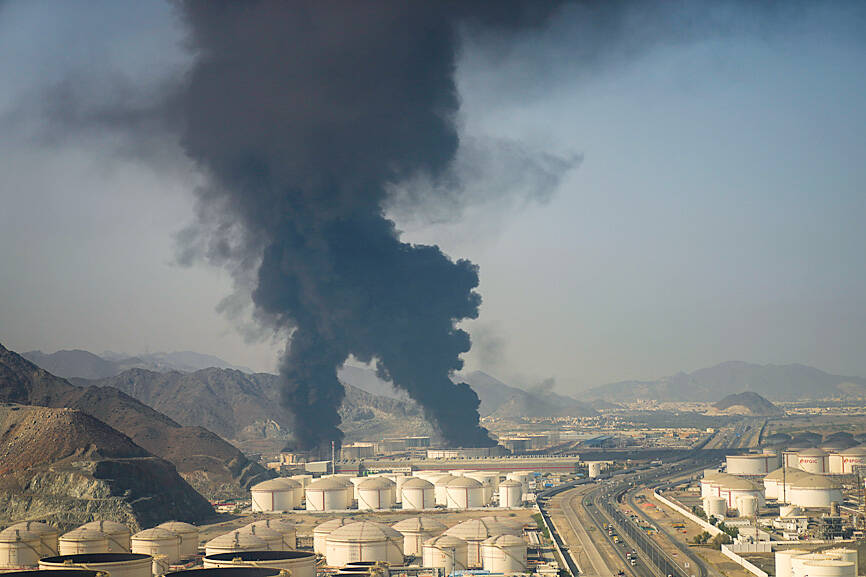
Photo: AP
“The US Navy also has a significant fleet which will be operating remotely for some time,” Neimark said. “That is a significant number of US troops that need to be fed, housed and working around the clock. These floating cities all need energy.”
This is provided in part by polluting diesel generators, even if most larger aircraft carriers are nuclear powered, an energy source that produces far less emissions than fossil fuels.
However, many experts take into account everything from the manufacture of weapons and explosives to post-war reconstruction efforts when estimating the total environmental impact of conflict.
The Gaza conflict generated about 33 million tonnes of carbon dioxide equivalent — an amount comparable to 7.6 million gasoline-powered cars, or the annual emissions of a small country such as Jordan, a study published in the peer-reviewed journal One Earth said.
By one estimate, the war in Ukraine has caused more than 300 million tonnes of additional emissions — equivalent to France’s annual output. This estimate, by the Initiative on GHG Accounting of War, takes into account military operations and reconstruction efforts, forest fires and longer flight routes.
This conflict is playing out on the Strait of Hormuz, a crucial artery for the passage of oil and gas supplies to global markets dependent on energy from the Gulf.
Ships transporting these highly flammable fuels through the narrow waterway — along with the region’s oil and gas refineries, and storage facilities — were “all a target” in this war, Neimark said.
“Clearly this conflict is different,” he said. “We have already seen a significant amount of refineries targeted. These toxic flames are deadly and have a severe climate cost.”
The oil wells set ablaze in Kuwait in the 1990s during the first Gulf War took months to extinguish and released an estimated 130 million to 400 million tonnes of carbon dioxide equivalent.
Since erupting on Feb. 28, the conflict has sent oil prices soaring and focused fresh attention on the global transition to cleaner, more climate-friendly forms of energy.
The economic knock-on effects of the war had put policy makers “under pressure to reduce the burden on prices over climate action,” Institute for Sustainable Development and International Relations’ Andreas Rudinger said.
Brussels has faced pressure to relax its emissions trading rules in response to surging energy prices, while other governments have taken steps to help motorists fill up at the pump.
However, there is also a “glass half-full perspective”, Rudinger said.
“From a purely economic standpoint ... rising fossil fuel prices make decarbonization and electrification solutions more attractive,” he said.
He pointed to the rise in popularity of heat pumps in the aftermath of Russia’s invasion of Ukraine, which caused energy prices in Europe to rise sharply.
In general, the increase in energy costs stemming from the war in the Middle East should temper demand in what economists call price elasticity.
Apart from climate concerns, strikes on energy infrastructure, oil tankers and military targets pollute the surrounding air and water, and spread highly toxic chemicals far and wide, experts say.
In Tehran, attacks on fuel depots last weekend plunged the capital into darkness as poisonous black clouds rose from burning oil facilities.
Targeting nuclear, military and energy sites had “extremely polluting” consequences for air, water and soil, Institute for International and Strategic Relations research fellow Mathilde Jourde said.
“We’re just scratching the surface, but can already see that there are hundreds of damaged facilities in Iran and neighboring countries that pose pollution risks to people and the environment,” Conflict and Environment Observatory director Doug Weir said. “We have particular concerns around damaged oil infrastructure, military facilities and the sensitive marine environment of the Persian Gulf.”

‘CROSSING THE LINE’: China’s embassy in Seoul criticized US Forces Korea Commander General Xavier Brunson, asking if his ‘hostile’ remarks were authorized by Washington South Korea and the US are in talks over recent public remarks by the commander of US Forces Korea, Seoul’s presidential office said yesterday, after the comments drew sharp criticism from China. In a recent podcast interview, US Forces Korea Commander General Xavier Brunson described South Korea as “the dagger in the heart of Asia” from China’s east coast, prompting the Chinese embassy in Seoul to say that he had “truly crossed the line.” The interview came amid growing speculation that Washington might seek to expand the role of US Forces Korea in countering the growing regional influence of China, a key

SEEKING ORDER: Rodrigo Paz said that ‘anyone who wants to destroy the nation will have to deal with this president and the full force of the constitution’ Bolivian President Rodrigo Paz on Wednesday said that the nation was at a “breaking point” after nearly a month of protests that have caused shortages of food, fuel and medicine. Paz, who took office six months ago amid the worst economic crisis there in four decades, is battling a groundswell of fury over his policies. The political capital, La Paz, has been besieged by low-income workers and members of the indigenous majority calling for his resignation. “The country needs order and is reaching breaking point,” the 58-year-old said at a public event in La Paz, renewing his appeal for dialogue. On Tuesday, the Bolivian

Forecasters in Europe yesterday warned of exceptional heat as record temperatures driven by a “heat dome” push temperatures well above seasonal norms across the continent. The surge follows a record-breaking Monday, with France logging its hottest day in the month of May on record, its weather agency said, and the UK also posting unprecedented highs. A so-called “heat dome” of warm air from northern Africa trapped under a high-pressure system over western Europe is behind the high temperatures not usually seen until high summer. Restrictions on outdoor work were imposed in parts of Italy, beaches in southwest France filled earlier than usual and

Australian researchers have trained lab-grown brain cells on a silicon computer chip to play the 1990s shooter game Doom and said they are just scratching the surface of what the neurons could be capable of doing. It is the science-fiction work of biotech boffins at Cortical Labs, who researched and developed the technology that harnesses the workings of the brain’s networking system. Each so-called “biological computer” contains about 200,000 living human brain cells, grown from stem cells that were harvested from blood donations. Having mastered the simple computer game Pong, where a paddle is moved up and down to send a ball


 RSS
RSS