


A 41-year-old man was killed on Thursday after ramming his pickup truck into a synagogue on the outskirts of Detroit, Michigan, causing a blaze and triggering a huge police response.
US media reported the assailant had lost family members in an Israeli strike on Lebanon, as part of the ongoing Middle East war.
A spokesperson for the US Department of Homeland Security identified the assailant as Ayman Mohamad Ghazali, who was born in Lebanon and came to Detroit in 2011 on a visa granted to spouses of US citizens, and became a US citizen himself in 2016.
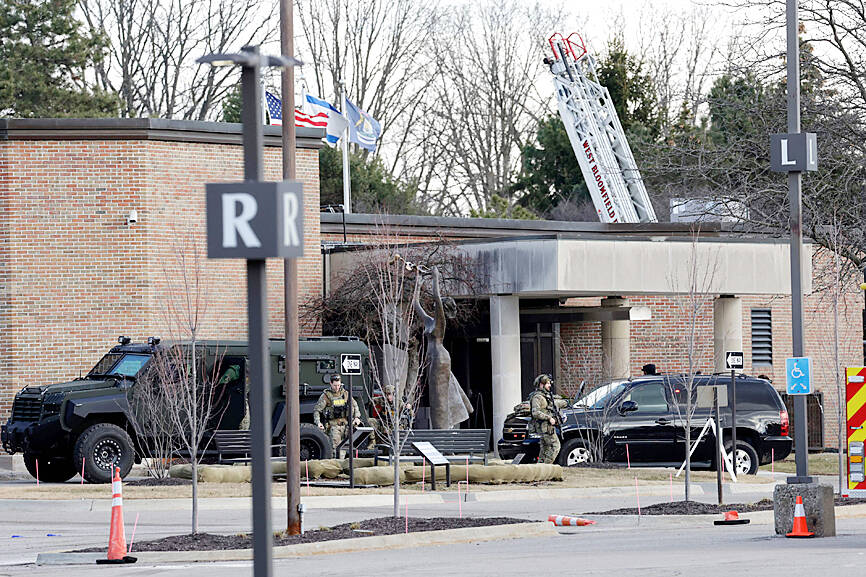
Photo: AFP
Security guards opened fire on Ghazali after he smashed a truck through the doors of the Temple Israel synagogue in West Bloomfield, Oakland County Sheriff Michael Bouchard told reporters.
At a news conference on Thursday evening, Bouchard said no synagogue staff or children were hurt in the attack, but 30 law enforcement officers were “taken to the hospital for smoke inhalation” after the evacuation efforts.
Earlier he said that one security guard was injured by the assailant’s truck.
The FBI are to investigate the incident “as a targeted act of violence against the Jewish community,” Jennifer Runyan, special agent in charge of the FBI’s Detroit field office, told reporters.
Law enforcement have not yet publicly detailed a motive.
US President Donald Trump called the attack “terrible.”
A neighbor told the Detroit Free Press newspaper that Ghazali “recently lost family in an Israeli strike in Lebanon.”
A source in Michigan’s Lebanese American community also told CBS News the strike occurred “roughly 10 days prior” and “killed several of his family members, leaving him devastated.”
The attack comes amid heightened security across the US following the launch two weeks ago of the US-Israeli war on Iran, a conflict that has since broadened to the Middle East.
In Lebanon on Thursday, authorities said that 687 people have been killed by Israel’s attacks, while Israeli Minister of Defense Israel Katz said that those strikes were “expanding.”
The synagogue attack also came on the same day as a shooting at Old Dominion University in Norfolk, Virginia, which FBI Director Kash Patel said was being investigated as “an act of terrorism.”
Patel, in a social media post, said that the university attack left one person dead and two others wounded.
“The shooter is now deceased thanks to a group of brave students who stepped in and subdued him,” he said.
That suspect was later identified as Mohamed Bailor Jalloh, a former member of the National Guard who pleaded guilty in 2016 to attempting to provide material support to the Islamic State.
Bouchard said the Michigan assailant rammed the Temple Israel building with his vehicle and then drove down a hallway, where he was engaged by security guards.
“We can’t say what killed him at this point, but security did engage the suspect with gunfire,” he said.
He added that the assailant appeared to be alone in the vehicle and that police dogs were checking the truck for explosives.
“It’s been complicated because there’s some fire,” he said. “We’re through an abundance of caution, clearing the vehicle for IEDs [improvised explosive devices] or any explosives.”
Smoke could be seen billowing from Temple Israel, one of the largest Reform Judaism congregations in the nation, after the attack.
Michigan Governor Gretchen Whitmer condemned what she called a “heartbreaking” attack.
“Michigan’s Jewish community should be able to live and practice their faith in peace,” she said. “Anti-Semitism and violence have no place in Michigan.”

‘CROSSING THE LINE’: China’s embassy in Seoul criticized US Forces Korea Commander General Xavier Brunson, asking if his ‘hostile’ remarks were authorized by Washington South Korea and the US are in talks over recent public remarks by the commander of US Forces Korea, Seoul’s presidential office said yesterday, after the comments drew sharp criticism from China. In a recent podcast interview, US Forces Korea Commander General Xavier Brunson described South Korea as “the dagger in the heart of Asia” from China’s east coast, prompting the Chinese embassy in Seoul to say that he had “truly crossed the line.” The interview came amid growing speculation that Washington might seek to expand the role of US Forces Korea in countering the growing regional influence of China, a key

SEEKING ORDER: Rodrigo Paz said that ‘anyone who wants to destroy the nation will have to deal with this president and the full force of the constitution’ Bolivian President Rodrigo Paz on Wednesday said that the nation was at a “breaking point” after nearly a month of protests that have caused shortages of food, fuel and medicine. Paz, who took office six months ago amid the worst economic crisis there in four decades, is battling a groundswell of fury over his policies. The political capital, La Paz, has been besieged by low-income workers and members of the indigenous majority calling for his resignation. “The country needs order and is reaching breaking point,” the 58-year-old said at a public event in La Paz, renewing his appeal for dialogue. On Tuesday, the Bolivian

Forecasters in Europe yesterday warned of exceptional heat as record temperatures driven by a “heat dome” push temperatures well above seasonal norms across the continent. The surge follows a record-breaking Monday, with France logging its hottest day in the month of May on record, its weather agency said, and the UK also posting unprecedented highs. A so-called “heat dome” of warm air from northern Africa trapped under a high-pressure system over western Europe is behind the high temperatures not usually seen until high summer. Restrictions on outdoor work were imposed in parts of Italy, beaches in southwest France filled earlier than usual and

Australian researchers have trained lab-grown brain cells on a silicon computer chip to play the 1990s shooter game Doom and said they are just scratching the surface of what the neurons could be capable of doing. It is the science-fiction work of biotech boffins at Cortical Labs, who researched and developed the technology that harnesses the workings of the brain’s networking system. Each so-called “biological computer” contains about 200,000 living human brain cells, grown from stem cells that were harvested from blood donations. Having mastered the simple computer game Pong, where a paddle is moved up and down to send a ball


 RSS
RSS