


Canadian Prime Minister Mark Carney on Thursday unveiled a C$35 billion (US$25.6 billion) plan to boost Canada’s defenses in the arctic as it tries to decrease its reliance on the US.
Canada has traditionally relied on US help to monitor the Canadian arctic, which covers 4.4 million square kilometers of land and sea — larger than India — and is almost completely uninhabited.
US President Donald Trump’s tariffs and musings about annexing Canada have put ties under strain.
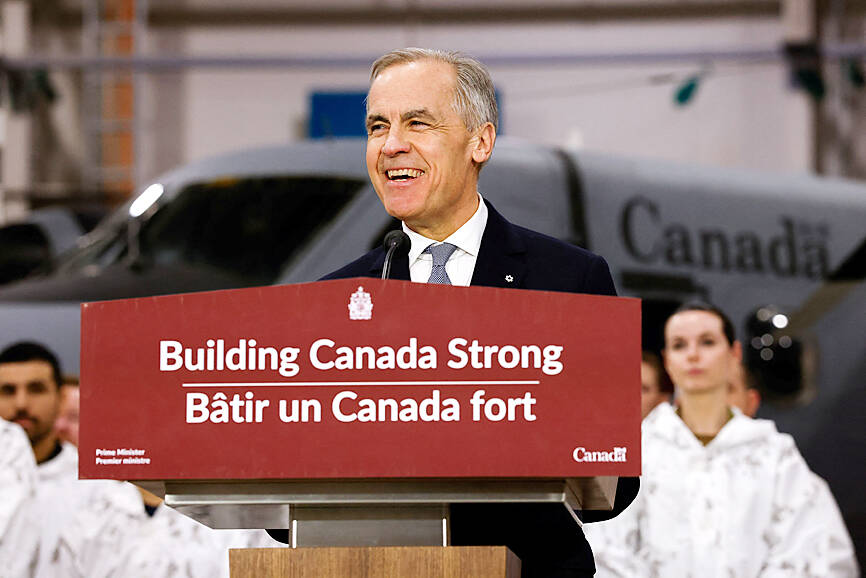
Photo: Reuters
“We will no longer depend on any one nation, and instead build a stronger, more independent country. With this new plan, Canada is taking full responsibility for defending our arctic sovereignty,” Carney said.
Even before Trump re-entered the White House last year, Canada had long been under pressure from the US to increase defense spending and vowed in June last year to boost funding for the armed forces.
The nation is promising to hit NATO’s 2 percent military spending target five years earlier than planned.
Carney in January said that the US and other major nations were eroding the traditional rules-based order that had long benefited Canada.
“The assumptions that shaped decades of Canadian defense and security are being upended,” he said on Thursday.
“Climate change is causing our arctic region to warm nearly three times faster than the global average, a shift that great powers are actively looking to exploit,” Carney said in a speech in Yellowknife, capital of the Northwest Territories and home to Canada’s arctic military command.
The plan laid out specifics of how previously announced funding for the arctic would be spent. Ottawa in 2022 announced a C$38.6 billion plan to modernize its defenses and the joint North American Aerospace Defense Command that Canada operates with the US.
Canada has four rudimentary arctic airfields that can accommodate six fighters each, and about 2,000 troops dotted around the region.
Carney’s plan calls for investing C$32 billion to expand the military airfields in the region and to build four operational support hubs.
The plan would also upgrade two commercial airports and fast-track two proposed roads from the arctic to Canada’s southern regions.
Trump has expressed keen interest in the arctic and its mineral potential. In addition to commenting about annexing Canada, he has insisted that the US needs Greenland to fend off threats from Russian and Chinese interests in the region.
Canada’s region comprises approximately 25 percent of the arctic and although the region is rich in rare minerals, it has very little infrastructure, which, combined with the extreme cold, makes mining operations extremely complex and costly to undertake.
Later on Thursday, Carney flew to northern Norway to observe biennial NATO drills.

‘CROSSING THE LINE’: China’s embassy in Seoul criticized US Forces Korea Commander General Xavier Brunson, asking if his ‘hostile’ remarks were authorized by Washington South Korea and the US are in talks over recent public remarks by the commander of US Forces Korea, Seoul’s presidential office said yesterday, after the comments drew sharp criticism from China. In a recent podcast interview, US Forces Korea Commander General Xavier Brunson described South Korea as “the dagger in the heart of Asia” from China’s east coast, prompting the Chinese embassy in Seoul to say that he had “truly crossed the line.” The interview came amid growing speculation that Washington might seek to expand the role of US Forces Korea in countering the growing regional influence of China, a key

SEEKING ORDER: Rodrigo Paz said that ‘anyone who wants to destroy the nation will have to deal with this president and the full force of the constitution’ Bolivian President Rodrigo Paz on Wednesday said that the nation was at a “breaking point” after nearly a month of protests that have caused shortages of food, fuel and medicine. Paz, who took office six months ago amid the worst economic crisis there in four decades, is battling a groundswell of fury over his policies. The political capital, La Paz, has been besieged by low-income workers and members of the indigenous majority calling for his resignation. “The country needs order and is reaching breaking point,” the 58-year-old said at a public event in La Paz, renewing his appeal for dialogue. On Tuesday, the Bolivian

Forecasters in Europe yesterday warned of exceptional heat as record temperatures driven by a “heat dome” push temperatures well above seasonal norms across the continent. The surge follows a record-breaking Monday, with France logging its hottest day in the month of May on record, its weather agency said, and the UK also posting unprecedented highs. A so-called “heat dome” of warm air from northern Africa trapped under a high-pressure system over western Europe is behind the high temperatures not usually seen until high summer. Restrictions on outdoor work were imposed in parts of Italy, beaches in southwest France filled earlier than usual and

Australian researchers have trained lab-grown brain cells on a silicon computer chip to play the 1990s shooter game Doom and said they are just scratching the surface of what the neurons could be capable of doing. It is the science-fiction work of biotech boffins at Cortical Labs, who researched and developed the technology that harnesses the workings of the brain’s networking system. Each so-called “biological computer” contains about 200,000 living human brain cells, grown from stem cells that were harvested from blood donations. Having mastered the simple computer game Pong, where a paddle is moved up and down to send a ball


 RSS
RSS