


US Secretary of State Marco Rubio is expected to visit China with US President Donald Trump later this month after appearing to show little interest in previous invitations from Beijing, the South China Morning Post reported today.
Rubio, the first sitting US secretary of state to be sanctioned by China, had been invited to visit but had not been “receptive” until recently, the Hong Kong-based newspaper said, citing anonymous sources.
Rubio’s attendance could smooth over some of the issues surrounding Trump’s visit to China, the report said, adding that frustration has been mounting in Beijing because of the lack of preparation for the trip.

Photo: AP
China imposed sanctions on Rubio in 2020 when he was still a senator — once in retaliation for US sanctions on Chinese officials over their treatment of Uighurs, and the second time in response to another round targeting Chinese and Hong Kong officials in the wake of the 2019 protests, the report said.
China has yet to clarify whether the sanctions would be waived, it said.
When asked about the matter in January last year, the Chinese Ministry of Foreign Affairs said it is necessary to maintain high-level communication between Chinese and US officials.
Sources believed that Rubio’s hesitation stemmed from his long-term stance toward China, as he might not want to be seen as softening his attitude, the report said.
However, he would not want to be absent from a globally significant summit, it said, citing sources.
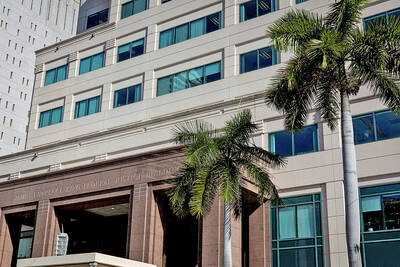
‘GROSS NEGLIGENCE?’ Despite a spleen typically being significantly smaller than a liver, the surgeon said he believed Bryan’s spleen was ‘double the size of what is normal’ A Florida surgeon who is facing criminal charges after allegedly removing a patient’s liver instead of his spleen has said he is “forever traumatized” by that person’s death. In a deposition from November last year that was recently obtained by NBC, 44-year-old Thomas Shaknovsky described the death of 70-year-old William Bryan as an “incredibly unfortunate event that I regret deeply.” Bryan died after the botched surgery; and last month, a grand jury in Tallahassee indicted Shaknovsky on a charge of manslaughter. “I’m forever traumatized by it and hurt by it,” Shaknovsky added, also saying that wrong-site surgeries can happen “during

Former Chinese ministers of national defense Wei Fenghe(魏鳳和) and Li Shangfu (李尚福) were both sentenced to death with a two-year reprieve over graft charges, state news agency Xinhua reported on Thursday, underscoring the severity of the purge in the military. The armed forces have been one of the main targets of a broad corruption crackdown ordered by Chinese President Xi Jinping (習近平) after coming to power in 2012. The purges reached the elite Rocket Force, which oversees nuclear weapons as well as conventional missiles, in 2023. Earlier this year they escalated further, resulting in the removal of the top general in

‘PERSONAL MISTAKES’: Eileen Wang has agreed to plead guilty to the felony, which comes with a maximum sentence of 10 years in federal prison A southern California mayor has agreed to plead guilty to acting as an illegal agent for the Chinese government and has resigned from her city position, officials said on Monday. Eileen Wang (王愛琳), mayor of Arcadia, was charged last month with one count of acting in the US as an illegal agent of a foreign government. She was accused of doing the bidding of Chinese officials, such as sharing articles favorable to Beijing, without prior notification to the US government as required by law. The 58-year-old was elected in November 2022 to a five-person city council, from which the mayor is selected

The Philippine Coast Guard yesterday said it deployed aircraft to issue radio warnings to a Chinese research ship in a disputed area of the South China Sea “swarming” with vessels from Beijing’s so-called maritime militia. The research vessel Xiang Yang Hong 33 (向陽紅33), which is capable of supporting submersible craft, was operating near a reef in the contested Spratly Islands (Nansha Islands, 南沙群島), which Taiwan also claims, the Philippine Coast Guard said. The Chinese ship was deploying a service boat toward the Spratly’s Iroquois Reef on Wednesday when it was spotted by a coast guard plane, “confirming ongoing unauthorized [marine scientific research]


 RSS
RSS