


North Korea’s launch last week of a missile from a naval destroyer elicited an uncharacteristically prosaic analysis from the country’s leader, Kim Jong-un.
The launch was proof that arming ships with nuclear weapons was “making satisfactory progress,” he said.
However, the test, and Kim’s mildly upbeat appraisal, were designed to reverberate well beyond the deck of the 5,000-tonne destroyer-class vessel the Choe Hyon — the biggest warship in the North Korean fleet.

Photo: AP
His pointed reference to nuclear weapons was made as the US and Israel continued their air bombardment of Iran — a regime US President Donald Trump had warned, without offering evidence, was only weeks away from having a nuclear weapon.
The widening war in the Middle East — and the existential threat to the Iranian regime — has likely reinforced North Korea’s decision to build a nuclear arsenal. For Kim and the dynasty that has ruled North Korea since it was founded by his grandfather in 1948, the nuclear program is about nothing less than regime survival.
“Kim must have thought Iran was attacked like that because it didn’t have nuclear weapons,” Song Seong-jong, a professor at Daejeon University and a former official at the South Korean Ministry of National Defense, said after the Middle East conflict erupted.
North Korea is several years into a nuclear weapons program that has gathered momentum despite UN sanctions and Trump’s attempts to use diplomacy to rid the Korean Peninsula of nuclear weapons.
The North conducted its first nuclear test in 2006 and its most recent in 2017, although doubts persist over the size of Pyongyang’s arsenal and its ability to marry a miniaturized nuclear warhead with a long-range missile theoretically capable of striking the US mainland.
A report last year by Stockholm International Peace Research Institute said the North has assembled about 50 warheads and possesses enough fissile material to produce up to 40 more.
What is certain is Kim’s decision to make nuclear deterrence a priority — and forging a loose alliance with Russia and China — has guaranteed that he would avoid the fate of the former leaders of Iraq and Libya, and now Venezuela and Iran.
The North Korean Ministry of Foreign Affairs’ response to the war in Iran has been nuanced. It condemned the US and Israeli airstrikes last weekend as an “illegal act of aggression” that exposed Washington’s “hegemonic and rogue” instincts, but stopped short of condemning Trump by name.
That leaves the door open to a potential resumption of nuclear talks, contingent on Washington dropping its demand that Pyongyang abandon its nuclear weapons and accepting it as a legitimate nuclear state.
“If the United States withdraws its policy of confrontation with North Korea by respecting our country’s current status … there is no reason why we cannot get along well with the US,” the Korean Central News Agency quoted Kim as saying at a ruling party congress last month.
What is less clear in the minds of analysts is whether the Iran war opens up a new opportunity for talks or pushes the North Korean regime to be more inward looking.
Sydney Seiler, a senior adviser at the Center for Strategic and International Studies, believes the conflict has made a nuclear deal between Washington and Pyongyang less likely.
“President Trump’s willingness to use military force and threats for negotiating leverage must make Kim nervous and less likely to hastily seek talks,” said Seiler, a former US special envoy who worked on the six-party talks on the North’s nuclear program.
However, other analysts said Kim’s desire to secure the regime’s long-term survival — and his rumored personal rapport with the US president — could draw him back to the negotiating table.
“Unlike Iran, it’s impossible to denuclearize North Korea,” said Cho Han-bum, of the state-run Korea Institute for National Unification, citing the presence of nuclear sites across the isolated country.
Going into those talks as head of a state with a nuclear deterrence could give Kim the latitude to win concessions from Trump, including security guarantees.
Trump has repeatedly said he would be open to meeting Kim, prompting speculation the two could hold talks when Trump visits China at the end of the month.
If those talks materialize, Kim knows he would be negotiating from a position of strength. As the Iranian leadership is finding to its cost, nuclear possession — not ambition — appears to be the path to security.
Additional reporting by Agencies

Through the noise of rushing papers and whirring belts at a print factory in Kyoto, two creators watch their photo essay come to life in broadsheet form — part of an effort to win new audiences in the age of artificial intelligence (AI). Despite the decline of the publishing industry, self-publication and handmade “zine” magazines are growing in popularity in Japan, reflecting the nation’s enduring love of paper in the digital era. While speaking to Agence France-Presse at the plant, his hands black with ink, one of the creators, Kazuma Obara, said: “I think [paper] is a medium that engages all five
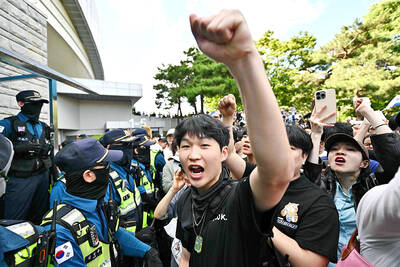
‘ABSURD MISTAKE’: The election commission said that there had been a failure to anticipate turnout after 14 polling stations ran short of ballot papers South Korean riot police yesterday cleared protesters from a Seoul polling station after a 35-hour blockade sparked by a shortage of ballot papers during local elections earlier this week. Wednesday’s election was the first nationwide vote since South Korean President Lee Jae-myung took office following the ouster of Yoon Suk-yeol over his short-lived martial law declaration. Lee’s ruling Democratic Party swept most races, but failed to flip the crucial Seoul mayoral seat. The South Korean National Election Commission apologized, blaming a failure to anticipate turnout after 14 polling stations in Seoul ran short of ballot papers. Some polling stations stayed open until 10pm to

Australian researchers have trained lab-grown brain cells on a silicon computer chip to play the 1990s shooter game Doom and said they are just scratching the surface of what the neurons could be capable of doing. It is the science-fiction work of biotech boffins at Cortical Labs, who researched and developed the technology that harnesses the workings of the brain’s networking system. Each so-called “biological computer” contains about 200,000 living human brain cells, grown from stem cells that were harvested from blood donations. Having mastered the simple computer game Pong, where a paddle is moved up and down to send a ball

France experienced its hottest spring on record, the French weather service said on Tuesday, after an exceptional early heat wave that also broke highs for the season in England and Wales. Meteo-France said the average nationwide temperature over March to May was 13.8°C — about 1.7°C above the norm, and surpassing records set in 2011 and 2020. “The warmest spring since records began in 1900,” it said in a bulletin. All three months were warmer than average, but the onset of an “unprecedented heatwave” late last month pushed the mercury to highs typically seen at the height of the summer. “Our country had never


 RSS
RSS