


Heat waves that lead to sudden and damaging drought are spreading across the globe at an accelerating rate, highlighting how climate change-fueled extremes could build dangerously off each other, a new study found.
Researchers from South Korea and Australia looked at compound extreme weather — a one-two punch of heat and drought — and found it increasing as the world warms. However, what is rising especially fast is the more damaging type where the heat comes first and then triggers the drought.
In the 1980s, that kind of extreme covered only about 2.5 percent of Earth’s land each year. By 2023, the last year the researchers studied, it was up to 16.7 percent, with a 10-year average of 7.9 percent.
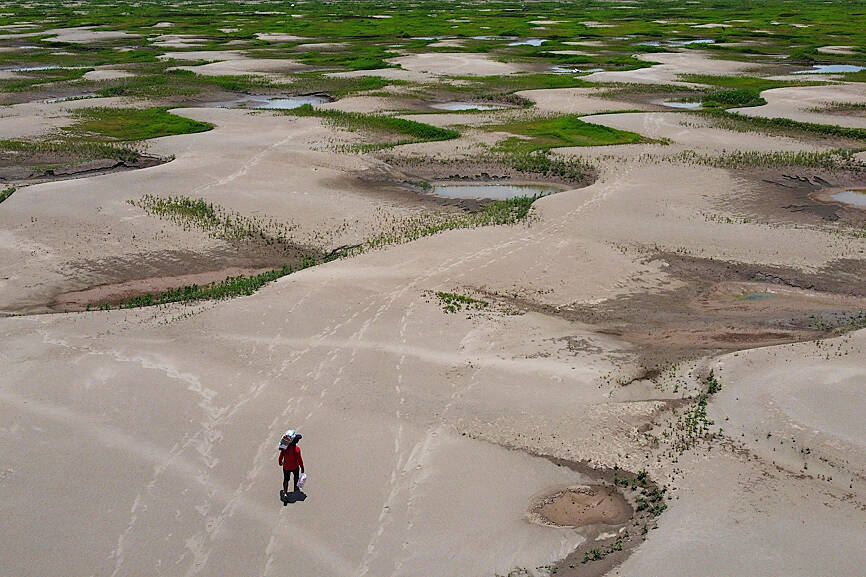
Photo: AP
The average has likely gone even higher with 2024’s record global heat and last year was nearly as warm, the study’s authors said.
In their study published in Science Advances, the scientists said the quickening rate of change is even more concerning than the raw numbers.
For about the first two decades since 1980 they examined, the spread of heat-first extremes increased, but the rate in the past 22 years is eight times higher than the earlier rate, the study found.
Events where drought happens first, followed by high heat, remain more common and are also rising, but the researchers focused on those increasing cases where heat struck first. That is because when heat strikes first, the droughts are stronger than when the droughts come first or do not come with high heat, coauthor and Hanyang University climate scientist Yeh Sang-wook said.
They also lead to “flash droughts,” which are more damaging than ordinary droughts, because they come on suddenly, not allowing people and farmers to prepare, lead author and Hanyang climate scientist Kim Yong-jun said.
Flash droughts — when warmer air gets thirstier it sucks more water out of soil — have been increasing in a warming world, past studies showed.
“The study illustrates a key point about climate change: The most damaging impacts often come from compound extremes. When heat waves, drought and wildfire risk occur together — as we saw in events like the Russian heat wave of 2010 or the Australian bushfires in 2019-20 — the impacts can escalate quickly,” University of Victoria climate scientist Andrew Weaver said. “What this study shows is that warming doesn’t just make heat waves more likely — it changes how heat and drought interact, amplifying the risks we face.”
Weaver was not part of the study, but he lives in the Pacific Northwest, where the 2021 heat dome and drought was what Kim called a top example of what they see rapidly increasing.
Others include the 2022 heat and drought around China’s Yangtze River, and the record heat and drought in the Amazon from 2023 to 2024, Kim said.
“The 2021 Pacific Northwest heat dome illustrates how quickly these compound extremes can escalate — temperatures near 50°C in Lytton [British Columbia] were followed by rapid drying and extreme wildfire conditions that destroyed the community,” Weaver said.
The study found the biggest increases in heat-first droughts in South America, western Canada, Alaska, the western US, and parts of central and eastern Africa.
Kim and Yeh said they noticed a “change point” around the year 2000, when everything sped up for heat-then-drought situations.
Woodwell Climate Research Center climate scientist Jennifer Francis, who was not part of the study, said the change point was “eerily coincident with the onset of rapid Arctic warming, sea-ice loss and decline in spring snow cover on Northern Hemisphere continents.”
In addition to long-term warming causing more compound extremes, Kim said they saw a speeding up in the way heat went from land to air and back again just before that 2000 change point.
He and Yeh speculated that Earth might have crossed a “tipping point” where the change is irreversible.
National Center for Atmospheric Research climate scientist Gerald Meehl, who was not part of the study, said several aspects of Earth’s climate and ecological systems changed in the late 1990s, with a possible trigger by a major El Nino event in 1997 to 1998.
It is hard to tell whether they are permanent changes, he added.
Some computer models forecast another major El Nino — a natural warming of parts of the Pacific that warp weather worldwide — brewing later this year.

A humanoid robot that won a half-marathon race for robots in Beijing on Sunday ran faster than the human world record in a show of China’s technological leaps. The winner from Honor, a Chinese smartphone maker, completed the 21km race in 50 minutes and 26 seconds, said a WeChat post by the Beijing Economic-Technological Development Area, also known as Beijing E-Town, where the race began. That was faster than the human world record holder, Ugandan Jacob Kiplimo, who finished the same distance in about 57 minutes in March at the Lisbon road race. The performance by the robot marked a significant step forward
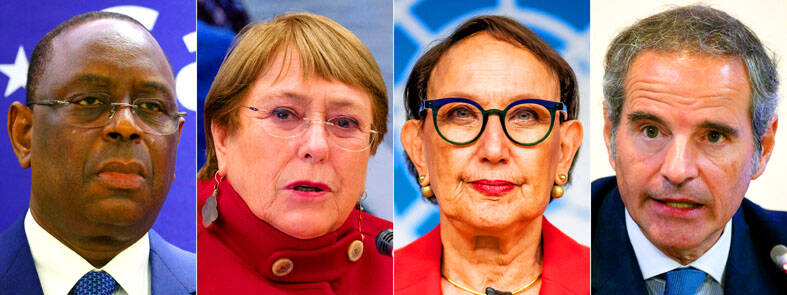
Four contenders are squaring up to succeed Antonio Guterres as secretary-general of the UN, which faces unprecedented global instability, wars and its own crushing budget crisis. Chile’s Michelle Bachelet, Argentina’s Rafael Grossi, Costa Rica’s Rebeca Grynspan and Senegal’s Macky Sall are each to face grillings by 193 member states and non-governmental organizations for three hours today and tomorrow. It is only the second time the UN has held a public question-and-answer, a format created in 2016 to boost transparency. Ultimately the five permanent members of the UN’s top body, the Security Council, hold the power, wielding vetoes over who leads the

South Korea’s air force yesterday apologized for a 2021 midair collision involving two fighter jets, a day after auditors said the pilots were taking selfies and filming during the flight and held them responsible for the accident. “We sincerely apologize to the public for the concern caused by the accident that occurred in 2021,” an air force spokesman told a news conference, adding that one of the pilots involved had been suspended from flying duties, received severe disciplinary action and has since left the military. The apology followed a report released on Wednesday by the South Korean Board of Audit and Inspection,

An earthquake registering a preliminary magnitude of 7.7 off northern Japan on Monday prompted a short-lived tsunami alert and the advisory of a higher risk of a possible mega-quake for coastal areas there. The Cabinet Office and the Japan Meteorological Agency said there was a 1% chance for a mega-quake, compared to a 0.1% chance during normal times, in the next week or so following the powerful quake near the Chishima and Japan trenches. Officials said the advisory was not a quake prediction but urged residents in 182 towns along the northeastern coasts to raise their preparedness while continuing their daily lives. Prime


 RSS
RSS