


US President Donald Trump was yesterday to meet with a dozen right-wing leaders from Latin America and the Caribbean to discuss issues facing the region, from organized crime to illegal immigration. The “Shield of the Americas” summit also aims to serve Washington by boosting US interests in the region and curbing those from foreign powers such as China.
Trump has already staked bold claims in Latin America with the ouster of former Venezuelan president Nicolas Maduro and working with his replacement, Delcy Rodriguez, to claim Venezuelan oil reserves for the US. The summit at Trump’s golf club in Doral, Florida — not far from his Mar-a-Lago residence in Palm Beach — marked the latest instance of the president moving ahead with his so-called “Donroe Doctrine” of asserting expanded US authority in the Western Hemisphere.
Among the leaders to attend the summit are Argentine President Javier Milei, Ecuadoran President Daniel Noboa and Salvadoran President Nayib Bukele — whose security crackdown is seen as a model for many in the region.
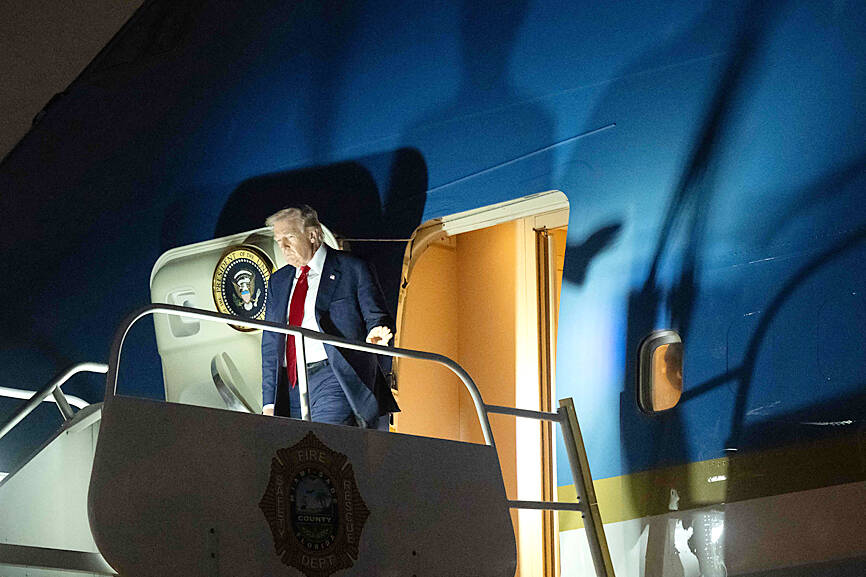
Photo: AFP
Most of the right-wing heads of state share concern about the rising power of drug cartels in Latin America, a phenomenon that has spread to countries considered fairly safe until recently such as Ecuador and Chile, International Institute for Strategic Studies Latin America expert Irene Mia said.
“All those countries used to be quite secure and didn’t really have an issue with organized crime, but they’ve seen increasing levels of organized crime because of the reconfiguration of the drug trade,” Mia said.
The strained security situation, which has contributed to the Latin American right wing’s recent string of electoral victories, means the trend of US intervention has received less pushback than in the past, she added.
Some of leaders, such as Noboa, have worked to deepen ties to Washington since coming to power.
Just this week, the US and Ecuador announced joint operations to combat drug trafficking that has turned one of the previously safest countries in Latin America to among the deadliest in just a few years.
In addition to Milei, Bukele and Noboa, Trump would also host the leaders of Bolivia, Costa Rica, the Dominican Republic, Guyana, Honduras, Panama, Paraguay, and Trinidad and Tobago — as well as Chilean president-elect Jose Antonio Kast.
Although some of the leaders have much to thank Trump for — such as US$20 billion in financial support to Argentina, or an endorsement that buoyed Honduran President Nasry Asfura’s razor-thin electoral victory — the durability of such a conservative coalition remains to be seen, Mia said.
“It’s entirely a negative agenda,” she said. “It’s all about the threats coming to the region for US security: migration, organized crime.”
Mia also pointed at the glaring absences from the summit, Mexico and Brazil, which are lead by leftists Claudia Sheinbaum and Luiz Inacio Lula da Silva respectively.
“Without Mexico and Brazil, it’s not going to be very successful in tackling those issues” of narcotrafficking and counterterrorism, she said.
“The Mexican cartels are really the CEO of the drug trafficking supply chain. And Brazil is also so important, because its organized crime groups are also increasingly powerful, they control the ports in Brazil and are key for the narco-trafficking towards Europe,” she added.
The support of the right-led Latin American countries for US interests “is quite fragile, because the relationship between Latin America and the US is so problematic,” Mia said.
“It’s a very fine balance to see whether the population will approve of Trump’s policy and until when,” she added.

‘CROSSING THE LINE’: China’s embassy in Seoul criticized US Forces Korea Commander General Xavier Brunson, asking if his ‘hostile’ remarks were authorized by Washington South Korea and the US are in talks over recent public remarks by the commander of US Forces Korea, Seoul’s presidential office said yesterday, after the comments drew sharp criticism from China. In a recent podcast interview, US Forces Korea Commander General Xavier Brunson described South Korea as “the dagger in the heart of Asia” from China’s east coast, prompting the Chinese embassy in Seoul to say that he had “truly crossed the line.” The interview came amid growing speculation that Washington might seek to expand the role of US Forces Korea in countering the growing regional influence of China, a key

SEEKING ORDER: Rodrigo Paz said that ‘anyone who wants to destroy the nation will have to deal with this president and the full force of the constitution’ Bolivian President Rodrigo Paz on Wednesday said that the nation was at a “breaking point” after nearly a month of protests that have caused shortages of food, fuel and medicine. Paz, who took office six months ago amid the worst economic crisis there in four decades, is battling a groundswell of fury over his policies. The political capital, La Paz, has been besieged by low-income workers and members of the indigenous majority calling for his resignation. “The country needs order and is reaching breaking point,” the 58-year-old said at a public event in La Paz, renewing his appeal for dialogue. On Tuesday, the Bolivian

Forecasters in Europe yesterday warned of exceptional heat as record temperatures driven by a “heat dome” push temperatures well above seasonal norms across the continent. The surge follows a record-breaking Monday, with France logging its hottest day in the month of May on record, its weather agency said, and the UK also posting unprecedented highs. A so-called “heat dome” of warm air from northern Africa trapped under a high-pressure system over western Europe is behind the high temperatures not usually seen until high summer. Restrictions on outdoor work were imposed in parts of Italy, beaches in southwest France filled earlier than usual and

Australian researchers have trained lab-grown brain cells on a silicon computer chip to play the 1990s shooter game Doom and said they are just scratching the surface of what the neurons could be capable of doing. It is the science-fiction work of biotech boffins at Cortical Labs, who researched and developed the technology that harnesses the workings of the brain’s networking system. Each so-called “biological computer” contains about 200,000 living human brain cells, grown from stem cells that were harvested from blood donations. Having mastered the simple computer game Pong, where a paddle is moved up and down to send a ball


 RSS
RSS