


Slick artificial intelligence (AI)-generated disinformation has flooded the election campaign in Nepal, which votes tomorrow in the first polls since deadly protests triggered by a brief ban on social media overthrew the government.
The protests in September last year were driven by tech-savvy young people angry at job shortages and flagrant corruption by an aging political elite.
Now parties across the political divide are tapping social media to push their agendas and woo voters, especially the young, including a surge of people registering to cast their ballot for the first time, but some of the content is manipulated or outright fake, experts and fact-checkers said.
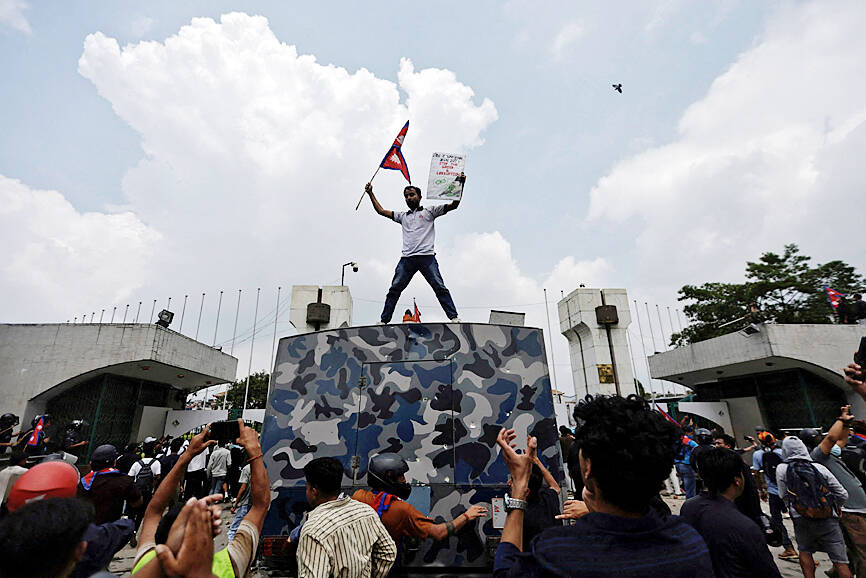
Photo: Reuters
“In a country where digital literacy is low, people believe what they see,” said Deepak Adhikari, editor of the independent NepalCheck team.
Kathmandu-based technology policy researcher Samik Kharel described a “digital battleground” in the buildup to the landmark vote, warning that Nepal lacked the expertise to monitor the onslaught of machine-generated content.
“It is even hard for experts to figure out what is real and fake,” Kharel said.
About 80 percent of all of Nepal’s internet traffic is through social media platforms, he said.
Internet analytics site DataReportal estimates that more than 56 percent of Nepal’s 30 million people are online, including 14.8 million Facebook users and about 4.3 million on Instagram. About 2.2 million are on TikTok, according to the Internet Service Providers’ Association of Nepal.
“Disinformation remains a top concern that could undermine the integrity of the election process,” said Ammaarah Nilafdeen of the US-based Center for the Study of Organized Hate.
“Nepal ... is grappling with the scale of the threat that disinformation poses to society and democracy at large,” Nilafdeen said.
The protests last year began after the government moved to regulate social media, briefly banning at least 26 platforms, including Facebook, Instagram, YouTube and X.
At least 77 people were killed in two days of unrest, parliament was set on fire and the government of four-time Nepalese prime minister K.P. Sharma Oli collapsed.
Activists used the group-chat app Discord to put forward their suggestion of interim leader — and days later their choice, 73-year-old former Nepalese chief justice Sushila Karki, was appointed to lead the nation to elections.
Social media is playing a key role again.
Loyalists of the ousted prime minister’s Marxist party have shared AI-generated images purporting to be drone photographs of a massive gathering — which were then reposted by top leaders, boasting a sea of more than 500,000 supporters.
Analysis by Nepalese online fact-check experts TechPana found the images had been created using OpenAI’s ChatGPT, while police said less than 5,000 people were at the real event.
Another AI-generated video that circulated on TikTok purported to show Gagan Thapa, leader of the Nepali Congress party, urging voters to back a rival party. The platform has removed the video.
In neighboring India, posts calling to restore Nepal’s deposed Hindu monarchy have made the rounds on social media, Nilafdeen said.
Such “ideological pushes” online — in this case “amplified by Hindu far-right supporters in India” — stand in contrast to “domestic demands for strengthening democratic institutions,” she said.
The Nepalese Election Commission says there is widespread use of hate speech and deepfake content, including videos created with readily available AI tools purporting to show candidates insulting opponents or using obscene language.
“It is a concerning issue,” commission information officer Suman Ghimire said.
More than 600 cases have been passed on to the authorities, he added, with about 150 handled by the police.
In one case, police detained a pro-royalist supporter, Durga Prasai, for social media posts allegedly meant to intimidate potential voters.
The commission can impose fines or bar candidates from running, but experts say the sheer scale of disinformation and hate speech online outstrips any effective response.
“Candidates and people close to political parties not only compete to win, but also compete to spread misinformation,” said Basanta Basnet, editor-in-chief of news Web site Onlinekhabar, which has collaborated with Nepal FactCheck to verify posts.
The organization has warned that “misinformation encourages citizens to take wrong decisions,” which in turn could undermine the “foundation of democracy.”

Through the noise of rushing papers and whirring belts at a print factory in Kyoto, two creators watch their photo essay come to life in broadsheet form — part of an effort to win new audiences in the age of artificial intelligence (AI). Despite the decline of the publishing industry, self-publication and handmade “zine” magazines are growing in popularity in Japan, reflecting the nation’s enduring love of paper in the digital era. While speaking to Agence France-Presse at the plant, his hands black with ink, one of the creators, Kazuma Obara, said: “I think [paper] is a medium that engages all five
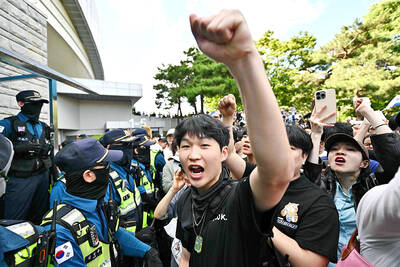
‘ABSURD MISTAKE’: The election commission said that there had been a failure to anticipate turnout after 14 polling stations ran short of ballot papers South Korean riot police yesterday cleared protesters from a Seoul polling station after a 35-hour blockade sparked by a shortage of ballot papers during local elections earlier this week. Wednesday’s election was the first nationwide vote since South Korean President Lee Jae-myung took office following the ouster of Yoon Suk-yeol over his short-lived martial law declaration. Lee’s ruling Democratic Party swept most races, but failed to flip the crucial Seoul mayoral seat. The South Korean National Election Commission apologized, blaming a failure to anticipate turnout after 14 polling stations in Seoul ran short of ballot papers. Some polling stations stayed open until 10pm to

Australian researchers have trained lab-grown brain cells on a silicon computer chip to play the 1990s shooter game Doom and said they are just scratching the surface of what the neurons could be capable of doing. It is the science-fiction work of biotech boffins at Cortical Labs, who researched and developed the technology that harnesses the workings of the brain’s networking system. Each so-called “biological computer” contains about 200,000 living human brain cells, grown from stem cells that were harvested from blood donations. Having mastered the simple computer game Pong, where a paddle is moved up and down to send a ball

France experienced its hottest spring on record, the French weather service said on Tuesday, after an exceptional early heat wave that also broke highs for the season in England and Wales. Meteo-France said the average nationwide temperature over March to May was 13.8°C — about 1.7°C above the norm, and surpassing records set in 2011 and 2020. “The warmest spring since records began in 1900,” it said in a bulletin. All three months were warmer than average, but the onset of an “unprecedented heatwave” late last month pushed the mercury to highs typically seen at the height of the summer. “Our country had never


 RSS
RSS