


Israel’s Supreme Court in a ruling published on Friday said it would freeze a government ban on 37 foreign non-governmental organizations (NGOs) working in Gaza and the occupied West Bank pending a final decision.
“Without taking any position, a temporary interim order is hereby issued,” the court said.
The decision theoretically allows the NGOs to continue working in Gaza and the West Bank until the court issues a final ruling, although aid groups expressed uncertainty as to how the freeze would be implemented.
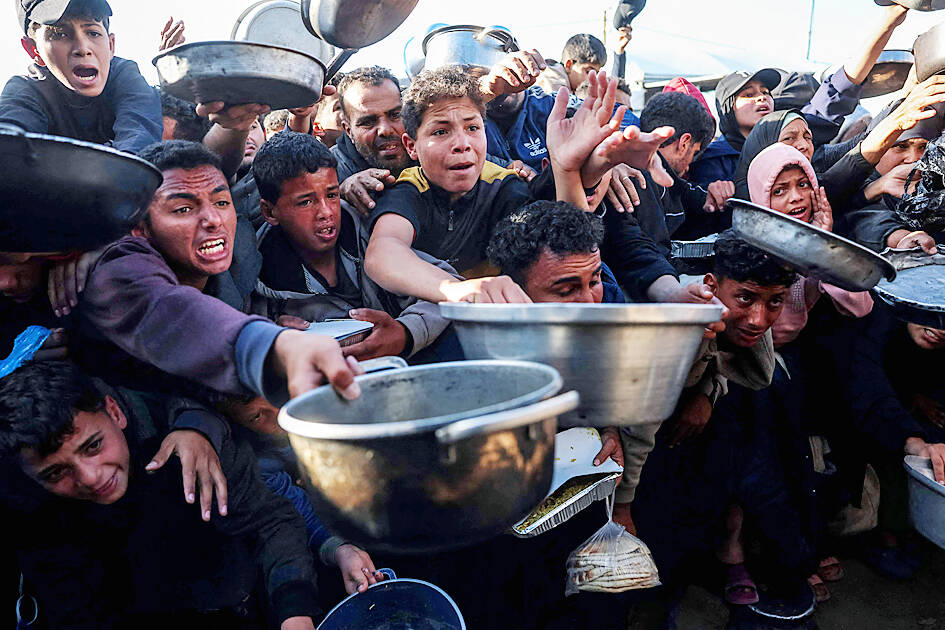
Photo: AFP
The organizations, including Doctors Without Borders (MSF), Oxfam, the Norwegian Refugee Council and CARE, were notified on Dec. 30 last year that their Israeli registrations had expired and that they had 60 days to renew them by providing lists of their Palestinian staff.
If they failed to do so, they would have to cease operations in Gaza and the West Bank from March 1.
The NGOs petitioned the Israeli Supreme Court via an umbrella organization, AIDA, after their charity registration in Israel was revoked at the end of a year-long battle during which the NGOs had refused to provide lists of their Palestinian employees to Israeli authorities.
The court said there existed a “genuine legal dispute” due to the foreign NGOs’ responsibilities to their employees’ privacy under European law.
The Israeli Ministry of Defense body in charge of civilian affairs in the Palestinian territories, Coordination of Government Activities in the Territories (COGAT), said the new registration process was “designed to ensure Hamas doesn’t infiltrate humanitarian organizations and use them as a disguise for its terror purposes.”
“Organizations who refused to comply should be asked one question: What are they hiding?” COGAT said.
Israel has accused NGOs such as MSF of employing Hamas fighters in Gaza, which the organization has denied, pointing to a rigorous vetting process for staff hiring.
“We are still waiting to see how the injunction will be interpreted by the state and whether or not this will mean an increase in our ability to operate,” AIDA director Athena Rayburn said, calling the ruling “a step in the right direction.”
“We will keep fighting to be able to do our jobs, and deliver life saving assistance to Palestinians in need,” she added.
Lawyer Yotam Ben-Hillel, who represented the NGOs in court, welcomed the injunction, but said that “we still don’t know how it will play out.”
“Today, the High Court of Justice has given the residents of Gaza and the West Bank some breathing room,” he said.
MSF project coordinator Craig Kenzie said the organization’s 28 remaining foreign staff left the Palestinian territory on Thursday and would not be able to return unless the ban was reversed.
“It’s a positive step, but it’s very light on the details, so it’s not clear what that results in in terms of getting supplies and foreign staff inside,” he said.
The organization’s supplies are running low, because none have been allowed in since the end of last year, Kenzie said, but added that 1,200 Palestinian staff would be seeing to day-to-day operations, which include clean water provision, surgeries and maternity health.
Although commercial cargo has entered Gaza, the goods they bring in are unaffordable for many Gazans left destitute by the war, and no other deregistered NGO has been able to get supplies in in recent months, he added.

Australians were downloading virtual private networks (VPNs) in droves, while one of the world’s largest porn distributors said it was blocking users from its platforms as the country yesterday rolled out sweeping online age restriction. Australia in December became the first country to impose a nationwide ban on teenagers using social media. A separate law now requires artificial intelligence (AI)-powered chatbot services to keep certain content — including pornography, extreme violence and self-harm and eating disorder material — from minors or face fines of up to A$49.5 million (US$34.6 million). The country also joined Britain, France and dozens of US states requiring

Hungarian authorities temporarily detained seven Ukrainian citizens and seized two armored cars carrying tens of millions of euros in cash across Hungary on suspicion of money laundering, officials said on Friday. The Ukrainians were released on Friday, following their detention on Thursday, but Hungarian officials held onto the cash, prompting Ukraine to accuse Hungary’s Russia-friendly government of illegally seizing the money. “We will not tolerate this state banditism,” Ukrainian Minister of Foreign Affairs Andrii Sybiha said. The seven detained Ukrainians were employees of the Ukrainian state-owned Oschadbank, who were traveling in the two armored cars that were carrying the money between Austria and
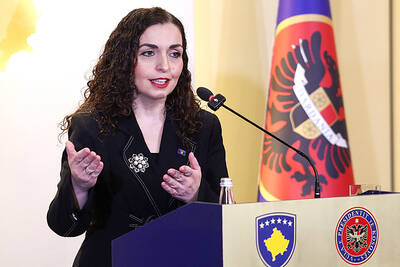
Kosovar President Vjosa Osmani on Friday after dissolving the Kosovar parliament said a snap election should be held as soon as possible to avoid another prolonged political crisis in the Balkan country at a time of global turmoil. Osmani said it is important for Kosovo to wrap up the upcoming election process and form functional institutions for political stability as the war rages in the Middle East. “Precisely because the geopolitical situation is that complex, it is important to finish this electoral process which is coming up,” she said. “It is very hard now to imagine what will happen next.” Kosovo, which declared

MORE BANS: Australia last year required sites to remove accounts held by under-16s, with a few countries pushing for similar action at an EU level and India considering its own ban Indonesia on Friday said it would ban social media access for children under 16, citing threats from online pornography, cyberbullying, online fraud and Internet addiction. “Accounts belonging to children under 16 on high-risk platforms will start to be deactivated, beginning with YouTube, TikTok, Facebook, Instagram, Threads, X, Bigo Live and Roblox,” Indonesian Minister of Communications and Digital Meutya Hafid said. “The government is stepping in so that parents no longer have to fight alone against the giants of the algorithm. Implementation will begin on March 28, 2026,” she said. The social media ban would be introduced in stages “until all platforms fulfill their


 RSS
RSS