


Iranian students on Saturday chanted anti-government slogans and scuffled with counter-protesters in the latest display of anger at the country’s clerical leaders, who also face a US military build-up aimed at pressuring them into a nuclear deal.
The gatherings at universities, which were reported by local and diaspora media outlets, followed a mass protest movement that was met with a government crackdown last month that left thousands dead.
The crackdown had prompted US President Donald Trump to threaten to intervene militarily, although the focus of his threats eventually shifted to Iran’s nuclear program, which Western governments fear is aimed at producing a bomb.
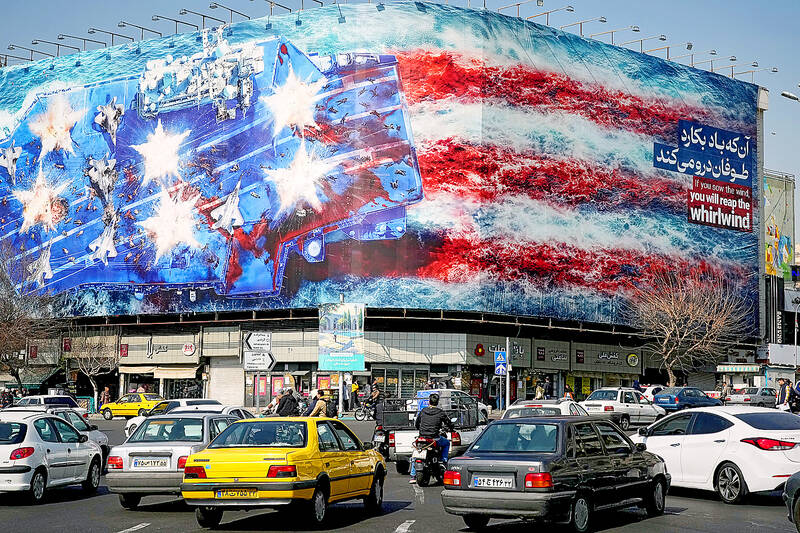
Photo: AP
The US and Iran have resumed Oman-mediated talks on a potential deal, but Washington has simultaneously increased its military presence in the region, dispatching two aircraft carriers, jets and weaponry to back its warnings.
Videos geolocated by Agence France-Presse to Tehran’s top engineering university showed fights breaking out in a crowd on Saturday as people shouted “bi sharaf,” or “disgraceful” in Farsi.
Footage posted by the Persian-language TV channel Iran International, which is based outside the country, also showed a large crowd chanting anti-government slogans at Sharif University of Technology.
The Fars news agency later said there were reports of injuries in scuffles at the institution.
Iranians had reprised their protest slogans earlier this week to mark the 40th day since thousands of people were killed as a wave of demonstrations was peaking on Jan. 8 and 9.
The unrest first broke out in December last year over prolonged financial strain, but exploded into mass anti-government protests that were suppressed in a violent crackdown by security forces.
The clerical authorities acknowledge more than 3,000 deaths, but say the violence was caused by “terrorist acts” fueled by Iran’s enemies.
However, the US-based Human Rights Activists News Agency (HRANA) has recorded more than 7,000 killings in the crackdown, the vast majority protesters, although the toll might be far higher.
Iranian authorities had initially acknowledged the legitimacy of the protesters’ economic demands, but as the movement took on an overtly anti-government tone, they accused archenemies the US and Israel of whipping up “riots.”
Fars said that what was supposed to be a “silent and peaceful sit-in” on Saturday of students commemorating those killed was disrupted by people chanting slogans including: “death to the dictator” — a reference to Iran’s supreme leader.
A video posted by Fars showed a group chanting and waving Iranian flags facing off with a crowd wearing masks and being held back by men in suits.
Ever since the initial wave of protests, the US and Iran have been trading threats of military action. Trump sent the aircraft carrier USS Abraham Lincoln to the region, while a second, the USS Gerald R Ford, is en route via the Mediterranean.
The US has also redeployed dozens of other warplanes to the Middle East — where it maintains several bases — while boosting its air defenses.
The build-up seeks to pressure Iran’s authorities as the two sides pursue nuclear talks.
Iranian Minister of Foreign Affairs Abbas Araghchi told US media this week that following the latest round of negotiations in Geneva, Switzerland, Tehran would be submitting a draft proposal for an agreement, saying it would be read in a matter of days.
Araghchi also said the “US side has not asked for zero enrichment” of uranium, contradicting statements from US officials.
Iran denies it is trying to produce nuclear weapons, but insists on its right to enrich uranium for civilian purposes.
The US media outlet Axios reported last week, citing an unnamed senior US official, that Washington was prepared to consider a proposed deal that only permitted “small, token enrichment.”
Trump has suggested that “bad things” would happen if Tehran did not strike a deal, saying on Thursday that it had 15 days to agree.
Fears of a conflict have prompted several foreign countries to urge their citizens to leave Iran, including Sweden, Serbia, Poland and Australia, which warned that “commercial flights are currently available, but this could change quickly.”
A previous round of nuclear diplomacy last year was interrupted by Israel’s surprise bombing campaign against the Islamic republic.
The US later joined its ally, striking nuclear facilities before declaring a ceasefire.
Iran has maintained that it would defend itself in the event of any new attack.
Iranian President Masoud Pezeshkian, in remarks to athletes carried by state television, said the country would “not yield to any trial, even if the powers of the world stand against us with injustice and try to force us into submission.”

‘CROSSING THE LINE’: China’s embassy in Seoul criticized US Forces Korea Commander General Xavier Brunson, asking if his ‘hostile’ remarks were authorized by Washington South Korea and the US are in talks over recent public remarks by the commander of US Forces Korea, Seoul’s presidential office said yesterday, after the comments drew sharp criticism from China. In a recent podcast interview, US Forces Korea Commander General Xavier Brunson described South Korea as “the dagger in the heart of Asia” from China’s east coast, prompting the Chinese embassy in Seoul to say that he had “truly crossed the line.” The interview came amid growing speculation that Washington might seek to expand the role of US Forces Korea in countering the growing regional influence of China, a key

SEEKING ORDER: Rodrigo Paz said that ‘anyone who wants to destroy the nation will have to deal with this president and the full force of the constitution’ Bolivian President Rodrigo Paz on Wednesday said that the nation was at a “breaking point” after nearly a month of protests that have caused shortages of food, fuel and medicine. Paz, who took office six months ago amid the worst economic crisis there in four decades, is battling a groundswell of fury over his policies. The political capital, La Paz, has been besieged by low-income workers and members of the indigenous majority calling for his resignation. “The country needs order and is reaching breaking point,” the 58-year-old said at a public event in La Paz, renewing his appeal for dialogue. On Tuesday, the Bolivian

Through the noise of rushing papers and whirring belts at a print factory in Kyoto, two creators watch their photo essay come to life in broadsheet form — part of an effort to win new audiences in the age of artificial intelligence (AI). Despite the decline of the publishing industry, self-publication and handmade “zine” magazines are growing in popularity in Japan, reflecting the nation’s enduring love of paper in the digital era. While speaking to Agence France-Presse at the plant, his hands black with ink, one of the creators, Kazuma Obara, said: “I think [paper] is a medium that engages all five

Australian researchers have trained lab-grown brain cells on a silicon computer chip to play the 1990s shooter game Doom and said they are just scratching the surface of what the neurons could be capable of doing. It is the science-fiction work of biotech boffins at Cortical Labs, who researched and developed the technology that harnesses the workings of the brain’s networking system. Each so-called “biological computer” contains about 200,000 living human brain cells, grown from stem cells that were harvested from blood donations. Having mastered the simple computer game Pong, where a paddle is moved up and down to send a ball


 RSS
RSS