


Meta Platforms Inc CEO Mark Zuckerberg yesterday said that he regretted the company’s slow progress in identifying underage users on Instagram, as he faced stinging criticism at a landmark social media trial over accusations that his company deliberately hooked children.
Asked to comment on complaints from inside the company that not enough was being done to verify whether children under 13 were using the platform, the 41-year-old head of Meta, which also owns Facebook and WhatsApp, said improvements had been made.
However, “I always wish that we could have gotten there sooner,” he added.
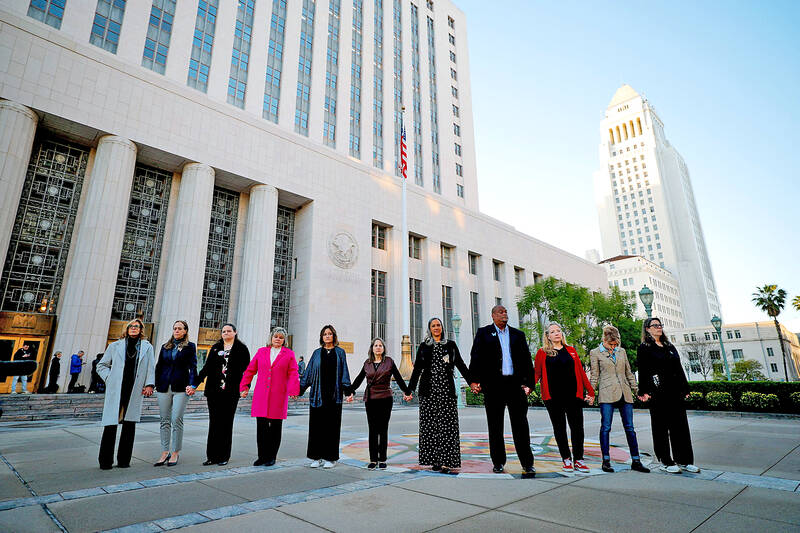
Photo: Reuters
Zuckerberg was the most hotly anticipated witness in the California trial, the first in a series of lawsuits filed by American families against social media platforms.
The trial marked the first time the multibillionaire addressed the safety of his world-dominating platforms directly before a jury and under oath.
Zuckerberg was very reserved at first, an Agence France-Presse journalist in the courtroom reported. However, he grew animated, showing signs of annoyance, shaking his head and waving his hands as he turned toward the jury.
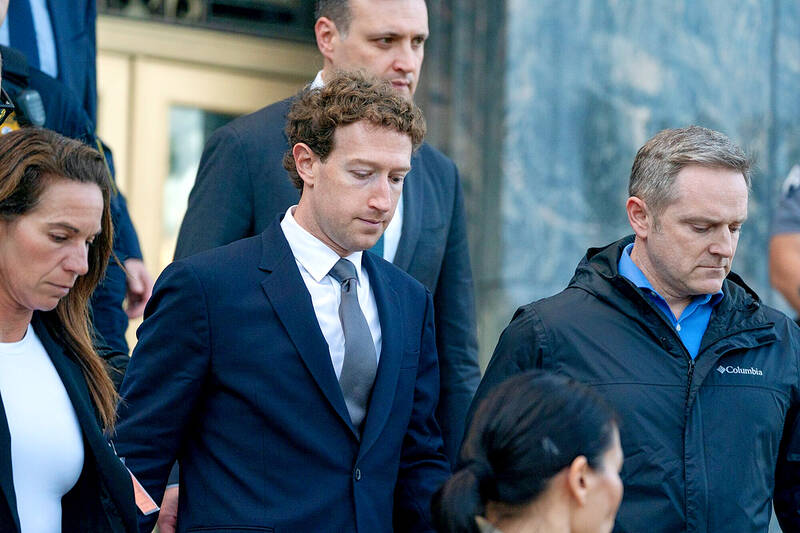
Photo: Bloomberg
The 12 jurors in Los Angeles heard the increasingly testy testimony, as plaintiff lawyer Mark Lanier pressed Zuckerberg on age verification and the tycoon’s guiding philosophy for making decisions at the vast social media company he controls.
During questioning by his own lawyers, a more relaxed Zuckerberg described time spent on the app as a “side effect” of a quality experience and often addressed the jurors directly to emphasize his points.
He also stressed his belief that Apple and Google, the companies behind operating systems powering most of the world’s smartphones, should arrange for age verification at the handset level instead of leaving it to each app.
“Doing it at the level of the phone is just a lot clearer than having every single app out there have to do this separately,” Zuckerberg said.
“It would be pretty easy for them,” he added.
Zuckerberg faced a barrage of internal e-mails, including warnings from colleagues that age verification was not fit for purpose and others that seemed to plainly display that encouraging more time spent on Instagram was long a central goal of the company.
The trial is set to last until late next month, when the jury is to decide whether Meta, as well as Google-owned YouTube, bear responsibility for the mental health problems suffered by Kaley G.M., a 20-year-old California resident who has been a heavy social media user since childhood.
Kaley G.M. started using YouTube at age six, Instagram at nine, then TikTok and Snapchat.
Under-13s are not allowed on Instagram, and Lanier pressed Zuckerberg on the fact that Kaley had easily signed up for the platform.
Zuckerberg was confronted with an internal document that said Instagram had 4 million users under 13 in 2015, at the time the plaintiff adopted the app, and that 30 percent of all children aged 10 to 12, or “tweens,” in the US were users.
Zuckerberg said that “we’re in the right place now” when it comes to age verification.
Lanier said that young people like Kaley were subject to Meta’s efforts to increase time spent on its wildly popular apps, despite Zuckerberg having told the US Congress under oath that this was not the case.
Faced with e-mails displaying internal targets for usage, Zuckerberg said that “we used to have goals around time,” but that the company’s aim was always to “build useful services” that connected people.
Zuckerberg was also read an old e-mail from former head of public policy Nick Clegg that said “the fact that we say we don’t allow under-13s on our platform, yet have no way of enforcing it, is just indefensible.”
The trial is set to determine whether Google and Meta deliberately designed their platforms to encourage compulsive use among young people, damaging their mental health in the process.
The case is expected to establish a standard for resolving thousands of lawsuits that blame social media for fueling an epidemic of depression, anxiety, eating disorders and suicide among young people.
TikTok and Snapchat, also named in the complaint, reached settlements with the plaintiff before the trial began.
Australians were downloading virtual private networks (VPNs) in droves, while one of the world’s largest porn distributors said it was blocking users from its platforms as the country yesterday rolled out sweeping online age restriction. Australia in December became the first country to impose a nationwide ban on teenagers using social media. A separate law now requires artificial intelligence (AI)-powered chatbot services to keep certain content — including pornography, extreme violence and self-harm and eating disorder material — from minors or face fines of up to A$49.5 million (US$34.6 million). The country also joined Britain, France and dozens of US states requiring

Hungarian authorities temporarily detained seven Ukrainian citizens and seized two armored cars carrying tens of millions of euros in cash across Hungary on suspicion of money laundering, officials said on Friday. The Ukrainians were released on Friday, following their detention on Thursday, but Hungarian officials held onto the cash, prompting Ukraine to accuse Hungary’s Russia-friendly government of illegally seizing the money. “We will not tolerate this state banditism,” Ukrainian Minister of Foreign Affairs Andrii Sybiha said. The seven detained Ukrainians were employees of the Ukrainian state-owned Oschadbank, who were traveling in the two armored cars that were carrying the money between Austria and

Kosovar President Vjosa Osmani on Friday after dissolving the Kosovar parliament said a snap election should be held as soon as possible to avoid another prolonged political crisis in the Balkan country at a time of global turmoil. Osmani said it is important for Kosovo to wrap up the upcoming election process and form functional institutions for political stability as the war rages in the Middle East. “Precisely because the geopolitical situation is that complex, it is important to finish this electoral process which is coming up,” she said. “It is very hard now to imagine what will happen next.” Kosovo, which declared

MORE BANS: Australia last year required sites to remove accounts held by under-16s, with a few countries pushing for similar action at an EU level and India considering its own ban Indonesia on Friday said it would ban social media access for children under 16, citing threats from online pornography, cyberbullying, online fraud and Internet addiction. “Accounts belonging to children under 16 on high-risk platforms will start to be deactivated, beginning with YouTube, TikTok, Facebook, Instagram, Threads, X, Bigo Live and Roblox,” Indonesian Minister of Communications and Digital Meutya Hafid said. “The government is stepping in so that parents no longer have to fight alone against the giants of the algorithm. Implementation will begin on March 28, 2026,” she said. The social media ban would be introduced in stages “until all platforms fulfill their


 RSS
RSS