


In a landmark case for the deeply Catholic country, a Polish bishop was to go to trial yesterday for allegedly covering up acts of pedophilia committed by priests in his diocese.
This is the first case in which a high-ranking church hierarchy has faced criminal charges for failing to inform authorities of church abuse by clergy.
“This is a spectacular case, and, in Polish realities, essentially unprecedented,” said Artur Nowak, a lawyer, publicist and writer who appeared in a watershed documentary about sexual abuse in the Catholic church in Poland.
Prosecutors said that Tarnow bishop Andrzej Jez was aware of two cases of priests abusing underage altar boys. One of the priests in the southern Polish city, Stanislaw P. — whose last name has been withheld due to Polish privacy laws — is believed to have abused 95 children, and committed sexual crimes against 77.
It was one of the largest cases of sexual abuse reported in the Catholic church in Poland — with incidents going as far back as the 1980s, in every parish where P. had served.
Neither clergyman was charged — the former’s victims were not able to precisely determine when the abuse took place, while the second priest, Fr. Tomasz K., claimed poor health, and the case was dropped. Stanislaw P., however, was ultimately stripped of his priesthood by the church.
In previous cases of alleged church cover-ups, prosecutors had declined to open investigations into church officials — arguing that the criminal code did not contain provisions requiring law enforcement to be notified in cases of abuse.
However, a 2017 amendment to the code made it obligatory to notify law enforcement immediately in cases of sexual offenses committed against children under 15.
The local curia denies the accusations against bishop Jez, writing in a statement on Tuesday that “the authorities of the Tarnow diocese made a dozen or so reports to law enforcement over the past years, implementing a ‘zero tolerance’ policy.”
Nowak, however, said that “by filing an indictment against such a high-ranking prelate, the prosecutor’s office must have had solid evidence.”
“If they had doubts, they wouldn’t have taken the case to court,” he added.
Zbigniew Cwiakalski, from the bishop’s defense team, declined to comment ahead of the trial.
With 88.8 percent of Poles feeling a “sense of belonging” to the Catholic church, the country had, until recently, seemed to be bucking the broader European trend toward secularization.
However, an increasing number of abuse scandals coming to light, popular pushback against the country’s strict abortion laws, and concern over the church’s involvement in politics contributed to a steep decline in the number of practicing Catholics, even if they remain nominally Catholic.
Last year, Poland’s Center for Public Opinion Research CBOS found that only 34 percent of Poles said they attended weekly Mass — down from almost 70 percent in the early 1990s.
Church abuse scandals have even touched former Polish pope John Paul II. His role in the downfall of the communist regime earned him world renown, but investigations into his time as archbishop of Krakow in the 1960s and 1970s accused him of neglecting to report known cases of child sexual abuse.
In 2021, the Vatican intervened, barring three Polish bishops from celebrating Mass in public and mandating that they leave their dioceses and pay into a fund for victims, over allegations of negligence.
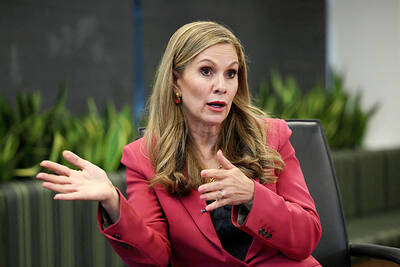
Australians were downloading virtual private networks (VPNs) in droves, while one of the world’s largest porn distributors said it was blocking users from its platforms as the country yesterday rolled out sweeping online age restriction. Australia in December became the first country to impose a nationwide ban on teenagers using social media. A separate law now requires artificial intelligence (AI)-powered chatbot services to keep certain content — including pornography, extreme violence and self-harm and eating disorder material — from minors or face fines of up to A$49.5 million (US$34.6 million). The country also joined Britain, France and dozens of US states requiring
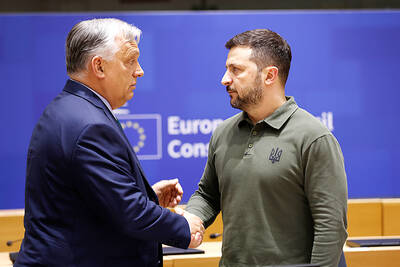
Hungarian authorities temporarily detained seven Ukrainian citizens and seized two armored cars carrying tens of millions of euros in cash across Hungary on suspicion of money laundering, officials said on Friday. The Ukrainians were released on Friday, following their detention on Thursday, but Hungarian officials held onto the cash, prompting Ukraine to accuse Hungary’s Russia-friendly government of illegally seizing the money. “We will not tolerate this state banditism,” Ukrainian Minister of Foreign Affairs Andrii Sybiha said. The seven detained Ukrainians were employees of the Ukrainian state-owned Oschadbank, who were traveling in the two armored cars that were carrying the money between Austria and
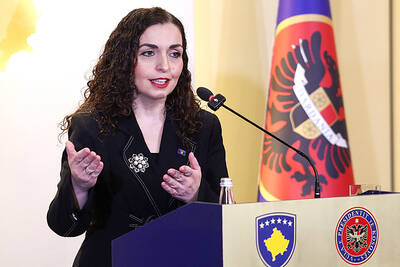
Kosovar President Vjosa Osmani on Friday after dissolving the Kosovar parliament said a snap election should be held as soon as possible to avoid another prolonged political crisis in the Balkan country at a time of global turmoil. Osmani said it is important for Kosovo to wrap up the upcoming election process and form functional institutions for political stability as the war rages in the Middle East. “Precisely because the geopolitical situation is that complex, it is important to finish this electoral process which is coming up,” she said. “It is very hard now to imagine what will happen next.” Kosovo, which declared

MORE BANS: Australia last year required sites to remove accounts held by under-16s, with a few countries pushing for similar action at an EU level and India considering its own ban Indonesia on Friday said it would ban social media access for children under 16, citing threats from online pornography, cyberbullying, online fraud and Internet addiction. “Accounts belonging to children under 16 on high-risk platforms will start to be deactivated, beginning with YouTube, TikTok, Facebook, Instagram, Threads, X, Bigo Live and Roblox,” Indonesian Minister of Communications and Digital Meutya Hafid said. “The government is stepping in so that parents no longer have to fight alone against the giants of the algorithm. Implementation will begin on March 28, 2026,” she said. The social media ban would be introduced in stages “until all platforms fulfill their


 RSS
RSS