


New Mexico lawmakers on Monday passed legislation to launch what they said was the first full investigation into what happened at Zorro Ranch, where the late US sex offender Jeffrey Epstein is accused of trafficking and sexually assaulting girls and women.
A bipartisan committee is to seek testimony from survivors of alleged sexual abuse at the ranch. Legislators are also urging local residents to testify.
Epstein died in what was ruled a suicide in a New York jail in 2019 while facing sex trafficking charges.
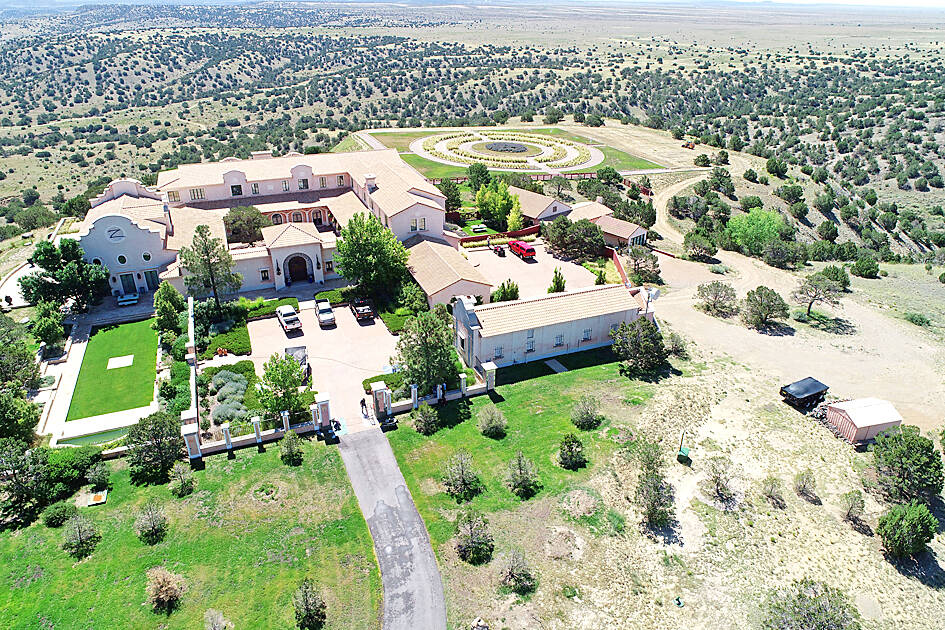
Photo: Reuters
The so-called truth commission, comprising four lawmakers, seeks to identify ranch guests and state officials who might have known what was going on at the more than 3,000 hectare property, or taken part in alleged sexual abuse in its hacienda-style mansion and guest houses.
The Democratic-led investigation adds to political pressure to uncover Epstein’s crimes that has become a major challenge for US President Donald Trump, weeks after the US Department of Justice released millions of Epstein-related files that shed new light on activities at the ranch.
The files reveal ties between Epstein and two former Democratic governors and an attorney general of New Mexico.
The legislation, which passed the New Mexico House of Representatives by a unanimous vote, could pose risks to any additional politicians linked to Epstein in the Democratic-run state, as well as scientists, investors and other high-profile individuals who visited the ranch.
The US$2.5 million investigation, which has subpoena power, aims to close gaps in state law that might have allowed Epstein to operate in the state.
The committee was to start work yesterday, and aims to deliver interim findings in July and a final report by the end of the year.
“He was basically doing anything he wanted in this state without any accountability whatsoever,” said New Mexico Representative Andrea Romero, a Democrat, who cosponsored the initiative.
Victim advocates applauded the move, saying Zorro Ranch had been overlooked by federal investigations that focused on Epstein’s Caribbean island and New York townhouse.
“Many of the survivors had experiences in New Mexico, and as we’ve learned, you know, there were local politicians and other people that were aware of what was happening in New Mexico,” said attorney Sigrid McCawley, whose law firm has represented hundreds of Epstein survivors.
They include the late Virginia Giuffre, who was abused many times at the ranch, she said.
Meanwhile, former US secretary of state Hillary Clinton said in a BBC interview published on Monday that Trump was orchestrating a “cover-up” of the Epstein files.
“Get the files out. They are slow-walking it,” Clinton, who is due to testify before a US Congressional committee on the issue, told the British broadcaster in an interview in Berlin.
Clinton’s husband, former president Bill Clinton, features regularly in the files, but no evidence has come to light implicating either Clinton in criminal activity.
The couple has been ordered to give closed-door depositions before the US House Oversight Committee, which is probing the deceased financier’s connections to powerful figures and how information about his crimes was handled.
“We will show up, but we think it would be better to have it in public,” Hillary Clinton told the BBC.
“I just want it to be fair,” she said. “I want everybody treated the same way.”
She and her husband “have nothing to hide,” she said. “We have called for the full release of these files repeatedly.”
Additional reporting by AFP

Australians were downloading virtual private networks (VPNs) in droves, while one of the world’s largest porn distributors said it was blocking users from its platforms as the country yesterday rolled out sweeping online age restriction. Australia in December became the first country to impose a nationwide ban on teenagers using social media. A separate law now requires artificial intelligence (AI)-powered chatbot services to keep certain content — including pornography, extreme violence and self-harm and eating disorder material — from minors or face fines of up to A$49.5 million (US$34.6 million). The country also joined Britain, France and dozens of US states requiring

Hungarian authorities temporarily detained seven Ukrainian citizens and seized two armored cars carrying tens of millions of euros in cash across Hungary on suspicion of money laundering, officials said on Friday. The Ukrainians were released on Friday, following their detention on Thursday, but Hungarian officials held onto the cash, prompting Ukraine to accuse Hungary’s Russia-friendly government of illegally seizing the money. “We will not tolerate this state banditism,” Ukrainian Minister of Foreign Affairs Andrii Sybiha said. The seven detained Ukrainians were employees of the Ukrainian state-owned Oschadbank, who were traveling in the two armored cars that were carrying the money between Austria and

Kosovar President Vjosa Osmani on Friday after dissolving the Kosovar parliament said a snap election should be held as soon as possible to avoid another prolonged political crisis in the Balkan country at a time of global turmoil. Osmani said it is important for Kosovo to wrap up the upcoming election process and form functional institutions for political stability as the war rages in the Middle East. “Precisely because the geopolitical situation is that complex, it is important to finish this electoral process which is coming up,” she said. “It is very hard now to imagine what will happen next.” Kosovo, which declared

MORE BANS: Australia last year required sites to remove accounts held by under-16s, with a few countries pushing for similar action at an EU level and India considering its own ban Indonesia on Friday said it would ban social media access for children under 16, citing threats from online pornography, cyberbullying, online fraud and Internet addiction. “Accounts belonging to children under 16 on high-risk platforms will start to be deactivated, beginning with YouTube, TikTok, Facebook, Instagram, Threads, X, Bigo Live and Roblox,” Indonesian Minister of Communications and Digital Meutya Hafid said. “The government is stepping in so that parents no longer have to fight alone against the giants of the algorithm. Implementation will begin on March 28, 2026,” she said. The social media ban would be introduced in stages “until all platforms fulfill their


 RSS
RSS