


Nepalese candidates yesterday launched their campaigns for next month’s parliamentary elections, the first since deadly anti-corruption protests toppled the previous government last year.
“This election will draw the future of the country,” Sushila Karki, who is serving as interim prime minister until the March 5 vote, said ahead of the launch.
The youth-led protests were triggered by a brief social media ban, but were fueled by anger at economic stagnation and an aging elite seen as out of touch.
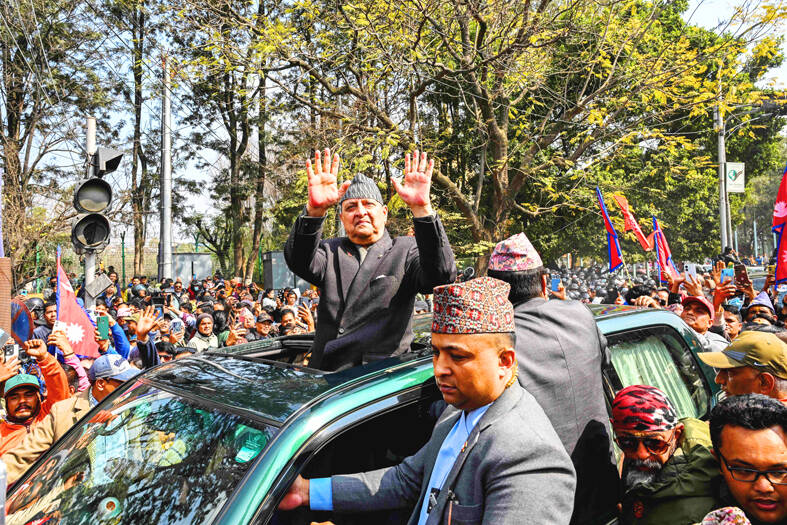
Photo: AFP
Over two days in September, 77 people were killed, scores were injured, hundreds of buildings set on fire — including parliament, courts and a Hilton hotel — and 73-year-old Marxist leader KP Sharma Oli ousted.
It was the Himalayan nation’s worst violence since a decade-long civil war in 2006.
Two weeks of campaigns would see a host of new, younger candidates promise to offer change, challenging veteran politicians who say they provide stability and security.
A key election clash would see rapper-turned-mayor Balendra Shah, 35, face Oli in a head-to-head battle in the former prime minister’s constituency.
Sharply dressed Shah, better known as Balen, has emerged as a symbol of youth-driven political change.
He has joined the Rastriya Swatantra Party, the fourth biggest in the previous parliament.
Also in the race is Nepalese Congress, the nation’s oldest party.
The party was once part of Oli’s coalition government, but has elected a new leader since the uprising — 49-year-old Gagan Thapa.
At the other end of the spectrum from Gen Z politics, supporters of former king Gyanendra Shah, 78 — deposed in 2008, ending 240 years of monarchy — would also campaign.
The Rastriya Prajatantra Party, which draws support from royalist nostalgia and frustration with mainstream politics, on Friday rallied thousands in Kathmandu as the ex-king drove through the streets waving from his car.
Nearly 19 million people have registered to vote, including 800,000 taking part for the first time.
They are to elect members to the 275-seat House of Representatives, with 165 via a direct vote and 110 through proportional representation.
More than 3,400 candidates are competing in the direct vote, 30 percent aged under 40.
Campaign banners and party flags are already being strung up in towns, with a string of rallies planned as candidates seek to woo voters.
“This election is being conducted in a special condition,” former chief justice Karki said, as she oversaw polling preparations last week. “This has to give the country a way out.”
The Nepalese Election Commission has said it is ready to hold the elections as planned, despite concerns over weather conditions, as many high-altitude areas might be snowbound that early in the year.
The vote is being held unusually early in the year, due to an accelerated election schedule brought on by the September unrest.
Extra security forces have been drafted to ensure calm, with about 300,000 officers and temporary election police deployed.
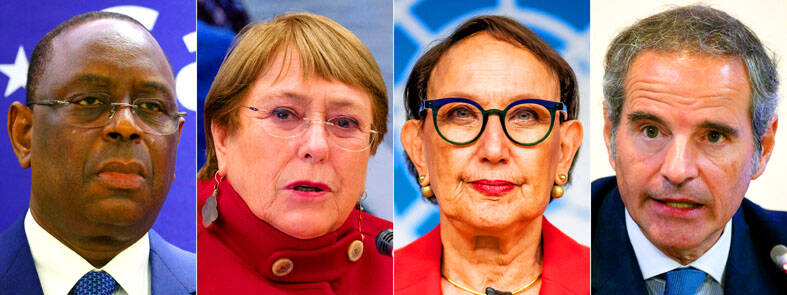
Four contenders are squaring up to succeed Antonio Guterres as secretary-general of the UN, which faces unprecedented global instability, wars and its own crushing budget crisis. Chile’s Michelle Bachelet, Argentina’s Rafael Grossi, Costa Rica’s Rebeca Grynspan and Senegal’s Macky Sall are each to face grillings by 193 member states and non-governmental organizations for three hours today and tomorrow. It is only the second time the UN has held a public question-and-answer, a format created in 2016 to boost transparency. Ultimately the five permanent members of the UN’s top body, the Security Council, hold the power, wielding vetoes over who leads the

South Korea’s air force yesterday apologized for a 2021 midair collision involving two fighter jets, a day after auditors said the pilots were taking selfies and filming during the flight and held them responsible for the accident. “We sincerely apologize to the public for the concern caused by the accident that occurred in 2021,” an air force spokesman told a news conference, adding that one of the pilots involved had been suspended from flying duties, received severe disciplinary action and has since left the military. The apology followed a report released on Wednesday by the South Korean Board of Audit and Inspection,

About 240 Indians claiming descent from a Biblical tribe landed at Tel Aviv airport on Thursday as part of a government operation to relocate them to Israel. The newcomers passed under a balloon arch in blue and white, the colors of the Israeli flag, as dozens of well-wishers welcomed them with a traditional Jewish song. They were the first “bnei Menashe” (“sons of Manasseh”) to arrive in Israel since the government in November last year announced funding for the immigration of about 6,000 members of the community from the states of Manipur and Mizoram in northeast India. The community claims to descend from

Young Chinese, many who fear age discrimination in their workplace after turning 35, are increasingly starting “one-person companies” that have artificial intelligence (AI) do most of the work. Smaller start-ups are already in vogue in Silicon Valley and elsewhere, with rapidly advancing AI tools seen as a welcome teammate even as they threaten layoffs at existing firms. More young people in China are subscribing to the model, as cities pledge millions of dollars in funding and rent subsidies for such ventures, in alignment with Beijing’s political goal of “technological self-reliance.” “The one-person company is a product of the AI era,” said Karen Dai


 RSS
RSS