

Ukrainian President Volodymyr Zelenskiy denounced Russian President Vladimir Putin as a “slave to war” in a speech to the Munich Security Conference on Saturday, adding that Russia’s attacks had damaged every power plant in the country.
Zelenskiy also drew parallels between the Russia-Ukraine talks over territorial concessions and the 1938 Munich Agreement, when Hitler forced territorial concessions from the European powers — one year before World War II.
Zelenskiy was speaking days before the fourth anniversary of Moscow’s invasion, which has killed hundreds of thousands, decimated eastern Ukraine and forced millions to flee.
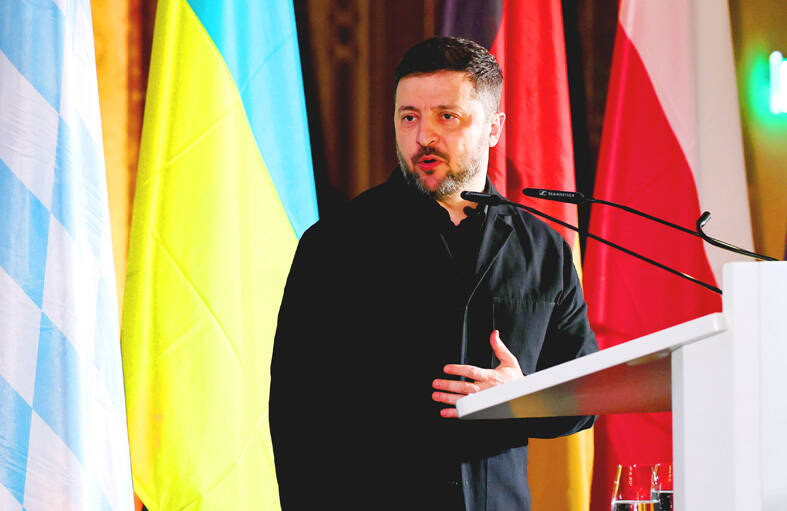
Photo: EPA
Kyiv and its Western allies have accused Moscow of deliberately freezing Ukraine’s population with its attacks on the energy grid.
“There is not a single power plant left in Ukraine that has not been damaged by Russian attacks,” Zelenskiy said. “Not one.”
“But we still generate electricity,” he added, praising the thousands of workers repairing the plants.
Once again, he appealed to the West to deliver air-defense systems to Ukraine more quickly.
Of Putin, who launched the war in February 2022, Zelenskiy said: “He may see himself as a czar, but in reality he is a slave to war.”
Russia and Ukraine are to hold US-brokered talks this week, and Zelenskiy said Kyiv was doing “everything” to end the war.
Zelenskiy also met with US Secretary of State Marco Rubio on the sidelines of the Munich conference. Russia has demanded that Ukraine withdraw from its Donetsk region and wants Kyiv to recognize its claim to the swathes of Ukraine that it occupies. Ukraine has ruled out surrendering its eastern regions.
“The Americans often return to the topic of concessions, and too often those concessions are discussed in the context only of Ukraine,” Zelenskiy said.
He drew parallels between the talks and the 1938 Munich Agreement, when European powers let Hitler take part of Czechoslovakia, only for World War II to break out the following year.
“It would be an illusion to believe that this war can now be reliably ended by dividing Ukraine — just as it was an illusion to believe that sacrificing Czechoslovakia would save Europe from a great war,” he said.
Kyiv was doing “everything” to end the war, he said, adding that viable security guarantees were the only way to get to a deal and prevent future Russian aggression.
“With Russia, you cannot leave a single loophole Russians can use to start a war,” he said.
Zelenskiy said that there would be more chance of ending the war if European countries had a seat at the negotiating table — something Russia has opposed.
This week’s talks in Geneva come after two rounds of negotiations in Abu Dhabi.
Zelenskiy wrote on social media that he had spoken by phone to US special envoy Steve Witkoff and US President Donald Trump’s son-in-law, Jared Kushner, ahead of the talks.
“We count on the meetings being truly productive,” he added.
With no diplomatic breakthrough so far, the Ukrainian leader has called on his Western allies to make faster political decisions.
“Weapons evolve faster than political decisions meant to stop them,” Zelenskiy said.
The Iranian-designed Shahed drones that Russia was using had become much more deadly, he added.
Returning to the question of elections in Ukraine, Zelenskiy said they would be held once Kyiv received security guarantees and a ceasefire had been agreed.
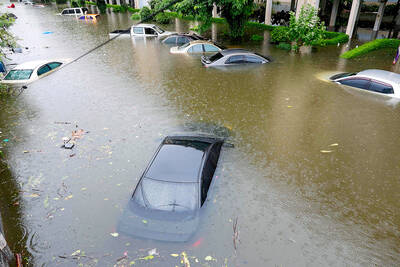
Several areas of Thailand’s capital city Bangkok were inundated by continuous rain from Thursday afternoon to yesterday morning that has disrupted traffic and forced some residents to evacuate. Major canals in Bangkok filled with accumulated rainfall exceeding 20cm, officials said yesterday. Floodwaters spread across the city, particularly in the central and eastern parts, blocking roads and stopping traffic. The Thai Meteorological Department warned that the heavy rain would continue in most parts of the country through today, citing a strong low-pressure system over the central region and strengthening southwest monsoon conditions. More than 84,000 people in 21 provinces nationwide were
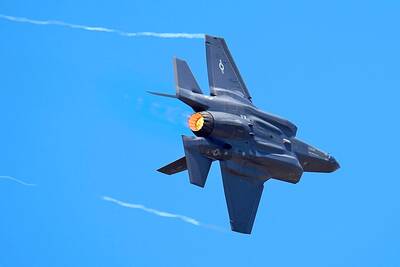
BAD TIMING: The disclosure of the incident, which is under investigation by at least two congressional committees, comes as Xi was to meet with Trump The Pentagon is investigating how parts of the US’ most advanced fighter jet ended up in Hong Kong, with a news outlet on Wednesday reporting that China has obtained the F-35 equipment. The F-35 Joint Program Office said in a statement that it and the US Department of Defense are aware of “a shipment issue” with F-35 components. “We are actively working with US authorities and industry partners to retrieve these components, investigate the incident and place safeguards to avoid a future occurrence,” the office said. UPS was shipping a cockpit canopy and weapons-bay door from an Australian military F-35 that was being
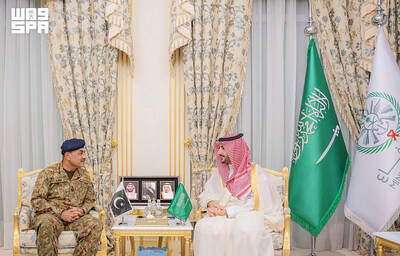
Yemen’s Saudi-led coalition early yesterday said it had intercepted two ballistic missiles and two drones launched by the Iran-backed Houthis toward the kingdom. The coalition said in posts on social media that the missiles were headed towards Khamis Mushait and the drones toward the capital, Riyadh, adding that it was monitoring the missile threat and drones launched at the kingdom, without providing further details. The Saudi Civil Defense had sent alerts overnight for Khamis Mushait and Abha, but not for Riyadh. The Houthis, who control the most populous parts of Yemen and much of the north, have been launching attacks
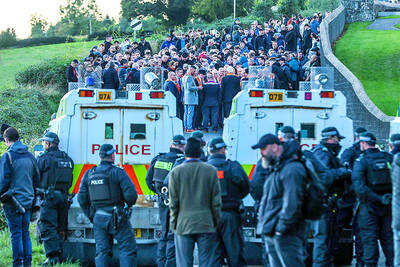
OLD WOUNDS: Protestant marchers seized on an overturned injunction to stage a march, which drew thousands of counterprotesters to block the road in Portadown UK leaders called for calm as a tense standoff with residents seeking to halt a pro-British Protestant march through a primarily Catholic area stretched into the night on Sunday, in one of the worst crises for Northern Ireland in the past few years. The tensions were triggered after a Belfast appeal court overturned a High Court injunction in the early hours of Sunday to clear the march by the Orange Order to go ahead for the first time since 1997. The Parades Commission, Northern Ireland’s independent body regulating contentious processions, had authorized 35 Orangemen to march silently along Garvaghy Road in Portadown,


 RSS
RSS