


The Bhumjaithai Party of Prime Minister Anutin Charnvirakul was on track to win the most seats in Thailand’s general election, according to unofficial results released by the state Election Commission after about 94 percent of polling stations had reported yesterday.
It was the first decisive victory of a conservative party in Thailand in years. Sunday’s election came against a backdrop of slow economic growth and heightened nationalist sentiment. Voter turnout stood at about 65 percent, significantly lower than in the 2023 election.
The commission’s running count, shown on its Web site, indicated that Bhumjaithai won about 193 seats in the 500-member Thai House of Representatives.

Photo: Reuters
The lower house comprises 400 lawmakers directly elected based on constituencies, while 100 others are chosen from “party list” nominees, who gain seats according to each party’s proportional share of the vote on a separate ballot indicating party preference.
A simple majority of 251 seats is needed for the body to elect a prime minister. The figures indicate Bhumjaithai would have to seek one or two partners to form a coalition government with Anutin returning as its head.
The progressive People’s Party, which had been tipped to win the most seats, was holding down second place with 118 seats. It swept all constituencies in Bangkok and a majority in the capital’s neighboring provinces. The party also took a lead in the party list totals, taking about 3.8 million more votes on party list ballots than Bhumjaithai.
Pheu Thai, the populist party representing the political machine of former Prime Minister Thaksin Shinawatra, trailed behind with 74 seats. It was considered a disappointing result for a political force that has often dominated Thai elections.
It is widely believed that Pheu Thai would accept, if asked, to join a coalition government led by Bhumjaithai.
Anutin has been prime minister since September last year, after serving in the Cabinet of his immediate predecessor, Paetongtarn Shinawatra, who was forced out of office for an ethics violation regarding mishandling relations with Cambodia.
Anutin dissolved parliament in December to call a new election after he was threatened with a no-confidence vote.
Subsequent border clashes with Cambodia allowed Anutin to recast himself as a wartime leader after his popularity initially slipped because of floods and financial scandals. His campaign focused on national security and economic stimulus.
While the result diverged from what earlier polls suggested, Bhumjaithai’s victory did not come as a surprise, said Napon Jatusripitak, director of the Center for Politics and Geopolitics at Thailand Future, a Bangkok-based think tank.
Beyond the nationalist boost from the border clashes, Napon said Bhumjaithai capitalized on traditional patronage networks outside Bangkok and major urban areas.
The party strategically positioned itself as a natural home for well-connected local politicians and worked with provincial allies to avoid vote splitting, Napon said.
“The result may have resolved a recurring dilemma in Thai politics, whereby conservative interests have repeatedly intervened to curtail democratic politics after losing at the ballot box. Whether this configuration produces genuine stability, however, remains to be seen,” he added.
Sunday’s voting included a referendum asking voters whether Thailand should replace its 2017 military-drafted constitution.
The vote was not on a proposed draft, but rather to decide whether to authorize parliament to begin a formal drafting process, which would require many further steps before coming to fruition. About 60 percent voted in favor, delivering a clear mandate for starting work on a new draft.

An American scientist convicted of lying to US authorities about payments from China while he was at Harvard University has rebuilt his research lab in Shenzhen, China, to pursue technology the Chinese government has identified as a national priority: embedding electronics into the human brain. Charles Lieber, 67, is among the world’s leading researchers in brain-computer interfaces. The technology has shown promise in treating conditions such as amyotrophic lateral sclerosis and restoring movement in paralyzed people. It also has potential military applications: Scientists at the Chinese People’s Liberation Army have investigated brain interfaces as a way to engineer super soldiers by boosting
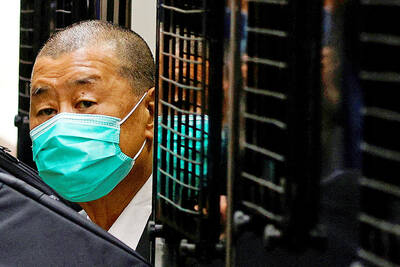
Jailed media entrepreneur Jimmy Lai (黎智英) has been awarded Deutsche Welle’s (DW) freedom of speech award for his contribution to Hong Kong’s pro-democracy movement. The German public broadcaster on Thursday said Lai would be presented in absentia with the 12th iteration of the award on June 23 at the DW Global Media Forum in Bonn. Deutsche Welle director-general Barbara Massing praised the 78-year-old founder of the now-shuttered news outlet Apple Daily for standing “unwaveringly for press freedom in Hong Kong at great personal risk.” “With Apple Daily, he gave journalists a platform for free reporting and a voice to the democracy movement in
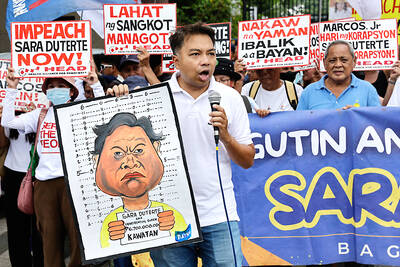
PHILIPPINE COMMITTEE: The head of the committee that made the decision said: ‘If there is nothing to hide, there is no reason to hide, there is no reason to obstruct’ A Philippine congressional committee on Wednesday ruled that there was “probable cause” to impeach Philippine Vice President Sara Duterte after hearing allegations of unexplained wealth, misuse of state funds and threats to have the president assassinated. The unanimous decision of the 53-member committee in the Philippine House of Representatives sends the two impeachment complaints to deliberations and voting by the entire lower chamber, which has more than 300 lawmakers. The complaints centered on Duterte’s alleged illegal use and mishandling of intelligence funds from the vice president’s office, and from her time as education secretary under Philippine President Ferdinand Marcos Jr. Duterte and the
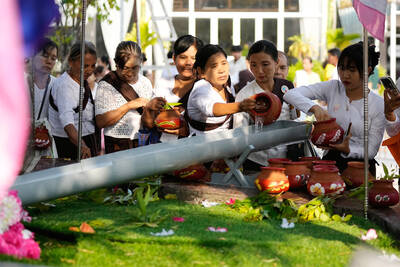
Burmese President Min Aung Hlaing yesterday cut all prisoners’ sentences by one-sixth, a blanket measure that a source close to deposed leader Aung San Suu Kyi said would further shorten her detention. Aung San Suu Kyi has been sequestered since a 2021 military coup, but the senior member of her dissolved National League for Democracy (NLD) party said that while her term had been reduced, her remaining sentence is still unclear. “We also don’t know exactly how many years she has left,” the source told reporters, speaking on condition of anonymity for security reasons. The military toppled Aung San Suu Kyi’s elected government


 RSS
RSS