


Thai Prime Minister Anutin Charnvirakul is widely expected to remain the country’s head after this weekend’s general election, regardless of the result.
His Bhumjaithai Party came third in the last vote, but Anutin — who championed Thailand’s decriminalization of cannabis — became prime minister in September last year after his predecessor, Paetongtarn Shinawatra, was ousted by court order.
“I came into office with a majority in the parliament,” Anutin said. “So it is clearly democratic.”
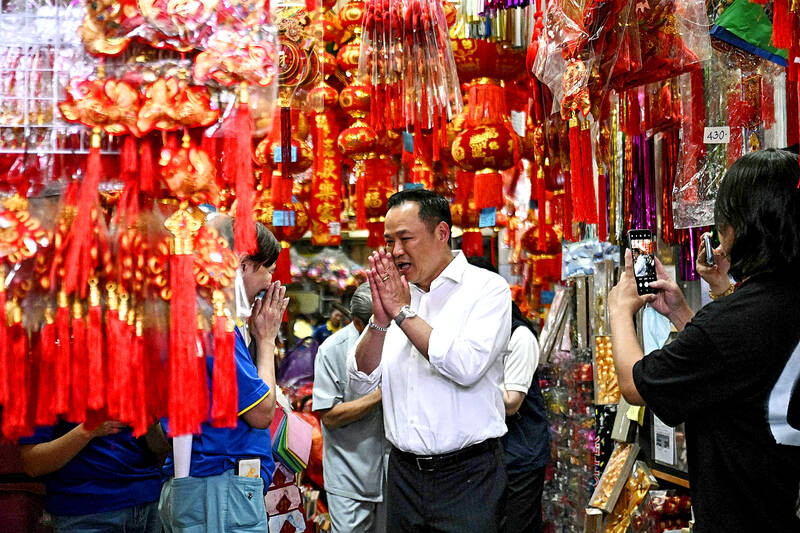
Photo: AFP
He secured the position with the backing of the reformist People’s Party, the largest parliamentary grouping, which opinion polls project would come first again this time — ahead of Bhumjaithai.
No overall majority is forecast, and analysts expect Anutin to emerge from the post-election negotiations at the head of a new coalition.
Its most likely partner is probable third-placed Pheu Thai, the party of the Shinawatra clan, which has dominated politics for two decades, although founder and former Thai prime minister Thaksin Shinawatra is now in prison.
“I have not prepared for loss,” Anutin said.
Despite his wealth, Anutin styles himself as a man of the people with a taste for street food, and appears on social media wearing a T-shirt and shorts while stir-frying with a wok, or performing 1980s Thai pop on the saxophone or piano.
A scion of a political and business dynasty, the family fortune centers on Sino-Thai Engineering, a construction firm that has secured lucrative government contracts over the decades, including for Bangkok’s main airport and the parliament building. His father was acting prime minister during a 2008 political crisis and went on to spend three years as interior minister.
Anutin’s political fortunes have long been intertwined with those of the Shinawatras, as ally and rival.
Anutin joined Thaksin’s party, then named Thai Rak Thai, in his early 30s and was banned from political activity for five years when it was dissolved in 2007.
Grounded from politics, he learned to fly, collecting a small fleet of private planes he used to deliver donated organs to hospitals for transplants.
He returned as leader of Bhumjaithai, a party that has proved something of a political chameleon, joining several government coalitions — he served as deputy to his three prime ministerial predecessors, including Paetongtarn.
Anutin managed tourism-reliant Thailand’s COVID-19 pandemic response as minister of health under a military-led government, and made global headlines when he delivered in 2022 on a campaign promise to legalize cannabis, in an attempt to stimulate the economy.
The Shinawatras’ grip on power is now faltering and their electoral appeal fading, with Thaksin jailed for corruption during his time in office, and his daughter Paetongtarn removed as leader by the Constitutional Court over her handling of a simmering border dispute with Cambodia.
Anutin pulled Bhumjaithai out of a coalition with Pheu Thai in June last year after Paetongtarn addressed Cambodia’s former leader Hun Sen as “uncle” and referred to a Thai military commander as her “opponent” in a leaked phone call, causing a widespread backlash.
Fighting broke out between the neighbors last year, leaving scores dead on both sides and displacing more than 1 million people.
Analysts said the wave of nationalism resulting from the border conflict has bolstered support for Bhumjaithai, whose opposition to loosening Thailand’s strict royal insult laws is seen as evidence of its conservative instincts.
“The conflict reshaped voter priorities around the role of the military and its role in safeguarding Thailand’s territorial sovereignty,” political scientist Napon Jatusripitak said. “The only credible party that can take ... a nationalist and a hawkish stance on the issue would be Bhumjaithai.”
Three months after taking office and before a ceasefire in December last year, Anutin dissolved parliament and called an election.
“Nobody wants fighting, nobody wants conflict, but we have to defend our integrity and sovereignty,” he said.

Young Chinese, many who fear age discrimination in their workplace after turning 35, are increasingly starting “one-person companies” that have artificial intelligence (AI) do most of the work. Smaller start-ups are already in vogue in Silicon Valley and elsewhere, with rapidly advancing AI tools seen as a welcome teammate even as they threaten layoffs at existing firms. More young people in China are subscribing to the model, as cities pledge millions of dollars in funding and rent subsidies for such ventures, in alignment with Beijing’s political goal of “technological self-reliance.” “The one-person company is a product of the AI era,” said Karen Dai

South Korea’s air force yesterday apologized for a 2021 midair collision involving two fighter jets, a day after auditors said the pilots were taking selfies and filming during the flight and held them responsible for the accident. “We sincerely apologize to the public for the concern caused by the accident that occurred in 2021,” an air force spokesman told a news conference, adding that one of the pilots involved had been suspended from flying duties, received severe disciplinary action and has since left the military. The apology followed a report released on Wednesday by the South Korean Board of Audit and Inspection,

About 240 Indians claiming descent from a Biblical tribe landed at Tel Aviv airport on Thursday as part of a government operation to relocate them to Israel. The newcomers passed under a balloon arch in blue and white, the colors of the Israeli flag, as dozens of well-wishers welcomed them with a traditional Jewish song. They were the first “bnei Menashe” (“sons of Manasseh”) to arrive in Israel since the government in November last year announced funding for the immigration of about 6,000 members of the community from the states of Manipur and Mizoram in northeast India. The community claims to descend from

‘TROUBLING’: The firing of Phelan, who was an adviser to a nonprofit that supported the defense of Taiwan, was another example of ‘dysfunction’ under Trump, a US senator said US Secretary of the Navy John Phelan has been fired, a US official and a person familiar with the matter said on Wednesday, in another wartime shakeup at the Pentagon coming just weeks after US Secretary of Defense Pete Hegseth ousted the Army’s top general. The Pentagon announced his departure in a brief statement, saying he was leaving the administration “effective immediately,” but it did not provide a reason or say whether it was his decision to go. The sources, who spoke on condition of anonymity, said Phelan was dismissed in part because he was moving too slowly to implement reforms to


 RSS
RSS