


As countries step up their use of Internet shutdowns to muzzle dissent, some are also taking advantage of the blackouts to increase censorship firewalls, Internet privacy company Proton said.
Proton, known for its encrypted e-mail and virtual private network (VPN) services, has for years observed how authoritarian governments apply “censorship as a playbook,” lead product manager Antonio Cesarano said.
Increasingly, it is observing governments in countries such as Iran and Myanmar emerging from Internet shutdowns with a supercharged ability to censor Internet access.

Photo: AFP
VPNs delivered by Proton and others provide a secure, encrypted connection over the Internet between a user and a server, giving users greater anonymity and often allowing them to avoid local restrictions on Internet use. However, the company worries governments are using long blackouts to beef up their ability to counter VPNs.
In several cases, internet shutdowns saw countries’ censorship capabilities “going from nothing, or something laughable, to something very skilled,” Cesarano said.
Proton VPN general manager David Peterson said the sudden jump in capabilities could indicate that “censorship as a service” technology “is being sold by other countries that have more know-how.”
“For example, over the past couple of years, we’ve seen the Chinese ‘great firewall’ technology used by Myanmar, Pakistan and some African nations,” he said.
The trend is emerging as the willingness to impose total Internet shutdowns is also growing, said Proton, which runs a non-profit VPN Observatory that tracks demand for its free VPN services to detect government crackdowns and attacks on free speech.
Cesarano, the spokesman for Proton’s Internet censorship and online freedom work, said the extreme and once almost unthinkable measure has “happened three times in six months.”
He highlighted the shutdown in Iran, when the country’s more than 90 million people were forced offline for nearly three weeks, obscuring a crackdown on country-wide protests which rights groups say killed thousands of people.
There was also the week-long shutdown implemented in Uganda in the days prior to the elections last month, and Afghanistan’s Internet and telecoms blackout last year.
Iran also completely shuttered the Internet for a week in June last year amid the conflict with Israel.
Blacking out the Internet completely was “very concerning, because it is very extreme,” Cesarano said, adding that a country’s entire economy basically grinds to a halt when the Internet shuts down.
“It’s very dangerous and costly for the population,” he said.
In some countries, such as Myanmar, where VPN use is illegal, the authorities deploy fake VPNs “as honeypots” to detect dissidents, Cesarano said.
Police might also stop people on the streets and search their phones for VPNs, he added.
Proton spokesman Vincent Darricarrere said the company launched a special feature “to disguise the VPN app and to disguise it as a different app, like a weather app or the calculator,” to help people escape detection.
Cesarano said the VPN Observatory can predict that a clampdown is coming from spikes in sign-ups.
Right before Iran’s Internet shutdown took effect on Jan. 8, the VPN Observatory noted a 1,000 percent rise in use of Proton’s VPN services, indicating an awareness of the coming clampdown.
It saw an 890 percent hike in VPN sign-ups in Uganda in the days before last month’s elections, the observatory said.

ROCKY RELATIONS: The figures on residents come as Chinese tourist numbers drop following Beijing’s warnings to avoid traveling to Japan The number of Chinese residents in Japan has continued to rise, even as ties between the two countries have become increasingly fractious, data released on Friday showed. As of the end of December last year, the number of Chinese residents had increased by 6.5 percent from the previous year to 930,428. Chinese people accounted for 22.6 percent of all foreign residents in Japan, making them by far the largest group, Japanese Ministry of Justice data showed. Beijing has criticized Tokyo in increasingly strident terms since Japanese Prime Minister Sanae Takaichi last year suggested that a military conflict around Taiwan could

Germany is considering Australia’s Ghost Bat robot fighter as it looks to select a combat drone to modernize its air force, German Minister of Defense Boris Pistorius said yesterday. Germany has said it wants to field hundreds of uncrewed fighter jets by 2029, and would make a decision soon as it considers a range of German, European and US projects developing so-called “collaborative combat aircraft.” Australia has said it will integrate the Ghost Bat, jointly developed by Boeing Australia and the Royal Australian Air Force, into its military after a successful weapons test last year. After inspecting the Ghost Bat in Queensland yesterday,

A pro-Iran hacking group claimed to breach FBI Director Kash Patel’s personal e-mail inbox and posted some of the contents online. The e-mails provided by the hacking group include travel details, correspondence with leasing agents in Washington and global entry, and loyalty account numbers. The e-mail address the hackers claim to have compromised has been previously tied to Patel’s personal details, and the leaked e-mails contain photos of Patel and others, in addition to correspondence with family members and colleagues. “The FBI is aware of malicious actors targeting Director Patel’s personal email information,” the agency said in a statement on
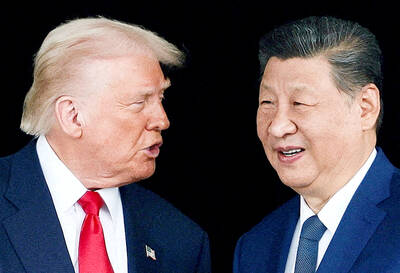
RIVALRY: ‘We know that these are merely symbolic investigations initiated by China, which is in fact the world’s most profligate disrupter of supply chains,’ a US official said China has started a pair of investigations into US trade practices, retaliating against similar probes by US President Donald Trump’s administration as the superpowers stake out positions before an expected presidential summit in May. The move, announced by the Chinese Ministry of Commerce on Friday, is a direct mirror of steps Trump took to revive his tariff agenda after the US Supreme Court last month struck down some of his duties. “China expresses its strong dissatisfaction and firm opposition to these actions,” a ministry spokesperson said in a statement, referring to the so-called Section 301 investigations initiated on March 11.


 RSS
RSS