


Italy has thwarted a series of Russian cyberattacks targeting the Milan-Cortina Winter Olympics, the Italian minister of foreign affairs said on Wednesday.
The attacks were “on foreign ministry offices, starting with Washington, and also some Winter Olympics sites, including hotels in Cortina,” Italian Minister of Foreign Affairs and International Cooperation Antonio Tajani said.
His office said the attacks had affected about 120 sites, including Italy’s embassy in Washington, but had since been “effectively neutralized.”
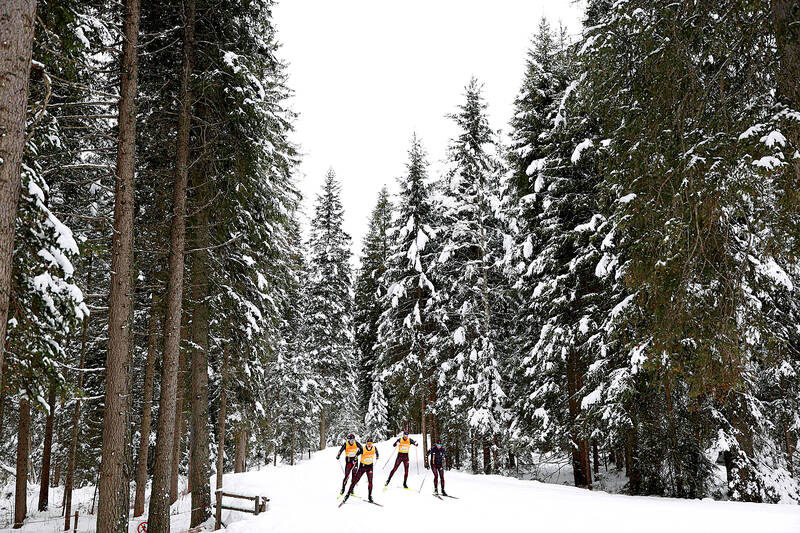
Photo: AFP
A Russian hacker group claimed responsibility for the attack, which it said was in response to the Italian government’s support for Ukraine.
“The pro-Ukrainian course of the Italian government leads to the fact that support for Ukrainian terrorists is punishable by our DDoS [distributed denial-of-service] missiles on Web sites,” a Telegram channel purporting to represent the group Noname057 wrote on the app.
DDoS attacks halt access to a Web site by overloading its servers with traffic.
The group said it had attacked the Web sites of several hotels in Cortina d’Ampezzo, one of the towns hosting events for the Games. Access to one of them remained blocked on Wednesday afternoon.
Italy has deployed about 6,000 police plus nearly 2,000 military personnel across the Games area, which stretches across half a dozen sites from Milan to the Dolomites.
Bomb disposal experts, snipers, anti-terrorism units and skiing police officers are among those deployed.
The Italian Ministry of Defense is also providing 170 vehicles plus radars, drones and aircraft.
Security is particularly focused on Milan, where political leaders including US Vice President J.D. Vance are expected for today’s opening ceremony.
The issue has become a fraught topic after it emerged that agents from the controversial US Immigration and Customs Enforcement (ICE) would be present.
Italian Minister of the Interior Matteo Piantedosi said ICE agents would not be patrolling the streets of Milan.
ICE’s Homeland Security Investigations (HSI) arm would operate within US diplomatic missions only, “are not operational agents” and “have no executive function,” he said.
It was standard for countries to send security officials to the Olympics, with Italy having sent them to Paris for the 2024 Games, Piantedosi said.
“ICE does not and will never be able to carry out operational police activities on our national territory,” he said.
The HSI investigates global threats, and is separate from the department carrying out the US immigration crackdown that has sparked widespread protests.
US Ambassador to Italy Tilman Fertitta said the HSI would be “strictly advisory and intelligence-based, with no patrolling or enforcement involvement.”
“At the Olympics, HSI criminal investigators will contribute their expertise by providing intelligence on transnational criminal threats, with a focus on cybercrimes and national security threats,” he said.
See CURLING on page 6

ROCKY RELATIONS: The figures on residents come as Chinese tourist numbers drop following Beijing’s warnings to avoid traveling to Japan The number of Chinese residents in Japan has continued to rise, even as ties between the two countries have become increasingly fractious, data released on Friday showed. As of the end of December last year, the number of Chinese residents had increased by 6.5 percent from the previous year to 930,428. Chinese people accounted for 22.6 percent of all foreign residents in Japan, making them by far the largest group, Japanese Ministry of Justice data showed. Beijing has criticized Tokyo in increasingly strident terms since Japanese Prime Minister Sanae Takaichi last year suggested that a military conflict around Taiwan could

Germany is considering Australia’s Ghost Bat robot fighter as it looks to select a combat drone to modernize its air force, German Minister of Defense Boris Pistorius said yesterday. Germany has said it wants to field hundreds of uncrewed fighter jets by 2029, and would make a decision soon as it considers a range of German, European and US projects developing so-called “collaborative combat aircraft.” Australia has said it will integrate the Ghost Bat, jointly developed by Boeing Australia and the Royal Australian Air Force, into its military after a successful weapons test last year. After inspecting the Ghost Bat in Queensland yesterday,
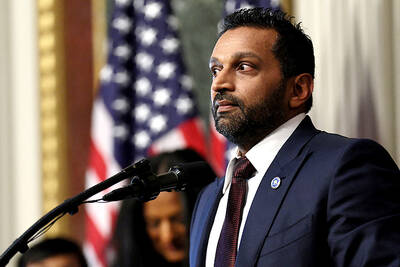
A pro-Iran hacking group claimed to breach FBI Director Kash Patel’s personal e-mail inbox and posted some of the contents online. The e-mails provided by the hacking group include travel details, correspondence with leasing agents in Washington and global entry, and loyalty account numbers. The e-mail address the hackers claim to have compromised has been previously tied to Patel’s personal details, and the leaked e-mails contain photos of Patel and others, in addition to correspondence with family members and colleagues. “The FBI is aware of malicious actors targeting Director Patel’s personal email information,” the agency said in a statement on
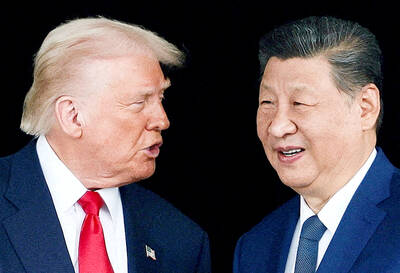
RIVALRY: ‘We know that these are merely symbolic investigations initiated by China, which is in fact the world’s most profligate disrupter of supply chains,’ a US official said China has started a pair of investigations into US trade practices, retaliating against similar probes by US President Donald Trump’s administration as the superpowers stake out positions before an expected presidential summit in May. The move, announced by the Chinese Ministry of Commerce on Friday, is a direct mirror of steps Trump took to revive his tariff agenda after the US Supreme Court last month struck down some of his duties. “China expresses its strong dissatisfaction and firm opposition to these actions,” a ministry spokesperson said in a statement, referring to the so-called Section 301 investigations initiated on March 11.


 RSS
RSS