


Tending crops by day and then logging on for a night shift of data labeling, 27-year-old Chandmani Kerketta is part of a rising rural Indian workforce helping power an artificial intelligence (AI) revolution.
From her home in India’s eastern Jharkhand state, Kerketta is part of an AI-driven labor shift that the government hopes would transform lives, including by bringing more women into the workforce.
The work is basic, but essential for machine learning — data labeling, annotation and quality checks.
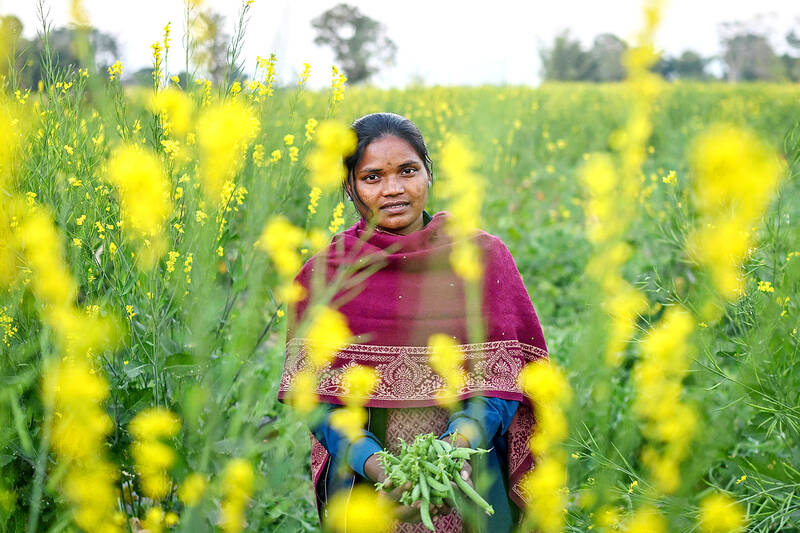
Photo: AFP
It is the type of information key for driverless cars.
“This job helped me finish my studies, and help at home on our farm,” Kerketta said as she tended tomatoes and peas.
Kerketta, from one of India’s constitutionally recognized tribal communities, was the first in her family to attend college.
She initially worked as an office assistant at a data-processing firm in Jharkhand’s capital, Ranchi, where she watched employees working at computers, but after a computer course at her village school, Kerketta joined an estimated workforce of at least 200,000 annotators in India’s villages and small towns — a growing figure, and roughly half of the world’s data-labeling workforce, according to US-based Scry AI.
Rural-based workers can label hundreds of images, videos and documents during eight-hour shifts, either from home or from modest Internet-connected centers.
“After my night shift of data work, I sleep a little, and then help in farming,” said Kerketta, who now holds a history degree. “In Jharkhand, farming is everything.”
Anju Kumari, 25, another rural AI worker in Jharkhand using a national fiber-optic cable network laid by Indian Railways, said the job had provided her with a pathway to a wider world.
Kumari said that work can include painstaking “labeling videos frame-by-frame,” giving the example of teaching AI whether a person using an ATM is “likely a burglar, or someone genuinely drawing cash.”
India, which is to host an international AI summit next month, has ambitious plans.
It is now third in a global AI power ranking, overtaking South Korea and Japan, based on more than 40 indicators from patents to private funding calculated by Stanford University’s Institute for Human-Centered AI.
US tech giants including Google, Microsoft and Amazon have announced multibillion-dollar investments to build some of the world’s biggest data centers in India.
The country is no stranger to back-end work for global technology firms.
Cities such as Bengaluru, Hyderabad and Chennai host major international players, but India’s AI push is also expanding into more remote regions.
In Tamil Nadu state, along a winding rural road, Indu Nadarajan travels to a small-town office where she labels images for autonomous vehicles, such as road markings, headlights and animals.
Nadarajan works for NextWealth, an AI-enabling services firm headquartered in Bengaluru, with offices across small towns, supporting clients from the US, Europe and Asia.
“Many go to Chennai and Bengaluru to learn about AI, but being here in our hometown and learning about AI makes me feel very proud,” said Nadarajan, who has a master’s degree in mathematics.
Every AI model relies on vast amounts of labeled data, regardless of its complexity. The more precise the labeling, the better the technology performs.
“When I can design a product for a US company 5,000 miles [8,047km] away, why can’t I do it from 200 miles away?” said NextWealth founder Sridhar Mitta, 80, a former chief technology officer at Indian technology giant Wipro. “Anybody can be anywhere and do the things, because the value goes through the Internet.”
His scattered employees earn anywhere between US$275 to US$550 a month.
While AI-driven automation might render some jobs obsolete, Mitta believes it would also generate opportunities.
“Micro-entrepreneurship will be the next phase for small towns,” Mitta said. “It may not be another billion-dollar company, but they will produce something which will be useful to the region.”
As AI reaches rural India, it is quietly reshaping lives — particularly for women from conservative backgrounds.
For Amala Dhanapal, a colleague of Nadarajan and the first graduate in her family — her father is a tailor and her mother a homemaker — working in AI has changed attitudes.
“It’s a big thing,” Dhanapal said, adding that it provided a gateway to learning and greater financial independence. “Most girls find it difficult to even pursue their education due to their family background.”
When Kerketta first began her data-annotation work, villagers mocked her.
“Now, when they see me going around on my scooter, they look at me with pride,” she said. “Just like I do myself.”
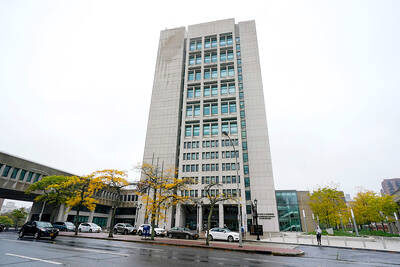
A coalition of civil rights groups on Tuesday asked a New York State judge to order one of its largest suburban counties to stop its deployment of nearly 600 license plate readers, calling it a warrantless and “indiscriminate surveillance system” that violates the state constitution. The class action lawsuit also alleged that Westchester County never got proper authorization to launch the program, which has amassed a database of 1.6 billion plate scans that has been shared with more than 50 outside law enforcement agencies. The complaint said the network “records the long-term travel patterns, daily habits, and intimate information of millions of

Pope Leo XIV on Wednesday blessed a giant new tower at Barcelona’s famed Sagrada Familia Basilica after celebrating mass inside what is now the world’s tallest church. A fireworks and light show illuminated the exterior of the temple at the end of the ceremony, bathing the unfinished basilica in shifting colours that highlighted its towering spires. A choir of 600 singers performed at the service which lasted around 90 minutes and was attended by Spanish Prime Minister Pedro Sanchez as well as King Felipe VI and Queen Letizia. The stained-glass windows in various colours shone brightly in between the tree-like

Voters in Switzerland yesterday cast their ballots on an initiative championed by the top right-wing party to cap the Alpine country’s population at 10 million. As of press time last night, early results showed that Swiss voters were leaning against it. The populist Swiss People’s Party, which has the most seats in parliament, has stirred up and fostered anti-migration sentiment over the years, notably about an influx of workers from the neighboring EU. Critics called the bid a self-inflicted wound, saying the boom in migration over the past generation has brought foreign labor and skills to sectors such as healthcare, finance, pharmaceuticals

Scientists have discovered communities of marine life — including jellyfish, tubeworms and brittle stars — thriving on a whale graveyard. The graveyards form when whale carcasses fall to the sea floor, becoming a sustaining snack for nearby critters. This one, which is up to 7km below the surface of the southeastern Indian Ocean, spans the largest area, and is so far the deepest found. A whale’s sheer size and the unique chemistry of its bones are the keys to forming these unique underwater neighborhoods, said Song Xikun (宋希坤), a biologist with the Chinese Academy of Sciences’ Institute of Deep-sea Science and Engineering


 RSS
RSS