


Come Thursday, barring a last-minute change, the final treaty in the world that restricted nuclear weapons deployments would be over.
New START, the last nuclear treaty between Washington and Moscow after decades of agreements dating to the Cold War, is set to expire, and with it restrictions on the two top nuclear powers. The expiration comes as US President Donald Trump, vowing “America first,” smashes through international agreements that limit the US, although in the case of New START, the issue might more be inertia than ideology.
Russian President Vladimir Putin in September last year suggested a one-year extension of New START.
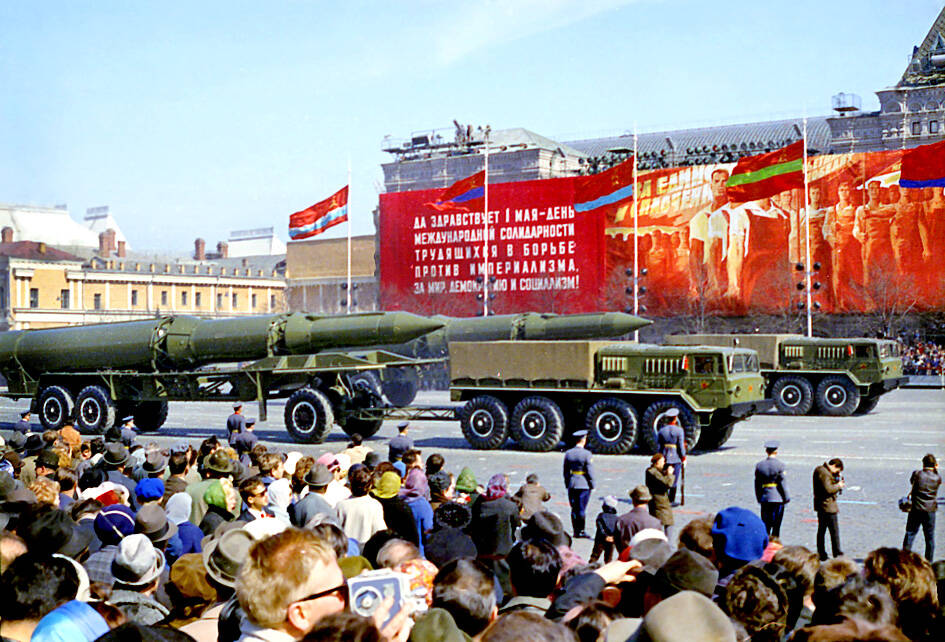
Photo: AP
Trump, asked afterward by a reporter for a reaction while he was boarding his helicopter, said an extension “sounds like a good idea to me” — but little has been heard since.
Former Russian president Dmitry Medvedev, who signed New START with then-US president Barack Obama in 2010, said in a recent interview with the Kommersant newspaper that Russia has received no “substantive reaction” on New START, but was still giving time to Trump.
A White House official said on condition of anonymity that Trump would like to see “limits on nuclear weapons and involve China in arms control talks.”
Photo: AFP
The way to do that, Trump “will clarify on his own timeline,” the official said.
Daryl Kimball, executive director of the Arms Control Association, which supports reducing nuclear risks, said Trump’s second administration, which has sidelined career diplomats and entrusted decisionmaking only to a handful of people, is not functioning in a normal way that would allow complex negotiations.
Trump “seems to have the right instinct on this issue, but has thus far failed to follow through with a coherent strategy,” Kimball said.
Jon Wolfsthal, director of global risk at the Federation of American Scientists, said Trump and Putin could pick up the phone and agree immediately at a political level to extend New START.
“This is a piece of low-hanging fruit that the Trump administration should have seized months ago,” he said.
Trump in October last year called for the US to resume nuclear testing for the first time in more than 30 years, although it is not clear he would carry it out.
Moscow in 2023 already suspended a key element of New START allowing inspections, as relations deteriorated sharply with then-US president Joe Biden’s administration over Russia’s invasion of Ukraine.
Alexander Khramchikhin, a Russian military analyst, said the two powers already had indicated they would do as they like.
“It’s clear that the treaty has reached its end,” he said. “It’s just an empty formality that will disappear.”
Vassily Kashin, director of the Center for Comprehensive European and International Studies in Moscow, said Russia would watch if the US ramps up its nuclear arsenal and, if so, would decide measures in response.
“But if the Americans don’t take any drastic measures, such as installing warheads, Russia will most likely simply wait, observe and remain silent,” he said.
New START restricted Russia and the US to a maximum of 1,550 deployed strategic nuclear warheads each — a reduction of nearly 30 percent from the previous limit set in 2002. It also limits launchers and heavy bombers to 800 each, although the number is still easily enough to destroy Earth.
During his first term, also faced with New START’s expiration, Trump insisted a new treaty bring in China — whose arsenal is fast growing, although well below the other two powers. A US negotiator even provocatively put an empty chair with a Chinese flag.
Biden on taking office in 2021 quickly agreed to extend New START by five years to this year. Despite his stance on New START, Trump has enthusiastically restarted diplomacy with Russia that Biden cut off over the war, inviting Putin to an August summit in Alaska and unsuccessfully trying to broker a deal in Ukraine.
US allies France and the UK also have established nuclear arsenals on a smaller scale, while India, Pakistan, Israel and North Korea have known nuclear weapons, but are not part of international agreements.

An American scientist convicted of lying to US authorities about payments from China while he was at Harvard University has rebuilt his research lab in Shenzhen, China, to pursue technology the Chinese government has identified as a national priority: embedding electronics into the human brain. Charles Lieber, 67, is among the world’s leading researchers in brain-computer interfaces. The technology has shown promise in treating conditions such as amyotrophic lateral sclerosis and restoring movement in paralyzed people. It also has potential military applications: Scientists at the Chinese People’s Liberation Army have investigated brain interfaces as a way to engineer super soldiers by boosting
Jailed media entrepreneur Jimmy Lai (黎智英) has been awarded Deutsche Welle’s (DW) freedom of speech award for his contribution to Hong Kong’s pro-democracy movement. The German public broadcaster on Thursday said Lai would be presented in absentia with the 12th iteration of the award on June 23 at the DW Global Media Forum in Bonn. Deutsche Welle director-general Barbara Massing praised the 78-year-old founder of the now-shuttered news outlet Apple Daily for standing “unwaveringly for press freedom in Hong Kong at great personal risk.” “With Apple Daily, he gave journalists a platform for free reporting and a voice to the democracy movement in
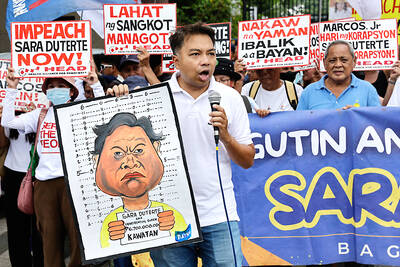
PHILIPPINE COMMITTEE: The head of the committee that made the decision said: ‘If there is nothing to hide, there is no reason to hide, there is no reason to obstruct’ A Philippine congressional committee on Wednesday ruled that there was “probable cause” to impeach Philippine Vice President Sara Duterte after hearing allegations of unexplained wealth, misuse of state funds and threats to have the president assassinated. The unanimous decision of the 53-member committee in the Philippine House of Representatives sends the two impeachment complaints to deliberations and voting by the entire lower chamber, which has more than 300 lawmakers. The complaints centered on Duterte’s alleged illegal use and mishandling of intelligence funds from the vice president’s office, and from her time as education secretary under Philippine President Ferdinand Marcos Jr. Duterte and the
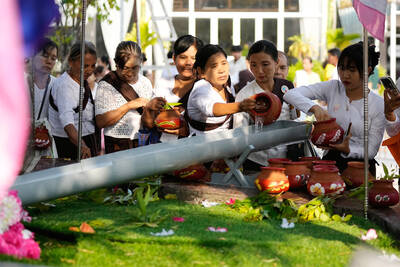
Burmese President Min Aung Hlaing yesterday cut all prisoners’ sentences by one-sixth, a blanket measure that a source close to deposed leader Aung San Suu Kyi said would further shorten her detention. Aung San Suu Kyi has been sequestered since a 2021 military coup, but the senior member of her dissolved National League for Democracy (NLD) party said that while her term had been reduced, her remaining sentence is still unclear. “We also don’t know exactly how many years she has left,” the source told reporters, speaking on condition of anonymity for security reasons. The military toppled Aung San Suu Kyi’s elected government


 RSS
RSS