


Germany plans to better protect its critical infrastructure as surging tensions with Russia stoke fears of sabotage attacks and other national security threats.
Proposed legislation would require power utilities, water companies and even some supermarket chains to reduce their vulnerability to terrorism, industrial accidents, natural disasters and public health emergencies.
The package, which aims to bring Germany in line with EU directives, would oblige essential services providers to step up physical security and alarm systems, carry out regular risk assessments and promptly report incidents.
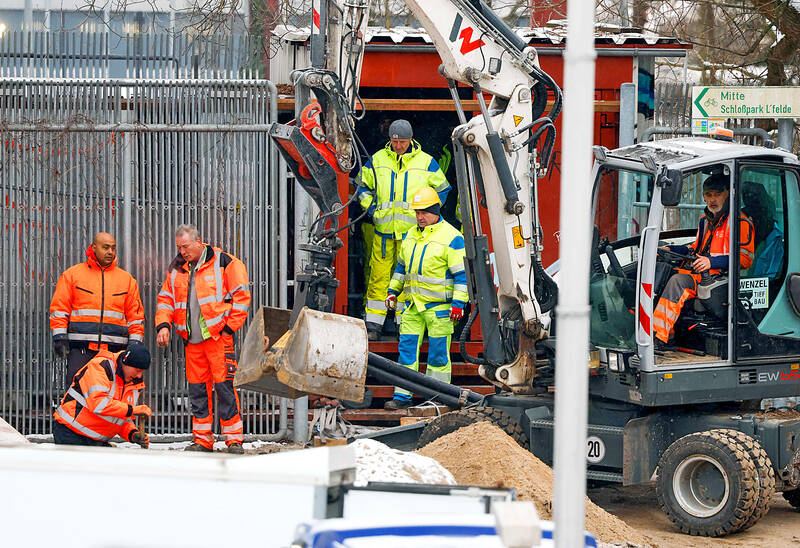
Photo: AFP
The measures cover facilities that provide critical services to more than 500,000 people in sectors including energy, water, food, health, transportation, information technology, telecommunications, financial services and waste disposal.
A wake-up call came weeks ago in Berlin when a midwinter arson attack on a high-voltage power cable claimed by a far-left militant group plunged tens of thousands of households into icy darkness for nearly a week.
“The left-wing extremist attack on the Berlin power grid and all the many other attacks — both small and large — in recent months have shown that we simply have to protect our critical infrastructure better,” German Chancellor Friedrich Merz said on Wednesday.
Information about such infrastructure should no longer be so easily available to the public, he said, calling for a shift from “transparency towards greater resilience.”
German lawmaker Konstantin von Notz, a security expert, said that the government’s response to the mounting threats had been “wholly inadequate” and that the new package is “far too late and too poorly crafted.”

Crowds in Bangladesh are flocking to snap photographs with an unlikely social media star — an albino buffalo with flowing blond hair nicknamed “Donald Trump” that is due to be sacrificed within days. Owner Zia Uddin Mridha, 38, said his brother named the 700kg bull over its flowing helmet of hair resembling the signature look of the US president. “My younger brother picked this name because of the buffalo’s extraordinary hair,” he said at his farm in Narayanganj, just outside the capital, Dhaka. Mridha said that a constant stream of curious visitors — social media fans, onlookers and children — have come throughout

It began as a satirical online project. Now millions of young people in India are flocking to it as an outlet for their frustration. A parody political party called the Cockroach Janta Party, with the insect as its symbol, has exploded across India’s social media by turning absurdist humor into protest. Memes and short videos mocking corruption, joblessness and political dysfunction have flooded social media sites, where millions of users are embracing the cockroach — known for its ability to survive harsh conditions — as a tongue-in-cheek symbol of endurance. The online movement’s rise has been unusually rapid. The Cockroach Janta Party (CJP)
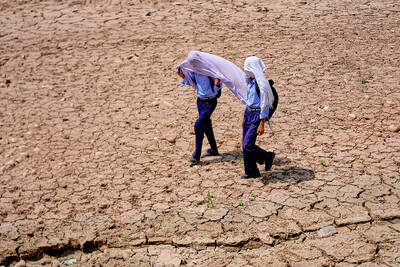
HOTTER: While Indians are accustomed to summer heat, climate change has caused northwestern India to warm faster than other parts of the country, an academic said Roads and markets have emptied during afternoons and some farmers have switched to nighttime work to avoid scorching temperatures as a heat wave grips large parts of India. The India Meteorological Department forecast maximum temperatures for yesterday of about 45°C in the capital, New Delhi, where authorities have opened temporary “cooling zones” to help people cope. The weather department warned that conditions would likely persist across several northern regions in the coming days, with temperatures staying well above seasonal averages. Authorities urged people to stay indoors during the hottest hours and take precautions against heat-related illnesses. India declares a heat wave whenever maximum temperatures

A Hong Kong astronaut is to join a Chinese space mission for the first time as part of a three-person crew launching today, as Beijing edges closer to its goal of landing people on the moon. The Tiangong space station — crewed by teams of three astronauts that are typically rotated every six months — is the crown jewel of China’s space program, boosted by billions in state investment in a bid to catch up with the US and Russia. The Shenzhou-23 mission is to blast off at 11:08pm from the Jiuquan Satellite Launch Center in northwestern China, carrying three astronauts to


 RSS
RSS