


Atomic scientists on Tuesday set their “Doomsday Clock” closer than ever to midnight, citing aggressive behavior by nuclear powers Russia, China and the US, fraying nuclear arms control, conflicts in Ukraine and the Middle East, Beijing’s actions around Taiwan and artificial intelligence (AI) worries among factors driving risks for global disaster.
The Bulletin of the Atomic Scientists set the clock to 85 seconds before midnight, the theoretical point of annihilation. That is four seconds closer than it was set last year.
The Chicago-based nonprofit created the clock in 1947 during the Cold War to warn the public about how close humankind was to destroying the world.
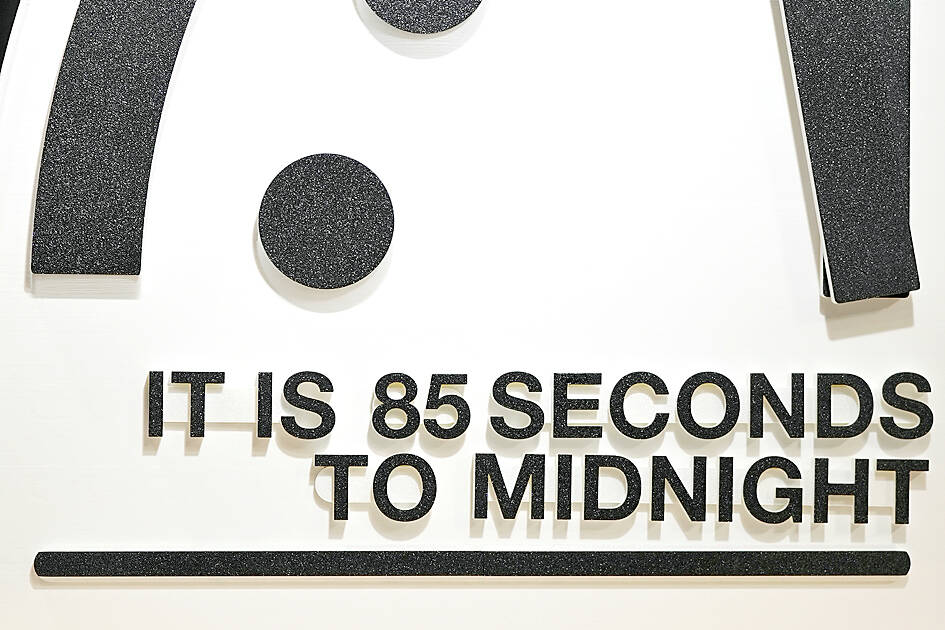
Photo: AP
The scientists voiced concern about threats of unregulated integration of AI into military systems and its potential misuse in aiding the creation of biological threats, as well as its role in spreading disinformation. They also noted continuing climate change challenges.
“Of course, the Doomsday Clock is about global risks, and what we have seen is a global failure in leadership,” nuclear policy expert and Bulletin president and CEO Alexandra Bell said. “No matter the government, a shift towards neo-imperialism and an Orwellian approach to governance will only serve to push the clock toward midnight.”
It was the third time in the past four years that the scientists moved the clock closer to midnight.
“In terms of nuclear risks, nothing in 2025 trended in the right direction,” Bell said. “Longstanding diplomatic frameworks are under duress or collapsing, the threat of explosive nuclear testing has returned, proliferation concerns are growing, and there were three military operations taking place under the shadow of nuclear weapons and the associated escalatory threat. The risk of nuclear use is unsustainably and unacceptably high.”
Bell pointed to Russia’s continued war in Ukraine, the US and Israeli bombing of Iran, and border clashes between India and Pakistan. She also cited continuing tensions in Asia, including on the Korean Peninsula and China’s threats toward Taiwan, as well as rising tensions in the western hemisphere since US President Donald Trump returned to office.
Maria Ressa, a 2021 Nobel Peace Prize recipient for her journalistic efforts exposing abuses of power in the Philippines including how social media platforms were used to spread disinformation, participated in the announcement.
She lamented the rise of technology that circulates lies more quickly than facts.
“We are living through an information Armageddon that’s brought about by the technology that rules our lives, from social media to generative AI. None of that tech is anchored in facts. Your chatbot is nothing but a probabilistic machine,” Ressa told an online news conference.
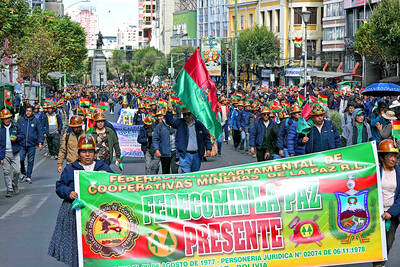
The Bolivian government on Friday struck a deal with protesting miners, but was still grappling with blockades and demonstrations by other workers across La Paz. Other groups are still blocking access roads into the city, which is also the seat of the government. Police on Thursday prevented the miners from entering the main square by using tear gas, while the demonstrators hurled stones and explosives with slingshots. Protests against the policies of Bolivian President Rodrigo Paz have convulsed the Andean nation since early this month, and roadblocks were choking routes into La Paz throughout Friday, the national road authority said. Miners demanded that Paz
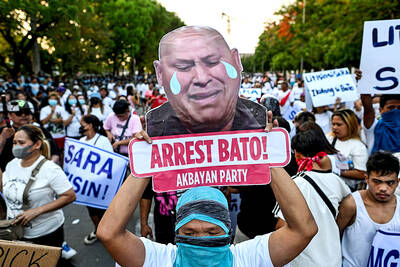
The Philippines said it has asked the country’s Supreme Court to allow it to arrest former Philippine president Rodrigo Duterte’s chief drug war enforcer to stand trial in an international tribunal. The International Criminal Court (ICC) last week unsealed an arrest warrant against Philippine Senator Ronald dela Rosa, accusing him along with Duterte and other “coperpetrators” of the “crime against humanity of murder.” Dela Rosa briefly sought refuge in the Philippine Senate last week while asking the Philippine Supreme Court to stop an ongoing attempt by government agents to arrest him. “By his own conduct, he has placed himself outside the protection of
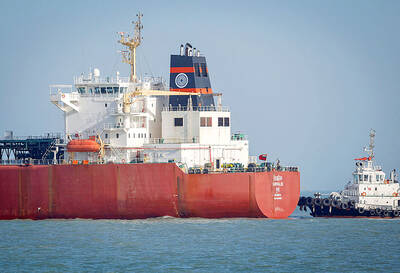
A ship anchored off the United Arab Emirates (UAE) was seized and taken toward Iran and another — a cargo ship near Oman — sank after being attacked, authorities said on Thursday, as tensions escalated near the Strait of Hormuz. It was not immediately clear who was behind these incidents, but they happened as a senior Iranian official reiterated his country’s claim of control over the waterway and another said it had a right to seize oil tankers connected to the US. The turmoil in the strait has been a sticking point for weeks in talks between the US and Iran to

The researchers in Ireland looked at their computer screen, marveling at a medieval book tracked down in a Roman library. They flipped through its digitized pages and found their sought-after treasure: the oldest surviving English poem. “We were extremely surprised. We were speechless. We couldn’t believe our eyes when we first saw that,” said Elisabetta Magnanti, a visiting research fellow at Trinity College Dublin’s school of English. The poem was also within the main body of Latin text, she said, calling it “extraordinary.” Composed in Old English by a Northumbrian agricultural worker in the 7th century, Caedmon’s Hymn appears within some copies of


 RSS
RSS