


Conservative politician and businessman Nasry Asfura was sworn in as president of Honduras on Tuesday after a closely fought election marred by allegations of fraud and political tension fueled by U.S. interference.
Asfura, 67, will serve a four-year term until January 2030. He has pledged to fight poverty, corruption and crime, and to revive the economy in one of the poorest countries in the Western Hemisphere.
"We have to get to work; work with humility and with the total commitment required to bring real solutions to every corner of our beloved Honduras," Asfura said in a ceremony at the National Congress.
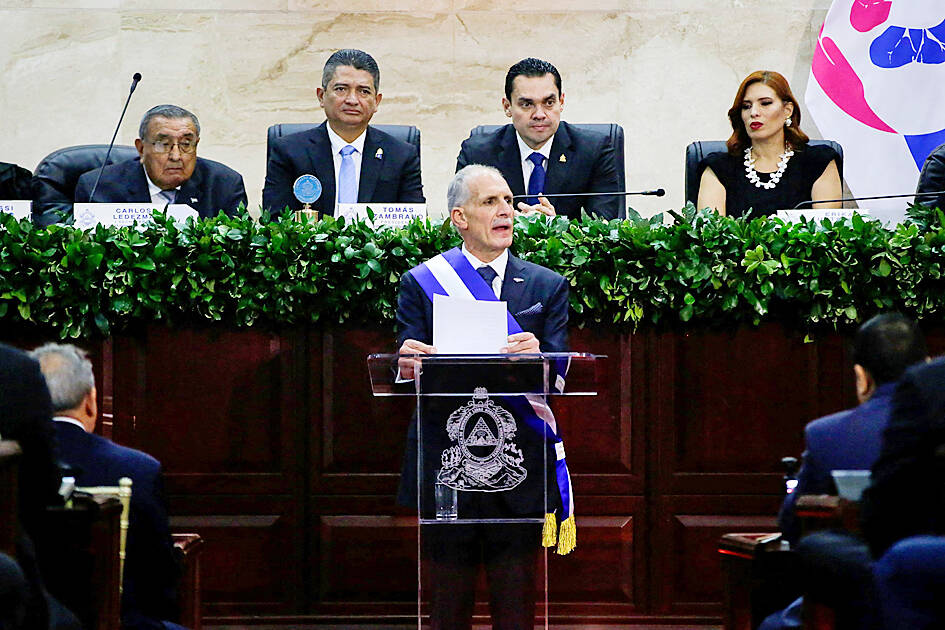
Photo: Reuters
"The clock has started ticking - there is no time to waste. We have to solve people’s problems to serve," he added.
Asfura has also pledged to restore diplomatic relations with Taiwan, which were severed by predecessor Xiomara Castro in 2023. Such a move would be a major diplomatic setback for China in Central America.
A former mayor of Tegucigalpa from 2014 to 2022, Asfura was inaugurated after months of electoral chaos in Honduras, fueled by a last-minute endorsement from U.S. President Donald Trump, a deeply troubled vote-counting process and a razor-thin victory of 26,000 votes over centrist candidate Salvador Nasralla.
Washington said in recent days it aimed to begin negotiations "as ?soon as possible" on a bilateral trade agreement with Honduras.
Still, Asfura enters office facing a delicate balancing act. While his party holds a simple majority, he will need the support of rival parties - including those that alleged voter fraud - in order to ratify international treaties or amend the constitution.
Asfura campaigned on a message of "work and more work," promising to attract investment, create jobs and impose austerity in government spending.
"In Honduras, everything is urgent," said political analyst Luis Leon in Tegucigalpa. "But two issues will determine whether people feel the government is responding: public health and investment to generate jobs."
Last year, government health workers went on strike for nearly a month to protest overdue pay as well as shortages of medicines and supplies.
A recent report by the World Bank, the Pan American Health Organization and journal The Lancet said Honduras’ public health system has deep structural weaknesses that leave it highly vulnerable to health crises.
Outgoing leftist Castro leaves office after expanding public investment and social spending. Her administration oversaw moderate economic growth and declines in poverty and inequality, though both remain high.
The homicide rate fell to its lowest level in recent history, but human-rights groups criticized Castro for maintaining a prolonged state of emergency in parts of the country to combat gang violence and for expanding the role of the military.

An American scientist convicted of lying to US authorities about payments from China while he was at Harvard University has rebuilt his research lab in Shenzhen, China, to pursue technology the Chinese government has identified as a national priority: embedding electronics into the human brain. Charles Lieber, 67, is among the world’s leading researchers in brain-computer interfaces. The technology has shown promise in treating conditions such as amyotrophic lateral sclerosis and restoring movement in paralyzed people. It also has potential military applications: Scientists at the Chinese People’s Liberation Army have investigated brain interfaces as a way to engineer super soldiers by boosting
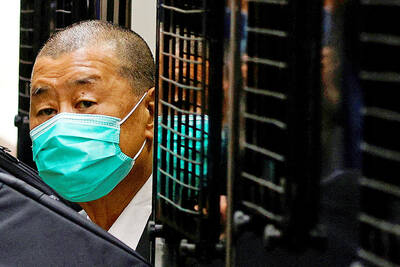
Jailed media entrepreneur Jimmy Lai (黎智英) has been awarded Deutsche Welle’s (DW) freedom of speech award for his contribution to Hong Kong’s pro-democracy movement. The German public broadcaster on Thursday said Lai would be presented in absentia with the 12th iteration of the award on June 23 at the DW Global Media Forum in Bonn. Deutsche Welle director-general Barbara Massing praised the 78-year-old founder of the now-shuttered news outlet Apple Daily for standing “unwaveringly for press freedom in Hong Kong at great personal risk.” “With Apple Daily, he gave journalists a platform for free reporting and a voice to the democracy movement in
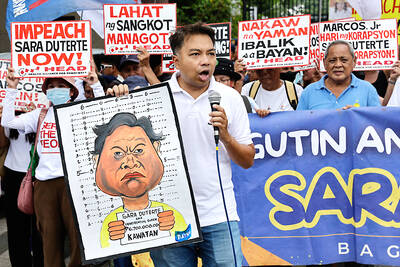
PHILIPPINE COMMITTEE: The head of the committee that made the decision said: ‘If there is nothing to hide, there is no reason to hide, there is no reason to obstruct’ A Philippine congressional committee on Wednesday ruled that there was “probable cause” to impeach Philippine Vice President Sara Duterte after hearing allegations of unexplained wealth, misuse of state funds and threats to have the president assassinated. The unanimous decision of the 53-member committee in the Philippine House of Representatives sends the two impeachment complaints to deliberations and voting by the entire lower chamber, which has more than 300 lawmakers. The complaints centered on Duterte’s alleged illegal use and mishandling of intelligence funds from the vice president’s office, and from her time as education secretary under Philippine President Ferdinand Marcos Jr. Duterte and the
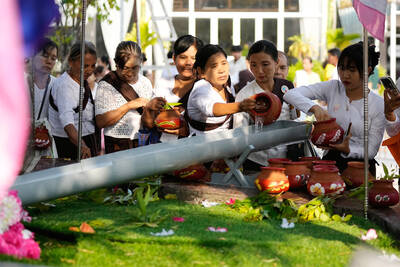
Burmese President Min Aung Hlaing yesterday cut all prisoners’ sentences by one-sixth, a blanket measure that a source close to deposed leader Aung San Suu Kyi said would further shorten her detention. Aung San Suu Kyi has been sequestered since a 2021 military coup, but the senior member of her dissolved National League for Democracy (NLD) party said that while her term had been reduced, her remaining sentence is still unclear. “We also don’t know exactly how many years she has left,” the source told reporters, speaking on condition of anonymity for security reasons. The military toppled Aung San Suu Kyi’s elected government


 RSS
RSS