


When the blaring sirens of ambulances and police cars reverberated through a cold January evening in Manuel Munoz’s Spanish village, he knew something had gone seriously wrong — and raced to help.
Normally quiet Adamuz, bathed in sunshine and surrounded by the Andalusia region’s quintessential olive grove landscape, found itself at the center of global headlines after Sunday’s nearby high-speed train collision killed at least 40 passengers and injured more than 120.
The fatal hit occurred just before 8pm and 60-year-old Munoz was one of several residents who assisted as the emergency services rushed victims from the disaster site to the southern village, helping to unload vans bringing aid.
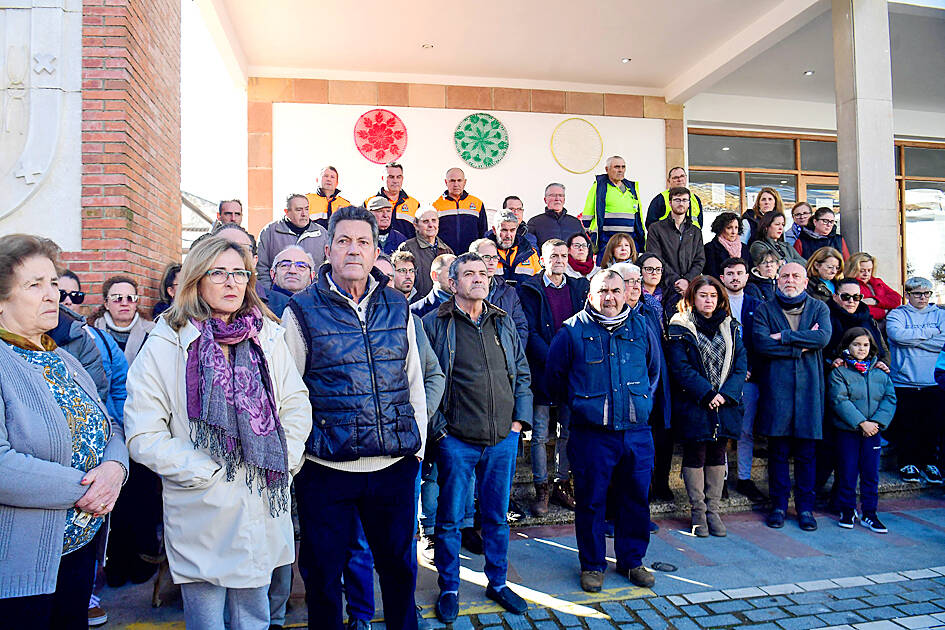
Photo: AFP
“The first thing we did was go to the [municipal] center, we started to bring water, blankets, whatever we could,” he said.
“We came when the first injured arrived. We left because we were hampering the work of the professionals,” added the olive oil factory worker, saying the village was “very shocked.”
The picturesque village morphed into a hive of activity as dozens of journalists swarmed around the village for information and to listen to visiting Spanish Prime Minister Pedro Sanchez in the municipal hall, where piles of donated blankets lay stacked from the previous night.
Mariana Costa, 65, said Adamuz “is a village of solidarity,” commending her neighbors who offered clothes, blankets, water and hot food to the survivors of one of Europe’s deadliest train disasters this century.
One supermarket reopened in the evening to distribute bread, sandwiches and drinks, the housewife said, adding that “the residents responded marvelously” to the traumatic event.
“Today, the whole village is feeling low, because the scale of the accident is very big,” she said. “I love living here, it’s a quiet village, we live well ... this cannot be real.”
Adamuz Mayor Rafael Angel Moreno paid tribute to residents who “dedicated themselves from minute one,” donating food, tools and vehicles to the cause.
“All that we had to hand was at the disposal of this fatal accident,” he told a news conference alongside Sanchez and Andalusia President Juan Manuel Moreno.
Adamuz “displayed something very typical of Andalusia, which is solidarity, which in the end defines the tenderness of a people like ours”, Moreno said.
However, the praise was scant consolation for locals, who were still struggling to come to terms with the catastrophe.
Sonia, a 49-year-old cleaning professional who declined to give her surname, said: “We’ve all been feeling awful, we feel very weird.”
“That they know the village because this has happened ... if only it was because we had won the lottery or for something joyful, but this ... we can’t believe it,” she said.
Following the accident, Spain yesterday began three days of national mourning.

Australians were downloading virtual private networks (VPNs) in droves, while one of the world’s largest porn distributors said it was blocking users from its platforms as the country yesterday rolled out sweeping online age restriction. Australia in December became the first country to impose a nationwide ban on teenagers using social media. A separate law now requires artificial intelligence (AI)-powered chatbot services to keep certain content — including pornography, extreme violence and self-harm and eating disorder material — from minors or face fines of up to A$49.5 million (US$34.6 million). The country also joined Britain, France and dozens of US states requiring

Hungarian authorities temporarily detained seven Ukrainian citizens and seized two armored cars carrying tens of millions of euros in cash across Hungary on suspicion of money laundering, officials said on Friday. The Ukrainians were released on Friday, following their detention on Thursday, but Hungarian officials held onto the cash, prompting Ukraine to accuse Hungary’s Russia-friendly government of illegally seizing the money. “We will not tolerate this state banditism,” Ukrainian Minister of Foreign Affairs Andrii Sybiha said. The seven detained Ukrainians were employees of the Ukrainian state-owned Oschadbank, who were traveling in the two armored cars that were carrying the money between Austria and
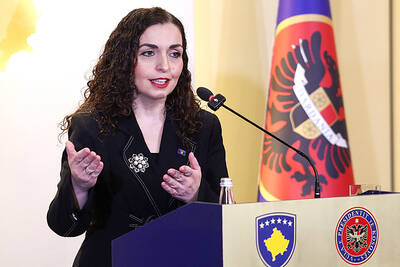
Kosovar President Vjosa Osmani on Friday after dissolving the Kosovar parliament said a snap election should be held as soon as possible to avoid another prolonged political crisis in the Balkan country at a time of global turmoil. Osmani said it is important for Kosovo to wrap up the upcoming election process and form functional institutions for political stability as the war rages in the Middle East. “Precisely because the geopolitical situation is that complex, it is important to finish this electoral process which is coming up,” she said. “It is very hard now to imagine what will happen next.” Kosovo, which declared

MORE BANS: Australia last year required sites to remove accounts held by under-16s, with a few countries pushing for similar action at an EU level and India considering its own ban Indonesia on Friday said it would ban social media access for children under 16, citing threats from online pornography, cyberbullying, online fraud and Internet addiction. “Accounts belonging to children under 16 on high-risk platforms will start to be deactivated, beginning with YouTube, TikTok, Facebook, Instagram, Threads, X, Bigo Live and Roblox,” Indonesian Minister of Communications and Digital Meutya Hafid said. “The government is stepping in so that parents no longer have to fight alone against the giants of the algorithm. Implementation will begin on March 28, 2026,” she said. The social media ban would be introduced in stages “until all platforms fulfill their


 RSS
RSS