


Syria’s army has seized swathes of the country’s north, dislodging Kurdish forces from territory over which they held effective autonomy for more than a decade.
The government appeared to be extending its grip on Kurdish-run areas after Syrian President Ahmed al-Sharaa issued a decree declaring Kurdish a “national language” and granting the minority group official recognition.
The Kurds have said Friday’s announcement fell short of their aspirations, while the implementation of a deal agreed to in March last year — intended to see Kurdish forces integrated into the state — has stalled.
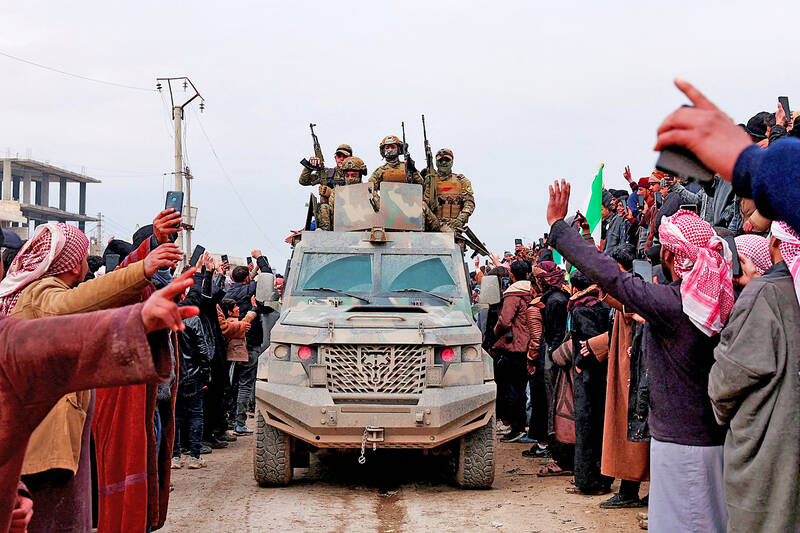
Photo: REUTERS
Government troops drove Kurdish forces from two Aleppo neighborhoods last week and on Saturday took control of an area east of the city.
Yesterday, the government announced the capture of Tabqa, about 55km west of Raqqa.
“The Syrian army controls the strategic city of Tabqa in the Raqqa countryside, including the Euphrates Dam, which is the largest dam in Syria,” Syrian Minister of Information Hamza Almustafa was quoted by the official SANA news agency as saying.
However, the Kurdish-led Syrian Democratic Forces (SDF) said they had “taken the necessary measures to restore security and stability” in Tabqa.
In Deir Hafer, about 50km east of Aleppo, reporters saw several SDF fighters leaving the town and residents returning under heavy army presence.
Syria’s army said four soldiers had been killed, while Kurdish forces reported several fighters dead. Both sides traded blame for violating a withdrawal deal.
Kurdish authorities ordered a curfew in the Raqqa region after the army designated a swathe of territory southwest of the Euphrates River a “closed military zone,” warning it would target what it said were several military sites.
SANA yesterday reported that the SDF destroyed two bridges over the Euphrates in Raqqa city, which lies on the eastern bank of the river.
Raqqa’s media directorate separately accused the SDF of cutting off the city’s water supply by blowing up the main water pipes.
Deir Ezzor Governor Ghassan Alsayed Ahmed said on social media that the SDF fired “rocket projectiles” at neighborhoods in government-controlled territories in the city center of Deir Ezzor, al-Mayadin and other areas.
The SDF said “factions affiliated with the Damascus government attacked our forces’ positions” and caused clashes in several towns on the east bank of the Euphrates, opposite al-Mayadin and which lie between Deir Ezzor and the Iraqi border.
On Friday, Syrian Kurdish leader and SDF chief Mazloum Abdi had committed to redeploying his forces from outside Aleppo to east of the Euphrates, but the SDF on Saturday said that Damascus had “violated the recent agreements and betrayed our forces,” with clashes erupting with troops south of Tabqa.
The army urged the SDF to “immediately fulfil its announced commitments and fully withdraw” east of the river.
The SDF controls swathes of Syria’s oil-rich north and northeast, areas captured during the civil war over the past decade.
US envoy Tom Barrack met Abdi in Erbil on Saturday, the presidency of Iraq’s autonomous Kurdistan region said.
While Washington has long supported Kurdish forces, it has also backed Syria’s new authorities. US Central Command on Saturday urged Syrian government forces “to cease any offensive actions in the areas between Aleppo and al-Tabqa”.
Al-Sharaa’s announcement on Friday marked the first formal recognition of Kurdish rights since Syria’s independence in 1946.
The decree stated that Kurds are “an essential and integral part” of Syria, where they have suffered decades of marginalization. It made Kurdish a “national language” and granted nationality to all Kurds — about 20 percent of whom were stripped of it under a controversial 1962 census.
The Kurdish administration in Syria’s northeast said the decree was “a first step,” but “does not satisfy the aspirations and hopes of the Syrian people.”

SPEAKING OUT: After Siranudh Scott’s allegations surfaced, celebrities and public figures took to social media to share their own experiences of sexual misconduct and abuse A high-profile alleged sexual abuse case within a wealthy Thai beer brewing family has prompted a wave of painful accounts from survivors of unconnected abuse in the conservative nation. Siranudh Scott, a member of the billionaire Thai family that founded the ubiquitous Singha beer brand, posted an emotional video this month accusing his elder brother Sunit of repeatedly abusing him when he was a teenager. Sunit, who is in his 30s, later denied the allegations in a video posted online, but Singha parent Boonrawd dismissed him from his executive role with the company on Tuesday last week. “I felt I needed to speak

A Hong Kong astronaut is to join a Chinese space mission for the first time as part of a three-person crew launching today, as Beijing edges closer to its goal of landing people on the moon. The Tiangong space station — crewed by teams of three astronauts that are typically rotated every six months — is the crown jewel of China’s space program, boosted by billions in state investment in a bid to catch up with the US and Russia. The Shenzhou-23 mission is to blast off at 11:08pm from the Jiuquan Satellite Launch Center in northwestern China, carrying three astronauts to

SEEKING ORDER: Rodrigo Paz said that ‘anyone who wants to destroy the nation will have to deal with this president and the full force of the constitution’ Bolivian President Rodrigo Paz on Wednesday said that the nation was at a “breaking point” after nearly a month of protests that have caused shortages of food, fuel and medicine. Paz, who took office six months ago amid the worst economic crisis there in four decades, is battling a groundswell of fury over his policies. The political capital, La Paz, has been besieged by low-income workers and members of the indigenous majority calling for his resignation. “The country needs order and is reaching breaking point,” the 58-year-old said at a public event in La Paz, renewing his appeal for dialogue. On Tuesday, the Bolivian
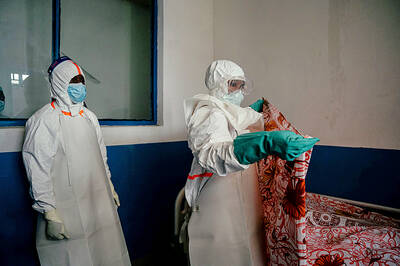
UPGRADED ALERT: The risk inside DR Congo is now considered ‘very high,’ while neighboring countries face a ‘high’ threat as the outbreak continues, the WHO said Ebola is spreading faster than responders can track it in eastern Congo, where health workers managed to follow up with barely one in five identified contacts in a single day. Authorities in the Democratic Republic of the Congo (DR Congo) reported 83 confirmed infections, 746 suspected cases and 1,603 identified contacts as of Thursday, but health workers were able to follow up on only 342 contacts that day — about 21 percent of the total under monitoring — data released by the DR Congo Ministry of Public Health on Friday showed. The figures suggest the response is falling behind the outbreak itself,


 RSS
RSS