


Work starts around sunrise for the federal officers carrying out the immigration crackdown in and around the Twin Cities, with hundreds of people in tactical gear streaming out of a bland office building near the main airport.
Within minutes, hulking SUVs, pickup trucks and minivans begin leaving, forming the unmarked convoys that have quickly become feared and common sights in the streets of Minnesota’s Minneapolis, Saint Paul and their suburbs.
Protesters also arrive early, braving the cold to stand across the street from the fenced-in federal compound, which houses an immigration court and government offices.
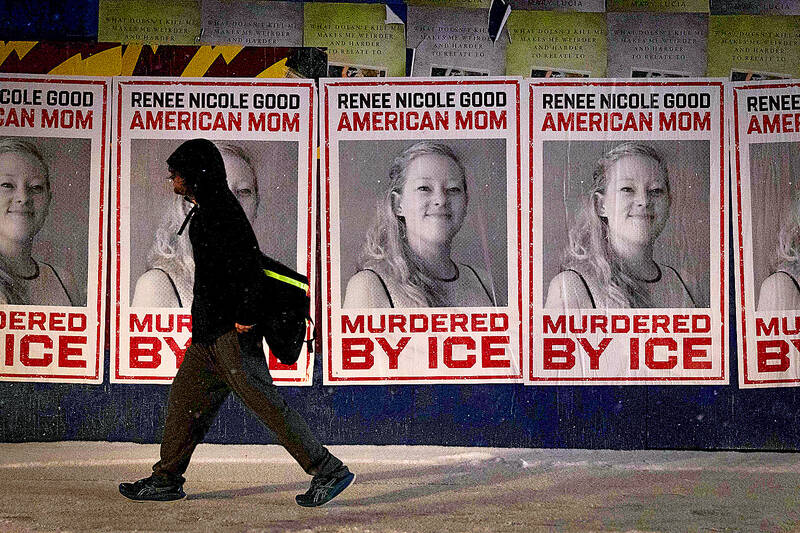
Photo: Getty Images via AFP
“Go home!” they shout as convoys roar past. “ICE [US Immigration and Customs Enforcement] out!”
Things often turn uglier after nightfall, when the convoys return and the protesters sometimes grow angrier, shaking fences and occasionally smacking passing cars. Eventually, the federal officers march toward them, firing tear gas and flash grenades before hauling away at least a few people.
“We’re not going anywhere!” a woman shouted on a recent morning. “We’re here until you leave.”
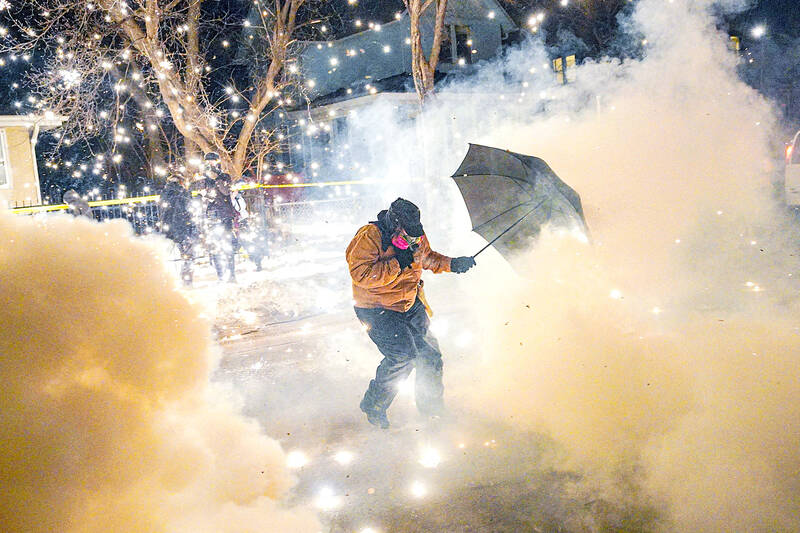
Photo: Reuters
This is the daily rhythm of Operation Metro Surge, US President Donald Trump’s latest and biggest crackdown yet, with more than 2,000 officers taking part. The surge has pitted city and state officials against the federal government, sparked daily clashes between activists and immigration officers in the deeply liberal cities, and left a mother of three dead.
The crackdown is barely noticeable in some areas, particularly in whiter, wealthier neighborhoods and suburbs, where convoys and tear gas are rare. Even in neighborhoods where masked immigration officers are common, they often move with ghostlike quickness, making arrests and disappearing before protesters can gather in force.
Still, the surge can be felt across broad swaths of the Twin Cities area, which is home to more than 3 million people.
“We don’t use the word ‘invasion’ lightly,” Minneapolis Mayor Jacob Frey, a Democrat, told reporters this week, adding that his police force has just 600 officers. “What we are seeing is thousands — plural, thousands — of federal agents coming into our city.”
Those agents have an outsized presence in a small city.
So as worry ripples through the region, children are skipping school or learning remotely, families are avoiding religious services and many businesses, especially in immigrant neighborhoods, have closed temporarily.
Drive down Lake Street, an immigrant hub since the days when newcomers came to Minneapolis from Norway and Sweden, and the sidewalks now seem crowded only with activists standing watch, ready to blow warning whistles at the first sign of a convoy.
At La Michoacana Purepecha, where customers can order ice cream, chocolate-covered bananas and pork rinds, the door is locked and staff let in people one at a time. Nearby, at Taqueria Los Ocampo, a sign in English and Spanish says the restaurant is temporarily closed because of “current conditions.”
A dozen blocks away at the Karmel Mall, where the city’s large Somali community goes for everything from food and coffee to tax preparation, signs on the doors warn: “No ICE enter without court order.”
It has been nearly six years since George Floyd was murdered by a Minneapolis police officer, but the scars from that killing remain raw.
Floyd was killed just blocks from where an ICE officer shot and killed Renee Good, a 37-year-old US citizen, during a Jan. 7 confrontation after she stopped to help neighbors during an enforcement operation.
Federal officials say the officer fired in self-defense after Good “weaponized” her vehicle. City and state officials dismiss those explanations, and point to multiple bystander videos of the confrontation.
For Twin Cities residents, the crackdown can feel overwhelming.
“Enough is enough,” said Johan Baumeister, who came to the scene of Good’s death soon after the shooting to lay flowers.
He said he did not want to see the violent protests that shook Minneapolis after Floyd’s death, but this city has a long history of activism and protests, and he had no doubt there would be more.
“I think they’ll see Minneapolis show our rage again,” he said.
He was right.
In the days since, there have been repeated confrontations between activists and immigration officers. Most amounted to little more than shouted insults and taunting, with destruction mostly limited to broken windows, graffiti and some badly damaged federal vehicles.
The most serious force comes from immigration officers, who have broken car windows, pepper-sprayed protesters and warned observers not to follow them through the streets. Immigrants and citizens have been yanked from cars and homes and detained, sometimes for days. Most clashes end in tear gas.
Drivers can now stumble across intersections blocked by men in body armor and gas masks, with helicopters clattering overhead and the air filled with the shriek of protesters’ whistles.
In a state that prides itself on its decency, there’s something particularly Minnesotan about the protests.
Soon after Good was shot, Minnesota Governor Tim Walz, a Democrat and regular Trump target, repeatedly said he was angry but also urged people to find ways to help their communities.
“It might be shoveling your neighbor’s walk,” he said. “It might mean being at a food bank. It might be pausing to talk to someone you haven’t talked to before.”
He and other leaders have pleaded with protesters to remain peaceful, warning that the White House was looking for a chance to crack down harder.
When protests do become clashes, residents often spill from their homes, handing out bottled water so people can flush tear gas from their eyes.
Residents stand watch at schools to warn immigrant parents if convoys approach while they are picking up their children. They take care packages to people too afraid to go out, and arrange rides for them to work and doctor’s visits.
On Thursday, in the basement of a Lutheran church in Saint Paul, the group Open Market MN assembled food packs for more than a hundred families staying home. Colin Anderson, the group’s outreach director, said the group has seen a surge in requests.
Sometimes, people do not even understand what has happened to them.
Like Christian Molina from suburban Coon Rapids, who was driving through a Minneapolis neighborhood on a recent day, taking his car to a mechanic, when immigration officers began following him. He wonders if it is because he looks Hispanic.
They turned on their siren, but Molina kept driving, unsure who they were.
Eventually, the officers sped up, hit his rear bumper and both cars stopped. Two emerged and asked Molina for his papers. He refused, saying he would wait for the police. Crowds began to gather and a clash soon broke out, ending with tear gas.
So the officers left.
They left behind an angry, worried man who suddenly owned a sedan with a mangled rear fender.
Long after the officers were gone he had one final question: “Who’s going to pay for my car?”
Australians were downloading virtual private networks (VPNs) in droves, while one of the world’s largest porn distributors said it was blocking users from its platforms as the country yesterday rolled out sweeping online age restriction. Australia in December became the first country to impose a nationwide ban on teenagers using social media. A separate law now requires artificial intelligence (AI)-powered chatbot services to keep certain content — including pornography, extreme violence and self-harm and eating disorder material — from minors or face fines of up to A$49.5 million (US$34.6 million). The country also joined Britain, France and dozens of US states requiring

Hungarian authorities temporarily detained seven Ukrainian citizens and seized two armored cars carrying tens of millions of euros in cash across Hungary on suspicion of money laundering, officials said on Friday. The Ukrainians were released on Friday, following their detention on Thursday, but Hungarian officials held onto the cash, prompting Ukraine to accuse Hungary’s Russia-friendly government of illegally seizing the money. “We will not tolerate this state banditism,” Ukrainian Minister of Foreign Affairs Andrii Sybiha said. The seven detained Ukrainians were employees of the Ukrainian state-owned Oschadbank, who were traveling in the two armored cars that were carrying the money between Austria and

Kosovar President Vjosa Osmani on Friday after dissolving the Kosovar parliament said a snap election should be held as soon as possible to avoid another prolonged political crisis in the Balkan country at a time of global turmoil. Osmani said it is important for Kosovo to wrap up the upcoming election process and form functional institutions for political stability as the war rages in the Middle East. “Precisely because the geopolitical situation is that complex, it is important to finish this electoral process which is coming up,” she said. “It is very hard now to imagine what will happen next.” Kosovo, which declared

MORE BANS: Australia last year required sites to remove accounts held by under-16s, with a few countries pushing for similar action at an EU level and India considering its own ban Indonesia on Friday said it would ban social media access for children under 16, citing threats from online pornography, cyberbullying, online fraud and Internet addiction. “Accounts belonging to children under 16 on high-risk platforms will start to be deactivated, beginning with YouTube, TikTok, Facebook, Instagram, Threads, X, Bigo Live and Roblox,” Indonesian Minister of Communications and Digital Meutya Hafid said. “The government is stepping in so that parents no longer have to fight alone against the giants of the algorithm. Implementation will begin on March 28, 2026,” she said. The social media ban would be introduced in stages “until all platforms fulfill their


 RSS
RSS