


Ugandan opposition leader Bobi Wine was cut off from communications yesterday after a police raid on his home, his party said, with the security forces determined to prevent unrest ahead of imminent election results.
Ugandan President Yoweri Museveni, 81, looked set to be declared winner and extend his 40-year rule later yesterday in an election marred by reports of at least 10 deaths under an ongoing Internet blackout.
As Uganda endured a tense wait after Thursday’s polls, Museveni had a commanding lead against Wine, 43, a former singer turned politician.
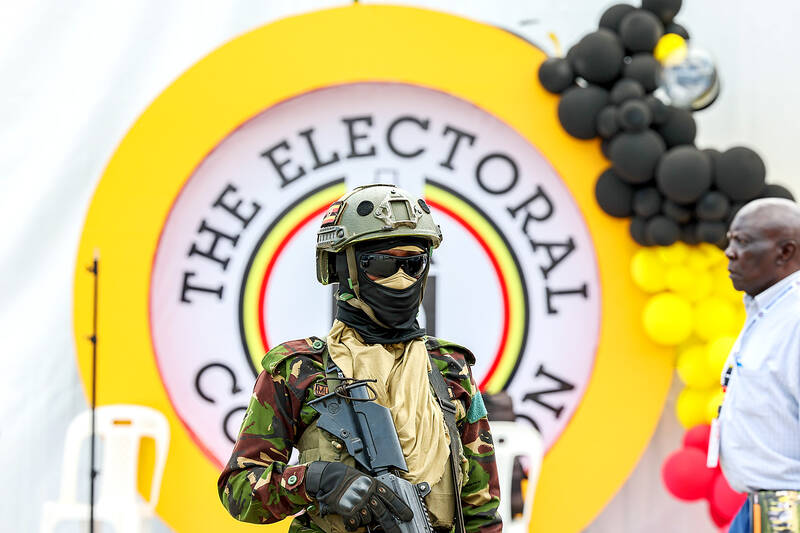
Photo: EPA
There were conflicting reports about Wine’s whereabouts after claims that police and the army had raided his home on Friday night. A senior official in his party, Nkunyingi Muwada, told reporters that “security personnel in black attire scaled the wall” of Wine’s residence and confiscated their phones.
Wine’s son, Solomon Kampala, who is currently outside Uganda, wrote on social media that his father “was able to escape” during the raid, which was later confirmed by Wine.
Reporters were blocked from entering Wine’s residence early yesterday and could not reach him or his entourage by phone.
Police said they had “controlled access in areas we feel are security hotspots.”
“We have not necessarily denied people accessing [Wine], but we cannot tolerate instances where people use his residence to gather and... incite violence,” police spokesman Kituuma Rusoke told reporters.
Wine’s party had earlier written on social media that he had been “forcibly taken” by an army helicopter from his compound, but later deleted the post.
The report was denied by the army as “absurd” and “designed to incite his supporters.”
A nearby stall-owner, 29-year-old Prince Jerard, said he had heard a drone and helicopter at the residence the previous night, with a heavy security presence.
“Many people have left [the area],” he said. “We have a lot of fear.”
With more than 90 percent of votes counted, Museveni was leading on 71.9 percent to Wine’s 24.5, the Ugandan Electoral Commission said
Wine, 43, whose real name is Robert Kyagulanyi, has emerged as the main challenger to Museveni in recent years, styling himself the “ghetto president” after the slum areas where he grew up in the capital, Kampala.
He has accused the government of “massive ballot stuffing” and attacking several of his party officials under cover of the Internet blackout, which was imposed ahead of the polls and remained in place yesterday.
His claims could not be independently verified, but the UN rights office said last week the elections were taking place in an environment marked by “widespread repression and intimidation” against the opposition.
Analysts have long viewed the election as a formality.
Museveni, a former guerrilla fighter who seized power in 1986, has total control over the state and security apparatus, and has ruthlessly crushed any challenger during his rule.
Election day was marred by significant technical problems after biometric machines — used to confirm voters’ identities — malfunctioned and ballot papers were not delivered for several hours in many areas.
There were reports of violence against the opposition in other parts of the country.
Muwanga Kivumbi, member of parliament for Wine’s party in the Butambala area of central Uganda, said that security forces had killed 10 of his campaign agents after storming his home.
Police gave a different account, saying an “unspecified number” of people had been “put out of action” when opposition members planned to overrun and burn down a local tally center and police station.

SPEAKING OUT: After Siranudh Scott’s allegations surfaced, celebrities and public figures took to social media to share their own experiences of sexual misconduct and abuse A high-profile alleged sexual abuse case within a wealthy Thai beer brewing family has prompted a wave of painful accounts from survivors of unconnected abuse in the conservative nation. Siranudh Scott, a member of the billionaire Thai family that founded the ubiquitous Singha beer brand, posted an emotional video this month accusing his elder brother Sunit of repeatedly abusing him when he was a teenager. Sunit, who is in his 30s, later denied the allegations in a video posted online, but Singha parent Boonrawd dismissed him from his executive role with the company on Tuesday last week. “I felt I needed to speak

A Hong Kong astronaut is to join a Chinese space mission for the first time as part of a three-person crew launching today, as Beijing edges closer to its goal of landing people on the moon. The Tiangong space station — crewed by teams of three astronauts that are typically rotated every six months — is the crown jewel of China’s space program, boosted by billions in state investment in a bid to catch up with the US and Russia. The Shenzhou-23 mission is to blast off at 11:08pm from the Jiuquan Satellite Launch Center in northwestern China, carrying three astronauts to
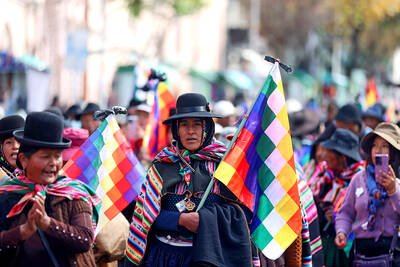
SEEKING ORDER: Rodrigo Paz said that ‘anyone who wants to destroy the nation will have to deal with this president and the full force of the constitution’ Bolivian President Rodrigo Paz on Wednesday said that the nation was at a “breaking point” after nearly a month of protests that have caused shortages of food, fuel and medicine. Paz, who took office six months ago amid the worst economic crisis there in four decades, is battling a groundswell of fury over his policies. The political capital, La Paz, has been besieged by low-income workers and members of the indigenous majority calling for his resignation. “The country needs order and is reaching breaking point,” the 58-year-old said at a public event in La Paz, renewing his appeal for dialogue. On Tuesday, the Bolivian
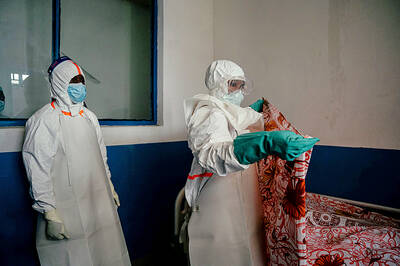
UPGRADED ALERT: The risk inside DR Congo is now considered ‘very high,’ while neighboring countries face a ‘high’ threat as the outbreak continues, the WHO said Ebola is spreading faster than responders can track it in eastern Congo, where health workers managed to follow up with barely one in five identified contacts in a single day. Authorities in the Democratic Republic of the Congo (DR Congo) reported 83 confirmed infections, 746 suspected cases and 1,603 identified contacts as of Thursday, but health workers were able to follow up on only 342 contacts that day — about 21 percent of the total under monitoring — data released by the DR Congo Ministry of Public Health on Friday showed. The figures suggest the response is falling behind the outbreak itself,


 RSS
RSS